
When Did Assists Become a Stat in Football? A Surprisingly Recent History
Assists in football were not officially tracked until the 1990s. We explain why football took so long to embrace the metric, the Opta-era arrival, and the modern xA evolution.
 Tap to enlarge
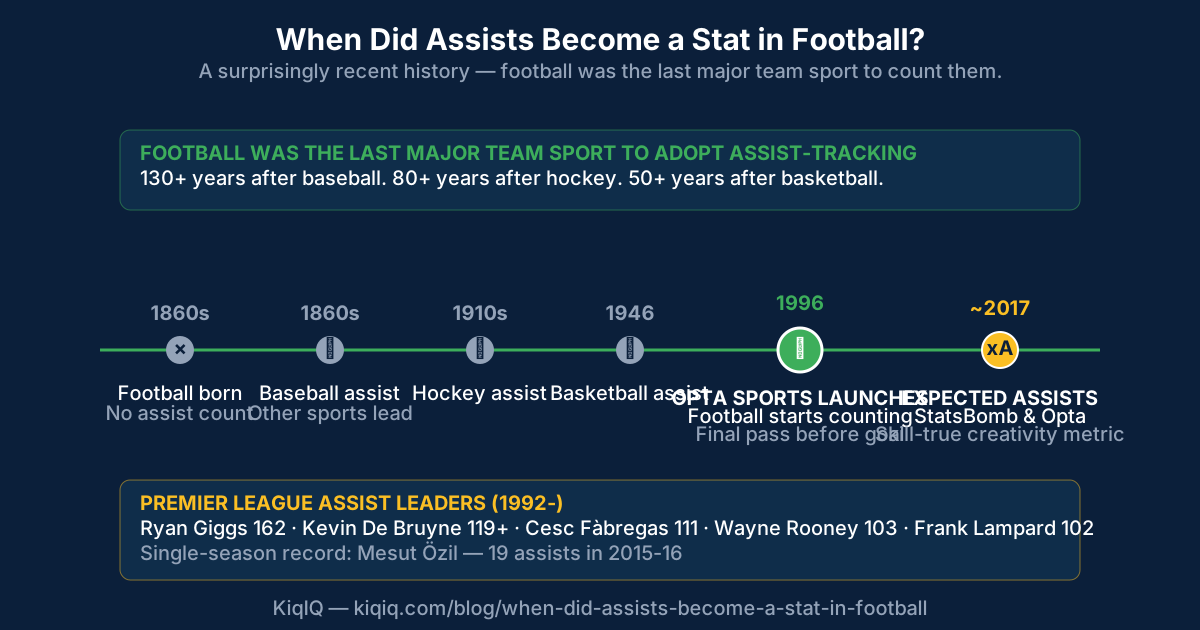
Assists in football were not officially tracked as a statistic until the 1990s — surprisingly recent compared to other sports. Hockey has tracked assists since the 1910s; baseball since the 1860s; basketball formally since 1946. Football resisted, partly because the sport's free-flowing nature made the "final pass" definition tricky, partly because traditional football culture prized goals over the build-up. The Opta data revolution of the 1990s changed that.
Why football was late to count assists
Three factors delayed assist-tracking in football compared to other sports:
- Definition difficulty. Hockey can clearly identify the puck-passer immediately before a goal. Football has a more chaotic build-up — was the assist the cross, the through-ball, or the carry that started the move? No simple answer.
- Culture of the goal. Traditional football celebrated the scorer almost exclusively. Newspapers reported scoreline + scorer. The build-up was for tactical writers, not statistics.
- No data infrastructure. Pre-1990s, no one was recording every pass in every match. Without that infrastructure, assist counting was impossible at scale.
The Opta revolution
Opta Sports was founded in 1996 in the UK, with a mission to systematically track every on-ball event in Premier League matches. By 1996-97 they were producing per-match data including goals, shots, passes, tackles, fouls — and crucially, assists, defined as 'the final pass before a shot that resulted in a goal'.
Opta's data was sold to broadcasters, newspapers, and clubs. By 2000-01, Match of the Day was citing Opta-derived stats including assists during analysis. By 2010, every Premier League match report included an assists column.
Football was the last major team sport to track assists systematically. Opta's 1996 launch is the inflection point.
The Opta assist definition
Opta's official assist definition has become the global standard:
- A pass, cross, set-piece delivery, or other on-ball action that directly precedes the goal-scoring shot, with only one or no intervening touches by the goalscorer (a normal first touch + shot is allowed; a dribble + shot may or may not credit depending on data provider).
- A goal scored from a rebound off the goalkeeper from a saved shot does not credit the original assister — but does credit a second assist or chance creator in some advanced datasets.
- A goal scored from a defensive deflection does not credit the deflector but credits the original passer.
- A penalty conversion does not credit anyone with an assist (the penalty is a discrete event).
Expected assists (xA) — the modern evolution
Once assists were systematically tracked, analysts noticed the metric was noisy. A pass that creates a 0.3 xG chance is the same chance regardless of whether the receiver scores or hits the post — but only the goal-scoring pass gets credited as an assist.
Expected Assists (xA) was introduced around 2017 by StatsBomb (and similar metrics by Opta and others). xA credits the assister with the xG of the chance they created, regardless of whether it was scored. A creator who consistently produces 0.5 xA per match is creating one expected goal every two matches — a robust signal even if their actual assists are inflated or deflated by team finishing variance.
Modern football analysis blends both: assists for the headline narrative, xA for the underlying skill measurement.
All-time Premier League assist leaders
Premier League era (1992-present) all-time leaders:
- Ryan Giggs — 162 assists (Manchester United, 1992-2014). Long the all-time leader.
- Cesc Fàbregas — 111 assists (Arsenal + Chelsea).
- Wayne Rooney — 103 assists (Manchester United + Everton).
- Frank Lampard — 102 assists (Chelsea + West Ham + Manchester City).
- Kevin De Bruyne — 119+ and counting (Manchester City, 2015-).
- Mesut Özil — 73 assists (Arsenal). Highest single-season Premier League assist total: 19 in 2015-16.
Why this history matters
Three implications of football's late assist-tracking:
- Pre-1996 assist counts are best estimates. Some retrospective data exists (especially for famous players) but it's not as systematic as data from 1996 onwards.
- Comparing pre-Opta and post-Opta players is tricky. Pelé's assist count is partial; Ronaldinho's is complete from his 1999 Brazilian league debut.
- xA is the better long-term metric. Because assist count depends on team-mate finishing, xA is more stable and a better skill signal — it tells you who's creating chances regardless of who finishes them.
Frequently asked questions
- When did football start tracking assists?
- Officially around 1996, when Opta Sports launched and began systematically tracking every on-ball event in Premier League matches including the final pass before each goal. Before that, assist counts existed informally in match reports but not as a tracked statistic. Football was the last major team sport to adopt assist-tracking — hockey had it since the 1910s, baseball since the 1860s, basketball since 1946.
- What's the official definition of an assist in football?
- A pass, cross, set-piece delivery, or other on-ball action that directly precedes the goal-scoring shot, with one or no intervening touches by the goalscorer. Goals from rebounds don't credit the original assister. Goals from defensive deflections still credit the original passer. Penalties don't credit any assist.
- Who has the most assists in Premier League history?
- Ryan Giggs holds the all-time Premier League assist record with 162 (1992-2014). Kevin De Bruyne is the active leader with 119+ and rising. Other top names: Cesc Fàbregas (111), Wayne Rooney (103), Frank Lampard (102). The single-season Premier League record is Mesut Özil's 19 in 2015-16.
- What is xA (expected assists)?
- xA credits the passer with the expected-goals (xG) value of the chance they created, regardless of whether it was scored. A pass that creates a 0.3 xG chance gives 0.3 xA, even if the receiver missed. xA is more stable than raw assists because it removes finishing-variance noise. Introduced around 2017 by StatsBomb and other providers, it's now the standard creativity metric.
References
- Opta Sports — Founding and Methodology — Opta
- StatsBomb — Expected Assists (xA) Methodology — StatsBomb
- Premier League Assist Leaders — Historical Database — Premier League
- A History of Assists in Team Sports — The Athletic
Key terms in this article
Ask KiqIQ a follow-up
Get a live, data-driven answer powered by api-football + KiqIQ's Poisson model. Try one of these prompts or write your own.
Part of pillar
Data and Systems
See every article in this knowledge pillar →
Related
Reviewed by a KiqIQ editor before publication. Spotted an error? Email editor@kiqiq.com — we follow our Corrections Policy.