
VAEP in Football: Valuing Actions by Estimating Probabilities
VAEP rates every on-ball action by how it changes the probability of scoring or conceding. We explain how it works, what it captures that xG misses, and where to find it.
 Tap to enlarge
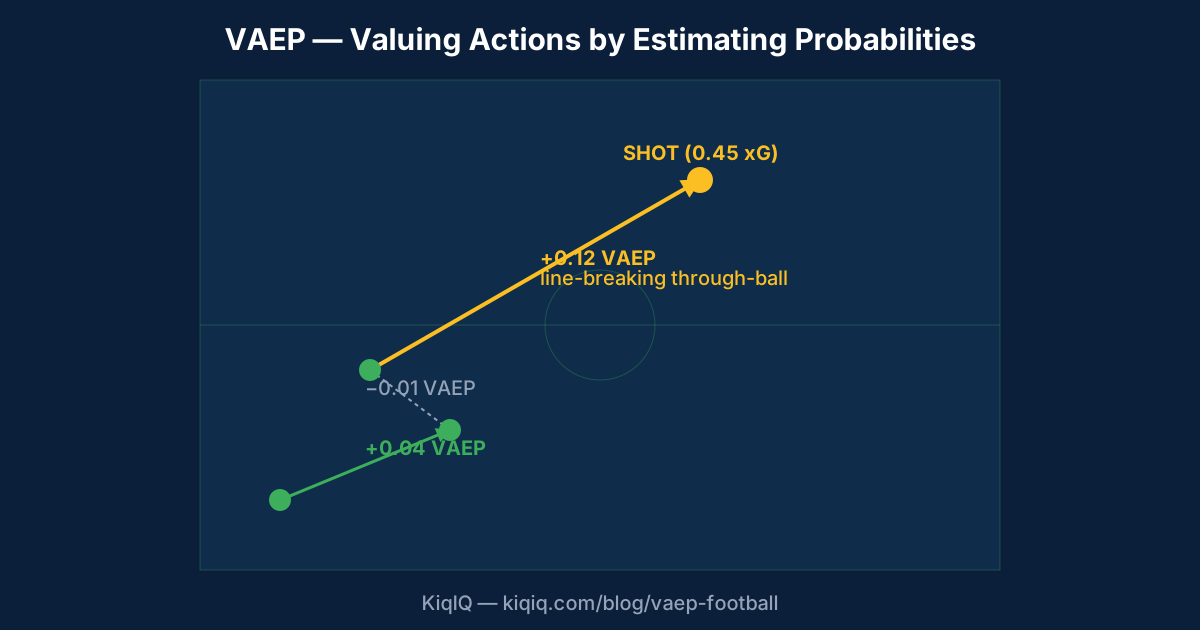
VAEP — Valuing Actions by Estimating Probabilities — is a football model that scores every on-ball action (pass, dribble, shot, cross, tackle) by how much it changes the probability of scoring or conceding within the next few seconds. Unlike xG, which only rates shots, VAEP rates the whole sequence.
Why VAEP exists
xG measures shot quality, but most of football is not shots. A team can lose 0–0 with no shots and still have created chance after chance, with the final ball just missing. xG cannot capture that. VAEP can.
VAEP was introduced in 2019 by Decroos, Bransen, Van Haaren, and Davis at KU Leuven. It uses two models — one for the probability of scoring within the next 10 actions, one for the probability of conceding — and rates every action by the change in those probabilities before and after the action.
How VAEP is calculated
Each on-ball action has a state before it (pitch zone, time, score, body part, possession history) and a state after. For each state, two models output:
- `P(score)` — probability the team in possession scores within the next 10 actions
- `P(concede)` — probability the team in possession concedes within the next 10 actions
VAEP rating = Δ P(score) − Δ P(concede). Positive = action increased net scoring probability. Negative = action decreased it.
What VAEP captures that xG misses
Three categories of action become measurable with VAEP that xG ignores:
- Progressive passes and carries. A pass that moves the ball from the centre circle into the half-space might add +0.04 VAEP. xG sees nothing.
- Defensive actions. A successful tackle in your own half drops opposition `P(score)` from 0.08 to 0.01 — a +0.07 VAEP defensive contribution. xG cannot rate this.
- Possession recycling. Some passes look pointless to the eye but maintain low concession risk. VAEP rewards them too — keeping `P(concede)` near zero is valuable.
VAEP per-90 leaders typically include
When aggregated to the player level (per 90 minutes), VAEP leaderboards typically feature creative #10s, ball-progressing midfielders, and high-touch wingers. The metric tends to surface players who do many small valuable things consistently — not just the headline shot-takers.
Example archetypes that score well in VAEP per-90: Kevin De Bruyne, Toni Kroos in his prime, Joshua Kimmich, Bruno Fernandes, Bukayo Saka. Strikers can score well too if they combine in build-up — Harry Kane during his Spurs years was a top-3 VAEP striker because his dropping-deep distribution generated huge value.
Limitations of VAEP
VAEP has known issues. First, it's path-dependent — a pass that ends in a goal nine actions later gets credited even if the actual goal-scoring action would have happened anyway. Second, it doesn't account for off-ball runs (it only sees the ball-carrier). Third, the underlying models are trained on historical data, so it can underweight emerging tactical patterns.
Practical use: VAEP is a complement to xG, not a replacement. Pair them. xG tells you about chance quality. VAEP tells you about the value of the actions that produced (or prevented) those chances.
VAEP vs Expected Threat (xT)
VAEP is closely related to Karun Singh's Expected Threat (xT), which scores every passing zone by the probability of scoring within 5 actions. xT is simpler — it ignores defensive actions and shots — but easier to compute.
Most analytics shops now use one or the other (or both). StatsBomb publishes their own variant called "OBV" (On-Ball Value) which is methodologically very similar to VAEP. The Athletic uses Twelve's G+ rating, also closely related.
Where to find VAEP data
The original VAEP paper code is open-source on GitHub (`socceraction` package). For ready-made data, StatsBomb publishes OBV with their IQ subscription. Twelve Football publishes G+ ratings. The Analyst (Opta) publishes possession value (PV) — also closely related.
For free public data, Karun Singh's xT lookup tables are the most accessible — easy to apply to any pass dataset.
Frequently asked questions
- What does VAEP stand for in football?
- VAEP stands for Valuing Actions by Estimating Probabilities. It is a model that rates every on-ball action — passes, dribbles, shots, tackles — by how much it changes the team's probability of scoring or conceding within the next 10 actions. Introduced by KU Leuven researchers in 2019.
- How is VAEP different from xG?
- xG only rates shots. VAEP rates every on-ball action. A progressive pass into the box that does not lead to a shot has zero xG but positive VAEP. A successful defensive tackle has zero xG but positive VAEP. VAEP captures the value of the whole sequence, not just the finish.
- What is a good VAEP per 90 for a midfielder?
- In the top 5 European leagues, top creative midfielders post VAEP/90 in the 0.40–0.60 range. Elite like De Bruyne can hit 0.70+. Defensive midfielders typically score 0.20–0.35. Below 0.15 per-90 for a starting midfielder is a concern flag.
- Is VAEP the same as xT or OBV?
- They are close cousins, not identical. xT (Karun Singh's Expected Threat) values passing zones; VAEP values actions including shots and defensive plays; OBV (StatsBomb) is a closer methodological match to VAEP. All three answer the same question — "how valuable was that action?" — with slightly different inputs.
References
- Actions Speak Louder Than Goals: Valuing Player Actions in Soccer — KDD 2019 (Decroos et al.) (Aug 2019)
- socceraction Python package — VAEP implementation — KU Leuven
- On-Ball Value (OBV) Methodology — StatsBomb
- Introducing Expected Threat (xT) — Karun Singh
Key terms in this article
Ask KiqIQ a follow-up
Get a live, data-driven answer powered by api-football + KiqIQ's Poisson model. Try one of these prompts or write your own.
Try the calculators
Apply the concepts from this article with KiqIQ's free calculators.
Part of pillar
Data and Systems
See every article in this knowledge pillar →
Related
Reviewed by a KiqIQ editor before publication. Spotted an error? Email editor@kiqiq.com — we follow our Corrections Policy.