
Football KPIs: The Key Performance Indicators That Actually Matter
Football KPIs (Key Performance Indicators) are the small set of metrics that consistently predict match outcomes. We list the 12 that matter, what each measures, and which are noise.
 Tap to enlarge
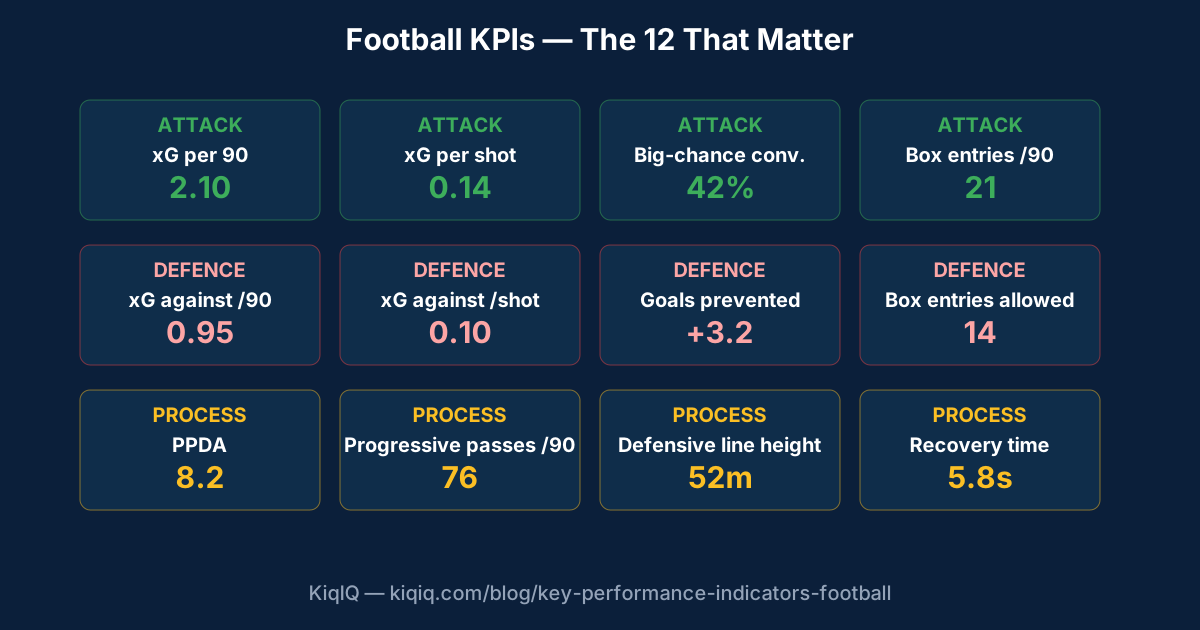
Football KPIs are the small set of metrics that consistently predict outcomes — both at match level and across a season. Most data dashboards are bloated with metrics that look interesting but have no predictive value. The KPIs that matter are 12 in total: 4 attacking, 4 defensive, and 4 process. Get those right and the rest is noise.
What makes a metric a KPI
A KPI is a metric that meets three criteria: it predicts something the team cares about (results, expected points, retention), it is reproducible across samples (the same team posts similar values season-to-season at constant tactical intent), and it can be acted on (the coaching staff can affect it through training).
Lots of football metrics fail one of these. "Possession %" predicts winning weakly (correlation ≈ 0.18 across the top 5 leagues). "Total shots" predicts goals weakly without an xG filter. "Pass completion %" is meaningless in isolation — a low-block side completes 65% of passes safely and a possession side completes 88% with progressive intent.
The 4 attacking KPIs
Four metrics predict goals scored across full seasons in the top 5 European leagues. Each correlates with goals at r ≥ 0.65:
- xG per 90. Expected goals from open play + set pieces. The headline attacking KPI.
- xG per shot. Average chance quality. Tells you whether xG is coming from many low-quality shots (long-range happy) or from creating good positions.
- Big-chance conversion rate. Goals scored from chances rated > 0.30 xG. Above-average sides convert 38-42%; elite finishers like Haaland convert 50%+.
- Box entries per 90. How often the team gets the ball into the opposition penalty area in open play. Strong leading indicator for xG.
The 4 defensive KPIs
Four mirror metrics predict goals conceded:
- xG against per 90. The defensive headline. Below 1.0 in top-5 league play is elite.
- xG against per shot. Concede many low-quality shots? You're a low block doing its job. Concede high-quality shots? Structural problem.
- Goals Prevented (xGOT − goals conceded). Goalkeeper performance signal. Positive = saving more than the average keeper would.
- Box entries allowed per 90. Counterpart to box entries. Combined with xG against, exposes whether the defence is concentrated low or stretched.
KPIs always come in attacking + defensive pairs. Good attack + bad defence usually balances; great teams are top-quartile on both halves.
The 4 process KPIs (predicting future performance)
These four don't describe results directly — they describe the system. They predict future xG and xG against:
- PPDA. Passes per defensive action — pressing intensity. See `/football/ppda-explained` for the deep dive.
- Progressive passes per 90. Volume of line-breaking passes. Strongest leading indicator for xG.
- Defensive line height (metres). Average X-coordinate of the defensive line. High line + high press = elite (Klopp's Liverpool, Pep's City). Low line + low press = low-block (Atlético Simeone).
- Recovery time after losing possession. Average seconds from turnover to win-back. Sub-7 seconds = elite counter-press; 11+ seconds = settled into shape.
KPIs that look like KPIs but aren't
Metrics that frequently appear in match reports but don't survive the predictive criteria:
- Possession %. Weak predictor of result on its own (r ≈ 0.18). 30%-possession Atlético sides have won the league.
- Total shots. Without xG filter, a single goal is worth 2 long-range hopeful shots. Use xG.
- Total tackles. Tackles are bad — they mean opposition got past the first line. Interceptions per 90 is more meaningful.
- Distance covered. Sprint count and high-intensity-distance matter; total distance often does not. A side covering 110 km might just be running back-and-forth aimlessly.
- Pass completion %. Useless without context — depends on pass length distribution and team style.
Building a KPI dashboard
A practical KPI dashboard for a top-flight team has 12 boxes — the 12 listed above. Each shows a rolling 5-match average, the season-to-date average, and the league percentile. That's enough to identify trends, drift, and breaks. More boxes adds noise, not signal.
For fans tracking a side, the same 12 metrics — published by FBref, StatsBomb, Understat, Opta — give a complete-enough picture to read whether a team's performance is improving, declining, or steady regardless of recent results.
KPIs over short vs long samples
All 12 KPIs are noisy over single matches. PPDA can swing 4 points in a 90-minute window. xG can be 1.0 different from goals on any given day. The signal builds over 5+ matches; the season-to-date average is what predicts forward.
Use match-level KPIs for tactical analysis (was the press intense today? did the chance quality match the expected output?). Use season-level KPIs for retention, recruitment, and managerial assessment.
Frequently asked questions
- What are the most important KPIs in football?
- The 12 KPIs that consistently predict outcomes are: xG per 90, xG per shot, big-chance conversion, box entries per 90 (attacking); xG against per 90, xG against per shot, goals prevented, box entries allowed (defensive); PPDA, progressive passes, defensive line height, ball recovery time (process). Other metrics like possession % or total shots are noise without these filters.
- Is possession % a key performance indicator?
- Possession % is a weak KPI. The correlation with winning across the top 5 European leagues is around 0.18 — meaningful but not decisive. A team can have 30% possession and win the league (Atlético 2013-14, 2020-21). Possession only matters when paired with what is done with it (progressive passes, chance creation, xG).
- How is xG different from total shots?
- xG (expected goals) weights every shot by chance quality — a 0.7 xG penalty counts seven times a 0.1 xG long-range strike. Total shots treats all shots equally. xG predicts goals far better. Two sides with 12 shots each can have wildly different xG totals depending on shot quality.
- Where can I find football KPI data?
- Free sources: FBref (full xG, xGA, progressive metrics for top 5 leagues), Understat (xG focus), Sofascore (match KPIs in-app). Paid: StatsBomb IQ, Opta Pro, Wyscout. KiqIQ surfaces the 12-KPI dashboard on every league hub page once API-Football data is wired in Phase 3.
References
- StatsBomb — Open-play xG and Progressive Pass Metrics — StatsBomb
- FBref — Per-90 KPI Reference — FBref
- Why Possession Doesn't Win Matches — The Analyst
- PPDA Methodology — StatsBomb
Key terms in this article
Ask KiqIQ a follow-up
Get a live, data-driven answer powered by api-football + KiqIQ's Poisson model. Try one of these prompts or write your own.
Try the calculators
Apply the concepts from this article with KiqIQ's free calculators.
Part of pillar
Data and Systems
See every article in this knowledge pillar →
Related
Reviewed by a KiqIQ editor before publication. Spotted an error? Email editor@kiqiq.com — we follow our Corrections Policy.