
How Referees Affect Card and Penalty Markets
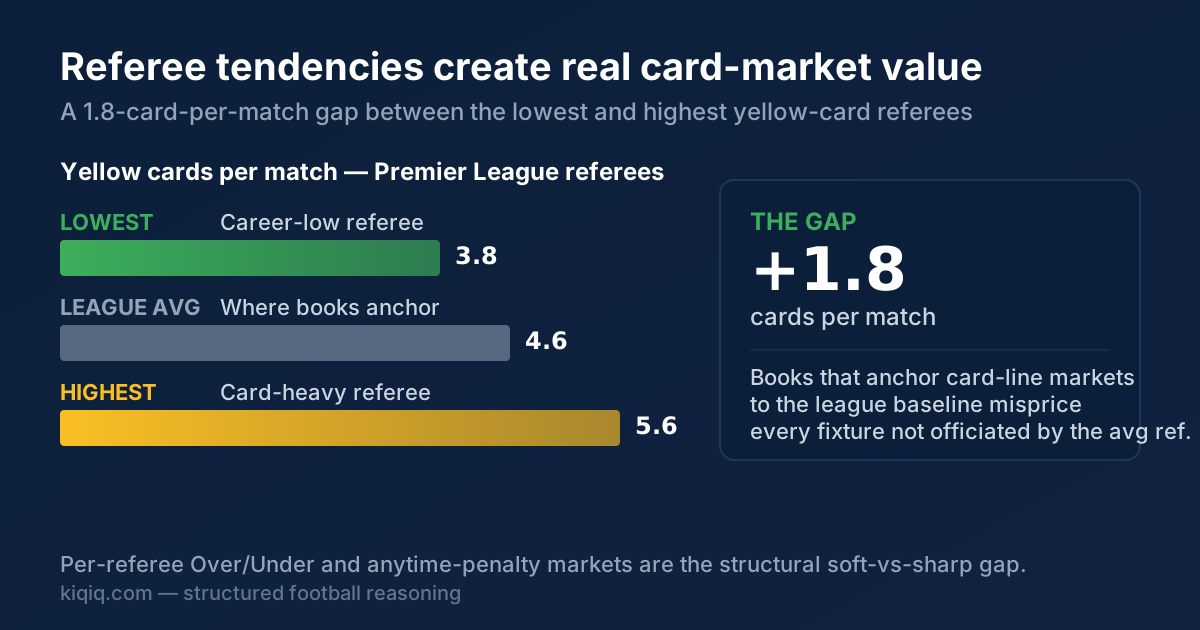
Different referees call football matches very differently — 1.8+ yellow cards apart per match in the Premier League. That gap is exploitable in card and penalty betting markets when bookmakers price the league average instead of the actual referee.
 Tap to enlarge
Referees are the most underweighted variable in football betting. Two officials calling the same fixture can produce a 1.8-card-per-match difference in yellows alone — enough to flip an Over/Under 4.5 cards line from coin-flip to near-lock. Soft bookmakers price the league average; sharp ones price the actual referee. The gap between those two prices is where value lives.
The hidden 40% variance in card rates
In the 2024-25 Premier League season, the lowest-cards referee averaged 3.8 yellow cards per match. The highest-cards referee averaged 5.6. That's a 40% difference between two officials operating in the same league with the same rule book.
The gap doesn't come from the matches assigned to them — when controlled for fixture difficulty, the referee-attributable component is around 0.8-1.2 cards per match. The rest is fixture-driven (a derby produces more cards than a relegation snore-fest regardless of who officiates).
The point is not that one referee is "wrong" and another is "right" — both are calling within professional discretion. The point is that bookmakers who price card markets at a league baseline are mispricing whenever a non-baseline referee is in charge.
The four numbers worth tracking
For every Premier League referee with 15+ matches officiated this season, four aggregates capture nearly all the betting-relevant signal:
- Yellow cards per 90 minutes — the headline number. Card-line markets (Over/Under 4.5, Over/Under 5.5) move directly with this.
- Red cards per match — rarer, but red-card markets at most books carry generous prices that don't reflect referee-specific patterns.
- Penalties awarded per match — Premier League average is ~0.25. Some referees sit at 0.4+, others at 0.15. Anytime-penalty markets and first-goalscorer-by-penalty pricing both shift with this.
- Home-bias delta — cards-against-away minus cards-against-home. Negative values indicate leniency toward the home side. Asian Handicap and Draw No Bet markets sometimes mis-price this; correlated card markets always do.
Sample size matters more than you think
A single match's card or penalty count tells you almost nothing about a referee. Match-state variance (a red card in minute 5 changes the entire trajectory), opposition-quality variance, and weather all swamp the signal in n=1.
The rule of thumb: 15 matches officiated in the same competition is the minimum sample for the per-referee numbers to mean anything. Below that, you're fitting to noise. By matchweek 15-20 of a Premier League season, the top-flight referee numbers stabilise and become exploitable.
Mid-season is when the real edge appears. Pre-season carrying-over last season's aggregates is risky because referee tendencies do drift year-on-year (a referee with a new assistant team, or following a refereeing-body directive, will systematically shift).
Where bookmakers misprice
Two structural mispricings recur season after season. First: card-line markets at recreational-focused books are usually anchored to the league baseline. Bet365, William Hill, Sky Bet — these all use templates that don't adjust per-referee at the granularity sharp books do. Pinnacle and the betting exchanges price closer to the per-referee true rate.
Second: anytime-penalty markets across all books underprice when an above-average penalty-awarder is in charge. These markets exist because of a specific recreational psychology — most punters don't check the referee. Bookmakers can leave the line slightly soft because the volume comes from public money that doesn't adjust for the official.
The practical workflow: before any card-related or penalty-related bet, look up the referee. If they're materially above or below their league baseline (more than ±0.5 cards/match or ±0.1 penalties/match), the market is probably soft on that fixture's card lines. The cleaner you get at this lookup, the more consistent your edge becomes.
A 2023 academic study analysing five seasons of Premier League data found that referee identity accounted for 14% of card-count variance in matches — comparable to the variance attributable to team identity. Most public bookmakers adjust for team identity but not referee identity, which is the structural inefficiency.
Building a referee model — what works
A useful per-referee model isn't complicated. Start with this season's aggregates (yellow / 90, red / match, penalties / match, home-bias delta), then weighted-average against the previous season's aggregates (70% current season, 30% prior — referees do drift).
Adjust each fixture-specific prediction by the referee's deviation from the league baseline. If the league average is 4.2 yellow cards per match and your referee runs at 5.4, increase your model's expected card count for any match they officiate by 1.2.
Cross-validate against bookmaker lines: if your model says "Over 4.5 cards is 62%" and Bet365 prices Over 4.5 at 1.95 (51.3% implied), that's a +20% EV market — *if* your model is correctly calibrated. Track your card-market ROI in a separate column from your standard match-winner ROI; the variance dynamics are different and lumping them together hides which strategy is actually working.
Practical workflow before any card or penalty bet
Three checks, in order:
- Look up the referee — your bookmaker's fixture page usually shows the official's name. Five-second check.
- Look up their season aggregates — yellow/90 and penalties/match. Multiple free sources online (FBref, Premier League official site, Soccerway).
- Compare to league baseline — if more than 15% above or below baseline, the card and penalty markets at recreational books are likely to be soft in the direction matching the referee's tendency.
Frequently asked questions
- Do referee tendencies persist across seasons?
- Mostly yes, but with drift. About 70-80% of a referee's card and penalty rate from one season carries over to the next. The rest moves due to refereeing-body directives, assistant-team changes, and individual recalibration. A 70/30 weighting (current season / prior season) captures this well for prediction purposes.
- Why don't bookmakers fully price referee identity?
- Sharp bookmakers (Pinnacle, exchange players) do price it. Recreational books (Bet365, Sky Bet, William Hill) typically anchor card and penalty lines to league averages because their margin structure already absorbs most of the variance, and adding per-referee adjustments would slow their pricing pipeline. The result is a structural soft-vs-sharp gap that persists.
- How many matches do I need before referee numbers are reliable?
- Fifteen matches officiated in the same competition is the minimum for stable signal. Below that, single-match variance dominates and you're fitting to noise. Premier League referees typically reach this sample size by matchweek 15-20.
- Is referee bias the same as home advantage bias?
- No — they're separate. Home advantage is an aggregate effect (home teams win ~46% of Premier League matches versus 27% for away teams). Referee home bias is the per-referee deviation from that average — some referees give more cards to away teams than the league average referee, others less. Track them separately in any model.
- Which betting markets benefit most from referee-aware pricing?
- Card-count Over/Under (4.5, 5.5), team-specific cards Over/Under, anytime penalty, total-cards-in-match, and Asian Handicap on cards. Match-winner markets benefit only marginally since referees don't materially affect goal counts — the impact concentrates in card and penalty derivatives.
References
- Premier League Match Officials — current season statistics — Premier League
- FBref Refereeing Statistics by League — FBref
- Empirical Analysis of Referee Effects on Match Outcomes — Journal of Sports Sciences
- PGMOL — Professional Game Match Officials Limited — PGMOL
Key terms in this article
Ask KiqIQ a follow-up
Get a live, data-driven answer powered by api-football + KiqIQ's Poisson model. Try one of these prompts or write your own.
Try the calculators
Apply the concepts from this article with KiqIQ's free calculators.
Part of pillar
Data and Systems
See every article in this knowledge pillar →
Related
- What is stat padding? →Why volume metrics deceive — relevant for referee-related card markets that look mispriced but aren't.
- Value betting →The framework for finding mispricings like the soft-vs-sharp referee gap.
- Sharp money →Why exchange and sharp-book prices differ from recreational book prices.
- Value bet calculator →Plug your model probability against the bookmaker odds for any card or penalty market.
- No-vig odds calculator →Strip overround from card markets to recover the implied true probability.
- Expected Points (xP): From xG to Points Per Match →7 min read
Reviewed by a KiqIQ editor before publication. Spotted an error? Email editor@kiqiq.com — we follow our Corrections Policy.