
The Spine of a Football Team: Goalkeeper, Centre-Back, Midfielder, Striker
The "spine" of a football team runs through four positions: goalkeeper, centre-back, central midfielder, and central striker. We explain why these four roles disproportionately decide matches.
 Tap to enlarge
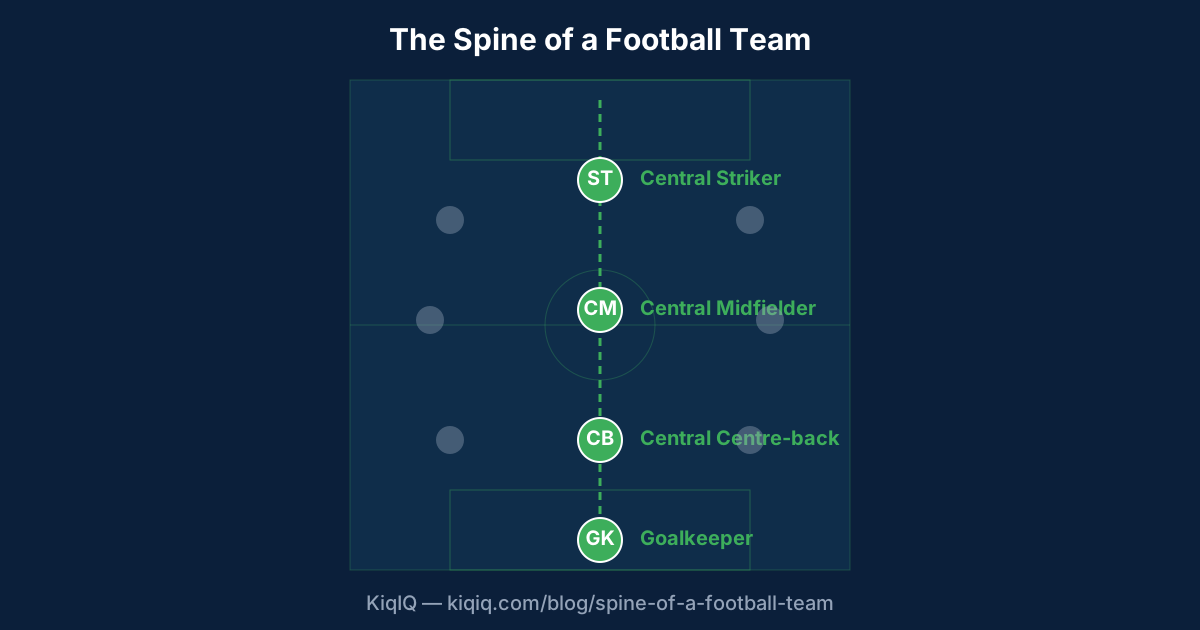
The "spine" of a football team is the vertical column of four central players: goalkeeper, central centre-back, central midfielder, and central striker. These four positions touch the ball in every phase of play — defence, transition, attack — and disproportionately decide match outcomes. Recruit the spine well, the team works. Get any one wrong, the whole structure wobbles.
Why the spine matters more than the wide positions
In modern football, the central column of the pitch is where most decisive actions happen. Heat-mapped goal data shows ~70% of goals in top-flight football are scored from central zones (the central third of the box). Most progressive passes go through central midfielders. Most defensive interventions in dangerous zones come from centre-backs. The wide players matter, but they finish moves that started centrally.
There is also a continuity argument. Wide players come on and off as game-state changes — full-backs swap to wing-backs, wingers get hauled off in the 70th minute. The spine plays. A team that can't change its spine without dropping in level is fragile.
The four spine positions
What each role demands
Each spine position has a specific cluster of attributes that disproportionately predicts team performance:
- Goalkeeper. Shot-stopping (Goals Prevented vs xGOT), distribution (pass accuracy under pressure), command of the area (cross-claims, sweeper actions). A keeper who concedes 5 fewer goals than xGOT over a season is worth ~7 points.
- Central centre-back. Aerial dominance (75%+ aerial duel win rate), defensive positioning (interceptions per 90 in dangerous zones), passing range (progressive passes per 90). Modern football has elevated CB passing — Van Dijk, Rüdiger, Saliba all rate elite on press-resistance.
- Central midfielder. Press resistance (turnover rate under pressure), progression (carries + progressive passes per 90), defensive output (interceptions + ball recoveries). The "complete #6" is the modern unicorn — Rodri, Casemiro at his peak, Declan Rice in transition.
- Central striker. Finishing (xG conversion rate), box presence (touches in box per 90), link play (key passes from central zones, hold-up success). Elite strikers profile differently — Haaland is a poacher; Kane drops; Lewandowski combines.
Spine quality is multiplicative, not additive. A weak goalkeeper amplifies a weak centre-back. A weak centre-back exposes a weak midfielder. The spine fails as a whole.
Why elite teams pay disproportionately for spine players
The transfer market reflects this. Look at the top 20 transfer fees of the last 5 years and count: roughly 16 of 20 are spine positions. Pogba, De Bruyne, Maguire, Van Dijk, Alisson, Haaland, Bellingham, Caicedo, Rice, Saliba — all spine.
Wide attackers do break the rule (Neymar, Mbappé, Hazard) but those are exceptional dual-threat players who effectively operate as second strikers in modern systems. The spine premium reflects how hard these positions are to upgrade and how costly an error is.
Building a spine — the recruitment template
Most successful long-term projects build the spine first, then layer the wide players. Liverpool 2017-19 acquired Alisson, Van Dijk, Fabinho, then Mané/Salah/Firmino were augmented. Manchester City acquired Ederson, Stones/Dias, Rodri, Haaland — wide players cycled around them.
Three principles emerge across these builds:
- Lead with the keeper. A top keeper unlocks the back-line's pressing height, which unlocks the midfield's positioning, which unlocks the attack's territory.
- Buy a #6 before a #10. Defensive midfielders are scarce; creative ones are plentiful. The #6 enables every other position.
- Spine players don't age the same way. Goalkeepers age slowly (Buffon to 43, Ter Stegen still elite at 33). Centre-backs and #6s age via decline in pace, but cognitive sharpness compensates. Strikers and #10s decline faster.
When the spine breaks
The clearest case study of recent years is Liverpool 2020-21. Van Dijk, Gomez, and Matip all suffered season-ending injuries by November. The midfield (Henderson, Fabinho) had to drop into centre-back roles. The team finished 3rd despite winning the title the year before. The spine had broken; everything else collapsed around it.
Manchester United's post-Ferguson era is another. The replacement of Vidic + Ferdinand was botched, the Fellaini/Rooney/Falcao spine never gelled, and no spine has held together for more than two seasons since. Trophy count reflects the diagnosis.
How fans can scout a team's spine quality
Three quick checks:
- Goals Prevented (xGOT minus goals conceded) for the keeper over a 25+ match window. Positive = elite.
- Aerial duel % and progressive passes per 90 for the central CB. Top CBs hit 75%+ aerial and 6+ progressive passes.
- Pass tempo + press-regain rate for the #6. Tempo above 18 passes/min when on the ball + press-regain rate above 35% = elite.
Frequently asked questions
- What is the spine of a football team?
- The spine is the vertical column of four central players: goalkeeper, central centre-back, central midfielder, and central striker. These positions touch the ball in every phase of play and disproportionately decide match outcomes — most goals are scored centrally, most progressive passes go through the middle, most defensive interventions in dangerous zones come from spine players.
- Why is the spine more important than the wide positions?
- ~70% of goals come from central zones, central midfielders carry most progressive passes, and centre-backs intervene in the most dangerous defensive moments. Wide players finish moves that started centrally. The spine also offers continuity — wide positions rotate more across game states, so the spine's consistent quality matters more.
- In what order should a club build its spine?
- Most successful builds start with the goalkeeper (a top keeper unlocks pressing height), then add a top central CB, then a defensive midfielder (#6), then a striker. Liverpool 2017-19 (Alisson → Van Dijk → Fabinho) and Manchester City's 2017-23 build (Ederson → Stones/Dias → Rodri → Haaland) both followed this template.
- What happens when the spine breaks?
- Spine quality is multiplicative — a single broken element compromises the whole structure. Liverpool 2020-21 are the clearest recent case: losing Van Dijk, Gomez, and Matip to injury forced midfielders to play CB and the team's title defence collapsed despite the rest of the squad staying intact.
References
- The Modern Spine — Recruitment Patterns — The Athletic
- Goal Distribution by Pitch Zone — StatsBomb
- Liverpool 2020-21 — When the Spine Broke — The Analyst
- Transfermarkt — Top 20 Transfer Fees 2020-25 — Transfermarkt
Key terms in this article
Ask KiqIQ a follow-up
Get a live, data-driven answer powered by api-football + KiqIQ's Poisson model. Try one of these prompts or write your own.
Try the calculators
Apply the concepts from this article with KiqIQ's free calculators.
Part of pillar
Fundamentals
See every article in this knowledge pillar →
Related
Reviewed by a KiqIQ editor before publication. Spotted an error? Email editor@kiqiq.com — we follow our Corrections Policy.