
Football IQ: What It Is and How Players, Coaches, and Fans Develop It
Football IQ is the ability to read the game — anticipating play, recognising tactical patterns, and making the right decision under pressure. We define it, test it, and explain how to develop it.
 Tap to enlarge
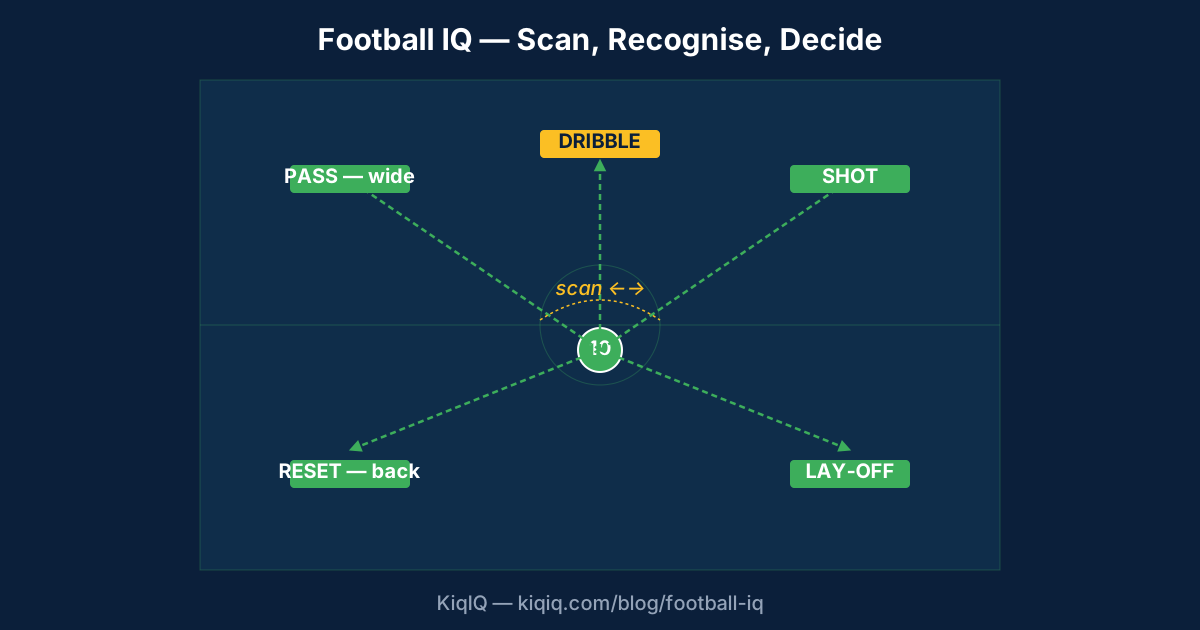
Football IQ is the ability to read the game — to anticipate play, recognise tactical patterns, and make the right decision under pressure. It blends three things: spatial awareness (where everyone is), situational awareness (what the game state demands), and decision speed (acting before the moment closes). Elite players have it. It can be developed.
What football IQ actually means
"Football IQ" is the umbrella term for the cognitive side of the game. It is not the same as technical skill (first touch, shooting), nor athletic profile (speed, strength). A player can be technically gifted and athletically dominant but still make poor decisions. Football IQ is the bridge between physical ability and effective execution.
Three components combine to form it: spatial awareness — knowing where teammates, opponents, the ball, and space are at any moment; situational awareness — understanding what the score, time, opposition, and weather demand; and decision speed — choosing the best option fast enough that it remains the best option.
How football IQ shows up on the pitch
High-IQ players consistently make plays that look obvious in hindsight but were unavailable in real-time to lower-IQ teammates. Five recurring signatures:
- Pre-touch scanning. Looking over the shoulder before receiving the ball — Frank de Boer measured it as 6+ scans per 10 seconds for elite midfielders.
- The right pass, not the obvious one. Sliding the ball into space rather than into the target's feet. Hitting the third-man rather than the obvious first option.
- Defensive anticipation. Stepping in front of the pass, not chasing the receiver. Reading the body shape of the passer.
- Tempo manipulation. Slowing down to draw a press, accelerating to break it. Knowing when to keep the ball, when to release.
- Situation-appropriate risk. Playing safe when 1-0 up in the 88th minute, taking the line-breaking pass when 0-1 down in the 75th.
Football IQ is mostly about what a player does *before* the ball arrives — not what they do once it has.
Why some players develop it earlier
Three factors correlate with high football IQ in young players: deliberate exposure (watching matches actively rather than passively), small-sided games (3v3 to 5v5 forces more decisions per minute than 11v11), and street football culture (unstructured play removes coach instructions and forces self-organisation).
Multi-sport athletes also tend to develop higher football IQ — the spatial reasoning learned in basketball, hockey, or rugby transfers. Several elite players (Andrea Pirlo, Lothar Matthäus, Andriy Shevchenko) credit their non-football sporting backgrounds for their game-reading.
Coaching football IQ
Football IQ is coachable, but slowly. Modern academies use four primary tools:
- Constraint-based games. Rules like "two-touch maximum" or "must score from a third-man combination" force specific decision patterns to embed.
- Video review with "freeze and predict". Pause footage at a pivotal moment; ask the player to call the next pass. Reveal. Discuss why their answer differed.
- Position rotation. Playing youth players in multiple positions builds awareness of what teammates in those positions need. Pep Guardiola plays his academy attackers as full-backs.
- Verbal cueing. Pre-touch instructions like "scan!" or "shape!" condition the player to check before receiving.
Measuring football IQ
Football IQ is hard to quantify directly. Proxies include: scan rate (head-checks per receipt — measurable from video), pass selection quality (is the chosen pass close to the maximum-EV pass available?), and decision time under pressure (seconds from receipt to action when pressed).
StatsBomb 360 and Skillcorner tracking data are starting to expose these metrics at scale. Defensive IQ is rated via metrics like adjusted defensive value (defensive actions in the right zones, not just total tackles).
How fans can train football IQ
Watching matches is not the same as studying matches. Three habits that build football IQ as a viewer:
- Watch off the ball. Pick a single off-ball player (a fullback, a #6) and follow them for 10 minutes. Notice their scanning, their positioning, their micro-decisions.
- Pause and predict. Pause a recorded match before a key pass. Predict what happens. Resume. Compare. Over 50 reps your prediction accuracy noticeably improves.
- Read the analysts. The Athletic's tactical column, The Analyst (Opta), StatsBomb, and Karun Singh all publish breakdowns that name the patterns. Naming a pattern makes it spotable next match.
Frequently asked questions
- What is football IQ?
- Football IQ is the ability to read the game — to anticipate play, recognise tactical patterns, and make the right decision under pressure. It combines spatial awareness (where everyone is), situational awareness (what the game demands), and decision speed (acting before the moment closes).
- Can football IQ be developed?
- Yes. The strongest evidence-based methods are constraint-based small-sided games, video review with freeze-and-predict drills, deliberate position rotation in youth, and verbal cueing of pre-touch scans. Multi-sport exposure also accelerates development.
- Which players are known for high football IQ?
- Andrea Pirlo, Xavi Hernandez, Sergio Busquets, Andrés Iniesta, Toni Kroos, Kevin De Bruyne, Lionel Messi, and Bernardo Silva are commonly cited. The trait is not position-specific — Maldini, Vidic, and Cannavaro showed elite defensive football IQ; Pirlo and Xavi showed elite midfield reading.
- How is football IQ different from technical skill?
- Technical skill is what you do when you have the ball — touch, passing accuracy, shooting. Football IQ is what you do before the ball arrives and how you decide what to do once it does. A high-IQ but technically modest player can outperform a low-IQ but technically gifted one through better decisions.
References
- The Cognitive Demands of Modern Football — The Athletic
- Frank de Boer on Visual Scanning in Elite Midfielders — UEFA Technical
- StatsBomb 360 Decision-Making Metrics — StatsBomb
- How Pep Guardiola Coaches Decision-Making — The Analyst
Key terms in this article
Ask KiqIQ a follow-up
Get a live, data-driven answer powered by api-football + KiqIQ's Poisson model. Try one of these prompts or write your own.
Try the calculators
Apply the concepts from this article with KiqIQ's free calculators.
Part of pillar
Fundamentals
See every article in this knowledge pillar →
Related
Reviewed by a KiqIQ editor before publication. Spotted an error? Email editor@kiqiq.com — we follow our Corrections Policy.