
How Is Possession Calculated in Football? The Methods and Why They Differ
Possession % is calculated three different ways depending on the data provider — by passing time, by ball-touch time, or by event count. We explain each method and why broadcast figures vary.
 Tap to enlarge
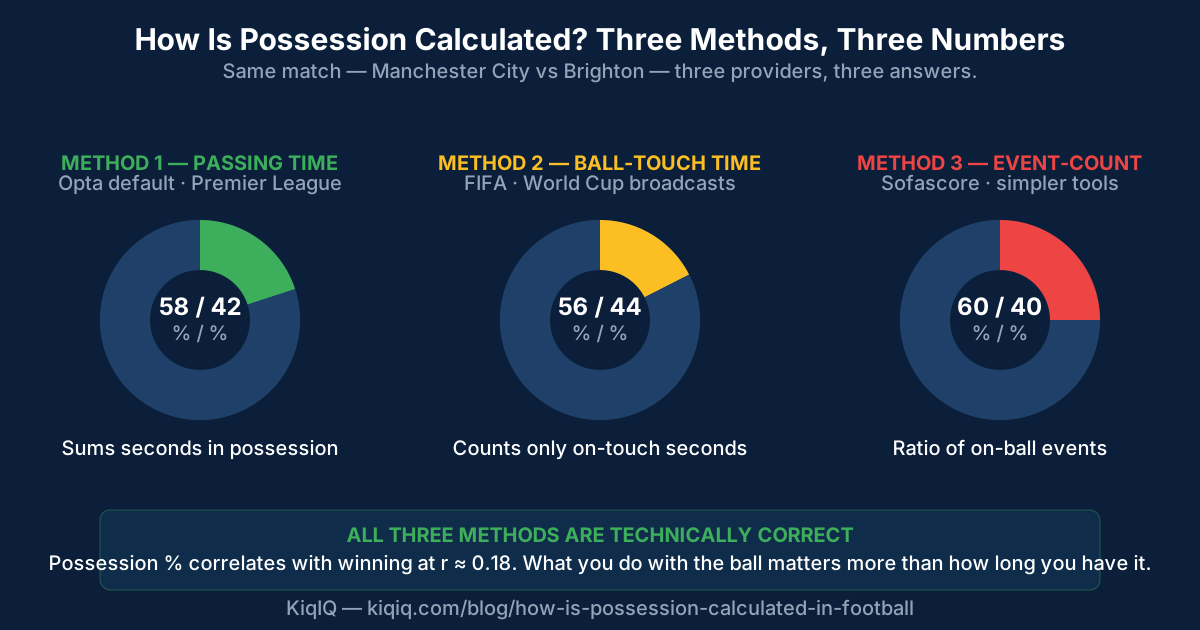
Possession in football is calculated three different ways depending on the data provider. Opta uses passing time (sum of seconds between a team's pass and the next opponent action). FIFA broadcasts often use ball-touch time. Some providers use a simple event-count ratio. The same match can show 56% / 44% on one screen and 60% / 40% on another — both are technically correct.
Method 1 — Passing time (Opta's standard)
Opta calculates possession by summing the time a team spent in active possession — defined as the period from when a team's player first controls the ball until an opponent intercepts, the ball goes out of play, or the half ends.
The clock starts on the first touch a team makes. If the same team plays a 4-pass sequence, then loses the ball, the entire sequence is added to their total. Stoppages (corners, throw-ins, free kicks) are excluded — only ball-in-play time counts.
This is the most common method on Premier League broadcasts and FBref. Sums to 100% across both teams. Tends to over-credit possession-heavy sides because longer passing chains accumulate more seconds.
Same match, same data — but two providers using different methods can disagree by 4-6 percentage points. There's no single correct number.
Method 2 — Ball-touch time
Ball-touch time counts only the seconds during which a player is actually in contact with the ball, plus a small post-touch buffer (typically 0.3-0.5 seconds). It excludes the 'ball in transit' time during a pass.
FIFA broadcasts and some European leagues use ball-touch time. It produces lower headline numbers (a 10-pass sequence might be 8 seconds of touch time but 25 seconds of passing time). Teams with quick one-touch passing look more 'touched' than teams with slow build-up.
Both teams' touch time + 'ball in transit' time should sum to total active match time. So unlike passing time, this method doesn't always sum to 100%.
Method 3 — Event-count ratio
Some smaller providers (Sofascore historically, certain analytics tools) calculate possession as the ratio of one team's on-ball events (passes, dribbles, shots, fouls won) to total on-ball events in the match.
This is the simplest method and the easiest to compute, but it's also the most distorted. A short-passing team will rack up event counts; a long-ball team will not. Two sides who actually had the ball for the same number of seconds can show 65% / 35% possession on this method if one passes more often than the other.
Event-count ratio sums to 100%. It's more often used in sub-elite leagues where clock-tracking infrastructure isn't available.
Why broadcast numbers differ
When you watch a Premier League match on Sky or TNT and see 58% / 42%, that's typically Opta passing-time. When you watch the same fixture on a Spanish broadcast showing 60% / 40%, that's likely a different provider's event-count ratio. Both are correct under their respective definitions.
FIFA's official numbers for World Cup matches use ball-touch time (which tends to give lower percentages and looks more 'fair' across teams). UEFA Champions League broadcasts use Opta passing time.
Why possession % is a weak match-outcome predictor
Across the top 5 European leagues, possession % correlates with winning at r ≈ 0.18 — meaningful but not decisive. A team can have 30% possession and win the league (Atlético 2013-14, 2020-21). A team can have 70% possession and lose 0-1 (any number of low-block defeats of Manchester City).
What predicts winning more strongly than possession % is *what you do with possession*. Progressive passes per 90, xG per 90, big-chance creation rate. These are causally connected to winning; raw possession % is correlated with style, not outcome.
When possession % does matter
Three contexts where possession does matter:
- Energy management. Holding possession late in matches preserves leads (Pep Guardiola's "ball circulation" closing-out approach).
- Defensive insulation. A team with 65%+ possession concedes fewer counter-attacks because the opposition spends less time in attacking phases.
- Style identification. Possession % is a fingerprint, not a verdict. Sides with consistently high possession share an identity (Pep, De Zerbi, Sarri); sides with consistently low possession also share one (Simeone, Mourinho).
Frequently asked questions
- How is possession calculated in football?
- Three methods. Opta's standard — passing time — sums the seconds a team spent in active possession from first control to opponent intercept or out-of-play. Ball-touch time counts only the seconds a player is in contact with the ball plus a small buffer. Event-count ratio compares one team's on-ball events to total events. Different providers use different methods, which is why broadcast numbers can disagree by 4-6 percentage points.
- Why do different broadcasts show different possession numbers?
- Because they use different providers and methods. Premier League broadcasts typically show Opta passing-time. FIFA World Cup uses ball-touch time. Some smaller broadcasts use event-count ratio. All can be technically correct under their respective definitions, but they don't agree on the same match.
- Does possession % predict winning?
- Weakly. Across the top 5 European leagues, the correlation between possession % and winning is around r = 0.18 — meaningful but not decisive. A team can win the league with 30% possession (Atlético 2013-14). What predicts winning much more strongly is what you do with possession — progressive passes, big-chance creation, xG per 90.
- What is the lowest possession % a team has won the league with?
- Atlético Madrid won La Liga in 2013-14 with average possession around 49% and again in 2020-21 with around 50%. Leicester City's 2015-16 Premier League title was won at ~43% possession — among the lowest of any modern champion. None had high possession; all had elite chance-quality control + counter-attacking efficiency.
References
- Opta — Possession Methodology — Opta
- FIFA Match-Data Standards — FIFA
- Why Possession Doesn't Win Matches — The Analyst
- Atlético Madrid 2013-14 — Tactical Profile — StatsBomb
Key terms in this article
Ask KiqIQ a follow-up
Get a live, data-driven answer powered by api-football + KiqIQ's Poisson model. Try one of these prompts or write your own.
Try the calculators
Apply the concepts from this article with KiqIQ's free calculators.
Part of pillar
Data and Systems
See every article in this knowledge pillar →
Related
Reviewed by a KiqIQ editor before publication. Spotted an error? Email editor@kiqiq.com — we follow our Corrections Policy.