
The Long Throw-In: Football's Underrated Weapon
The long throw-in is football's underrated set-piece weapon. We explain the technique, the data on conversion rates, and the famous practitioners from Rory Delap to Joe Hodge.
 Tap to enlarge
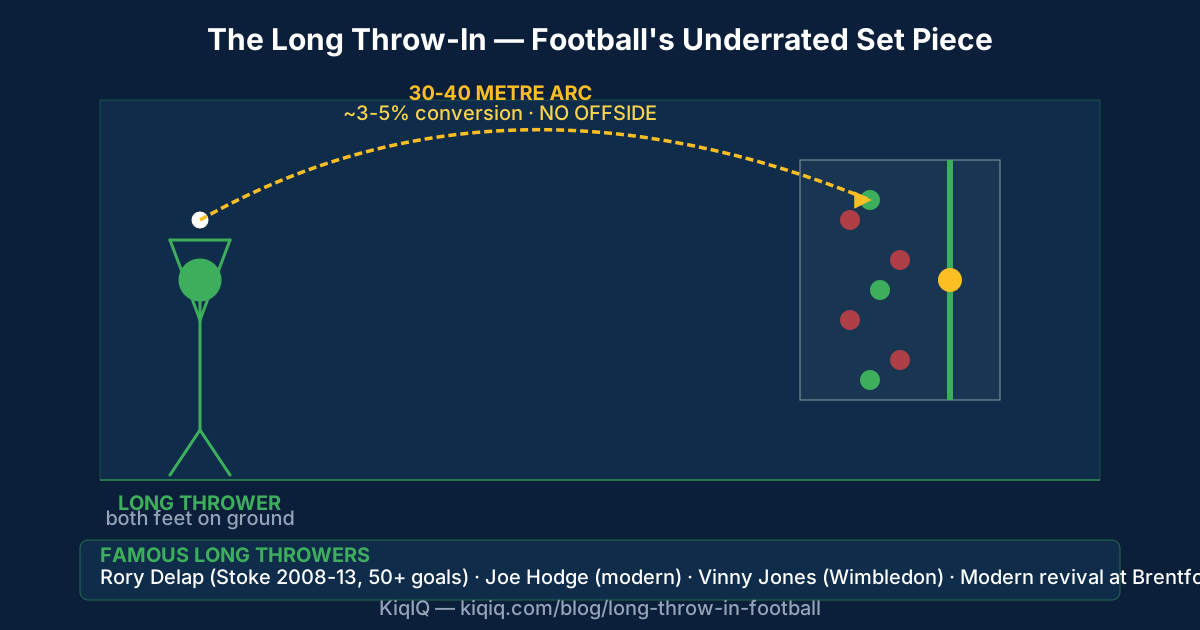
The long throw-in is football's underrated set-piece weapon. A specialist who can throw 30-40 metres effectively turns every throw-in inside the opposition half into a set-piece opportunity equivalent to a corner — except defenders can't be marked goal-side because there's no offside. Rory Delap's Stoke City teams (2008-13) used long throws to score 50+ goals over five seasons. Modern teams with a long-thrower (Brentford, Sheffield United, Crystal Palace) consistently outperform expected set-piece xG.
How the long throw works
A long throw-in follows the same IFAB Law 15 rules as any throw-in: both feet on or behind the touchline, both hands on the ball, ball delivered from behind and over the head.
The "long throw" specialist generates 30-40 metres of distance using the run-up, the wind-up, and full body extension. Famous practitioners (Delap, Joe Hodge, certain Brentford players) can hit 40+ metres consistently. The standard senior throw-in is 15-20 metres — half the range.
A long throw is the only set-piece that has no offside. Attackers can stand right next to the goalkeeper and contest crosses without consequence.
Why it's so dangerous
Three structural advantages compound:
- No offside. Attackers can position anywhere in the box without the offside trap. This shifts defensive responsibility onto the back-line individuals — they have to physically engage rather than let the offside flag handle it.
- Long-throw delivery is harder to clear than a cross. A throw-in arrives flatter and faster than a typical inswinging cross; goalkeepers find it harder to claim, and the ball stays in dangerous areas longer.
- Second-ball value. The crowded box creates many second-ball opportunities. Teams that win second balls add 0.05-0.10 xG per long throw on average.
Long-throw conversion data
Across the top 5 European leagues, set-piece data shows:
- Goals per long throw. ~3-5% conversion rate — comparable to a corner kick.
- xG per long throw. ~0.04-0.07 xG per delivery — slightly lower than a typical corner but volume matters.
- Goals scored from long throws by long-throw specialist teams. Stoke 2008-13 averaged 8-12 long throws per match; Sheffield United 2019-20 averaged 6-9.
- Combined with set-pieces. Teams with a long-thrower + set-piece coach (Brentford under Thomas Frank) post the highest set-piece xG per match in elite leagues.
Famous long-throw practitioners
The history of the long throw includes some recognisable names:
- Rory Delap (Stoke City, 2008-13). The defining modern long-thrower. Delap's throws hit the penalty area from 38-42 metres. Stoke scored 50+ goals from his throws across five seasons.
- Joe Hodge (Wolves academy, 2024-25). Modern long-throw specialist. 40m+ range. Brentford-coached.
- Tony Pulis's teams (multiple clubs). Pulis built squads around long-throw specialists wherever he managed.
- Kim Källström (Arsenal, 2014). Threw long during a brief loan spell — was identified as a long-throw target despite never being known for it.
- Vinny Jones (Wimbledon, 1980s-90s). A pre-modern long-thrower; the original "Crazy Gang" tactical innovation.
- Jose Salomon Rondon (West Brom, 2015-18). Used a long-throw routine that produced multiple goals.
How to defend a long throw
Three defensive principles:
- Match the height in the back-line. A defender shorter than the long-thrower's target striker is a guaranteed conceded contact.
- Goalkeeper command. The goalkeeper must claim or punch crosses aggressively — staying on the line is a goal conceded.
- Block the wind-up. Some teams allow a single defender to obstruct the throw-in itself (legal under Law 15) to disrupt the throw-distance.
- Mark the second ball. The first ball is contested by the back-line; the second ball is a midfielder's job. Teams that lose long-throw goals usually lose them on the second ball.
How to coach a long-thrower
Three principles:
- Strength training. Long throws come from full-body extension — back, hip, shoulder. The thrower must train pull-up strength, lat development, and rotational core power.
- Run-up consistency. Most long-throwers use a 4-8 step run-up. Inconsistency in the run-up produces erratic distance.
- Targeting practice. Drill landing the ball at specific zones (near-post, far-post, six-yard box) repeatedly. Throwing far is half; throwing accurately is the other half.
Modern revival of the long throw
Around 2018-22, several Premier League sides re-discovered the long throw as a tactical weapon. The Brentford set-piece coaching renaissance under Thomas Frank explicitly trained the technique. By 2024-25, more than 8 Premier League sides had a designated long-throw specialist on the team-sheet — a return to a tactic that had been dormant since the Stoke years.
Frequently asked questions
- What is a long throw-in in football?
- A long throw-in is a throw-in delivered from 30-40 metres, typically into the opposition penalty area. It follows the same IFAB Law 15 rules as any throw-in — both feet behind the touchline, both hands on the ball, delivered over the head — but with specialist technique and strength to achieve unusual distance. It functions as a set-piece equivalent to a corner kick.
- Why is the long throw effective?
- Three structural advantages: no offside (attackers can position anywhere), flatter and faster delivery than a typical cross (harder for goalkeepers to claim), and second-ball value in a crowded box. Conversion rates are similar to corner kicks (3-5%), but specialist teams add an extra 5-12 long throws per match to their set-piece volume.
- Who is the most famous long-throw specialist?
- Rory Delap of Stoke City (2008-13) is the defining modern long-thrower. His throws regularly hit the penalty area from 38-42 metres. Stoke scored more than 50 goals from Delap's throws across five Premier League seasons under Tony Pulis — the most famous tactical use of the long throw in the Premier League era.
- How do you defend a long throw?
- Match height in the back-line (a shorter defender against the target striker is a conceded duel), aggressive goalkeeper command (claim or punch the cross — never stay on the line), legally obstruct the wind-up where possible, and prioritise marking the second ball (most long-throw goals come from second-ball winners, not the initial contact).
References
- Set-Piece Goal Distribution Data — StatsBomb
- IFAB Laws of the Game — Law 15: The Throw-In — IFAB
- Rory Delap and the Stoke Long-Throw Era — The Athletic
- The Modern Set-Piece Coaching Renaissance — The Analyst
Key terms in this article
Ask KiqIQ a follow-up
Get a live, data-driven answer powered by api-football + KiqIQ's Poisson model. Try one of these prompts or write your own.
Try the calculators
Apply the concepts from this article with KiqIQ's free calculators.
Part of pillar
Tactical Intelligence
See every article in this knowledge pillar →
Related
Reviewed by a KiqIQ editor before publication. Spotted an error? Email editor@kiqiq.com — we follow our Corrections Policy.