
Football Set-Piece Tactics: Coaching Guide to Corners, Free-Kicks, Throw-Ins
Set-pieces account for ~25-30% of goals in elite football. We map the modern tactical playbook for attacking and defending corners, direct/indirect free-kicks, and throw-ins — including specialist coach roles.
 Tap to enlarge
Set-piece tactics cover the organised play around dead-ball restarts: corners, direct and indirect free-kicks, throw-ins, and goal kicks. Set-pieces account for roughly 25-30% of goals in elite football. Modern clubs now employ dedicated set-piece coaches (Arsenal, Brentford, Liverpool, RB Leipzig) because set-pieces are the most controllable scoring opportunity — both attacking and defending — in the entire game.
Why set-pieces are tactically important
Three reasons set-pieces have grown in importance:
- Higher conversion rate than open play. Around 8-12% of corners result in a shot, and 2-3% in a goal — compared to ~10% of open-play attacks resulting in a shot.
- Trainable. Set-pieces are the only part of football that can be rehearsed exactly because the starting position is fixed.
- Equaliser at any quality level. A weaker team can score from set-pieces against a stronger team, meaning under-performing teams over-rely on them.
Brentford and Arsenal turned set-pieces into a competitive advantage in the 2020s with dedicated specialist coaches Bernardo Cueva (Brentford) and Nicolas Jover (Arsenal).
Attacking corners
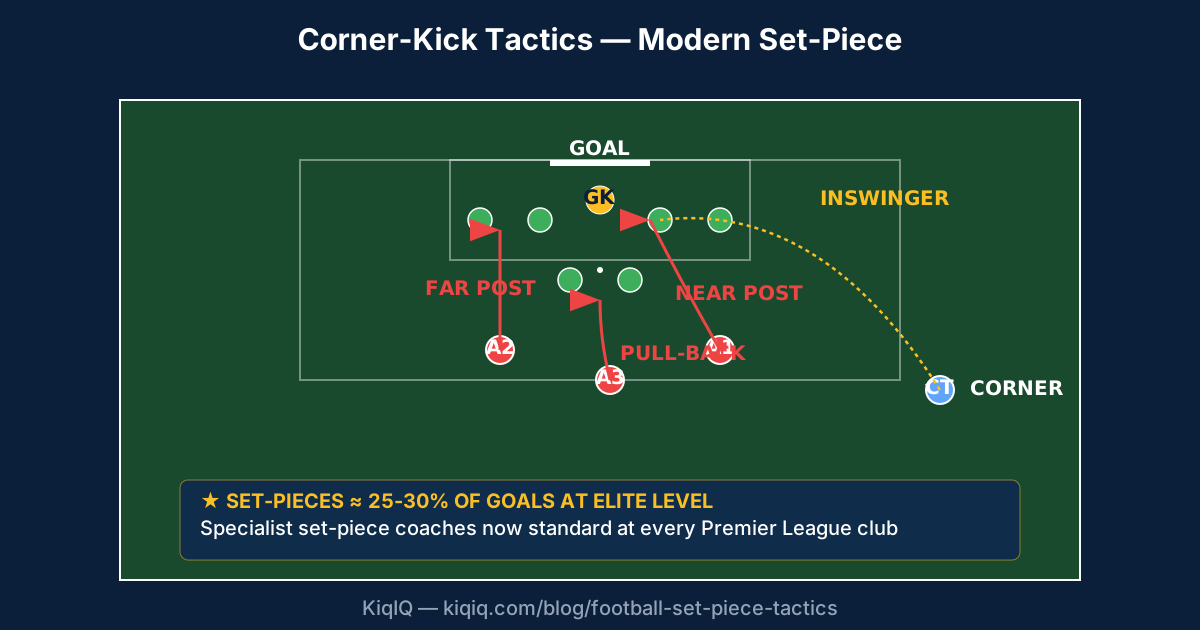
Modern attacking corner-kick tactics fall into 5 categories:
- Near-post flick-on. Attacker runs to the near post and flicks the ball across goal for a far-post run-in finish.
- Far-post overload. 3-4 attackers stack at the far post; ball drops in for a header or volley. Used by tall teams.
- Pull-back / short corner. A short pass to a stationary attacker outside the box, who delivers a low cross or shoots from the edge.
- Block / screen routine. Multiple attackers block defensive markers, freeing one runner to arrive unmarked.
- Inswinger vs outswinger. Inswinger curls toward the goal — favours scoring directly from the corner. Outswinger curls away — favours headed finishes from far-post runs.
Defending corners
Two defensive systems with hybrid variants:
- Zonal marking. Defenders position in pre-allocated zones; the strongest aerial defender takes the most-dangerous zone (typically front of the 6-yard box). Pioneered by Rafa Benítez at Liverpool.
- Man-marking. Each defender tracks one specific attacker. Strong against well-organised attacks but vulnerable to blocks/screens that free runners.
- Hybrid. A blend — zonal at the front-post and 6-yard box plus man-marking on dangerous aerial threats. The dominant modern approach.
- Zone-1 keeper. The goalkeeper claims the front-post / 6-yard box space. Sweeper-keepers are particularly strong here.
Free-kicks: direct vs indirect
Direct free-kicks can be shot at goal directly. Indirect free-kicks must touch a second player before going in. Tactical applications:
- Direct free-kicks within 25-30m of goal. Shooting attempt from the wall side. Typical conversion ~8-10% at elite level.
- Direct free-kicks from wider angles. Crossed in for headed / volleyed finishes. Treated like a corner setup.
- Indirect free-kicks in the box (rare). Awarded for technical infringements (e.g. goalkeeper holding for >6 seconds). Set up like a tap-in routine — second player touches and a third shoots.
- Wall composition. Defenders form a wall to block a direct shot. The number of players (2-5) depends on the angle and proximity to goal.
Throw-ins as a set-piece
Throw-ins were historically not treated as a set-piece. Modern coaches treat them seriously:
- Long throws. Specialists like Rory Delap (Stoke 2007-13) made long throws into the box equivalent to corners. Reduced as defensive techniques caught up.
- Short throw / restart. Quick throws to maintain possession. Modern build-up tactics use throw-ins as standard restarts.
- Specialist routines. Some clubs employ throw-in coaches (Liverpool hired Thomas Grønnemark in 2018) to optimise positioning, body shape, and receiver movement.
- Marker drag-out. Throw-in goes to a deep midfielder; opposition is dragged out of shape; the second-pass options open.
The rise of the set-piece coach
Specialist coaches who have moved set-pieces into mainstream football operations:
- Nicolas Jover (Arsenal). Hired 2021. Arsenal's set-piece goal output rose ~50%+ vs prior seasons.
- Bernardo Cueva (Brentford). A leading set-piece innovator; Brentford routinely outperformed expected goals from set-pieces.
- Gianni Vio (Italy national team / clubs). Pioneer of Italian set-piece innovation; ~3,000+ documented set-piece routines.
- Mikkel Andreasen (Brentford / others). Data-driven set-piece analyst.
- League-wide adoption. By 2026, almost every Premier League club has at least one staff member dedicated to set-pieces.
How set-piece coaches break the routines down
The day-to-day of a set-piece coach is heavy on video. They build a private library of every corner, free-kick, and throw the opposition has run over the last 10 matches, tag each routine by starting position, runner sequence, and target zone, then export the four or five clips that most resemble what their own side will face on the weekend.
Most clubs run this on a dedicated tag-and-clip platform built for exactly this workflow rather than scrubbing through full match footage: frame-accurate clipping, multi-layer drawing tools for marking blocker patterns and decoy runs, and the ability to package a 90-second briefing video the manager can show in the changing room without any editing software in between. The professional and amateur tiers handle the set-piece use case the same way.
Set-piece data and metrics
How set-pieces are measured:
- Set-piece xG. xG generated specifically from set-piece situations.
- Conversion rate. Goals / set-pieces taken (corners, free-kicks).
- Defensive set-piece xG conceded. Mirror metric on the defensive side.
- Aerial duel win rate from set-pieces. Scouting input for centre-backs and forwards.
- Set-piece routine variability. Top clubs use 20+ distinct routines per match to prevent the opposition from preparing specific defences.
Frequently asked questions
- How important are set-pieces in football?
- Set-pieces (corners, free-kicks, throw-ins, penalties) account for approximately 25-30% of goals scored in elite football. The percentage rises higher in tighter matches and tournaments where defences are organised. Set-pieces are the most controllable scoring opportunity in football because the starting position is fixed and the routine can be rehearsed.
- What is a set-piece coach in football?
- A set-piece coach is a specialist who designs and trains a team's attacking and defensive routines for corners, free-kicks, and throw-ins. Examples include Nicolas Jover (Arsenal), Bernardo Cueva (Brentford), and Gianni Vio (Italy). Most Premier League clubs now employ at least one such specialist as of 2025-26.
- What is the difference between zonal and man-marking on corners?
- Zonal marking: each defender stands in a pre-allocated zone of the box and defends balls coming into that zone (regardless of which attacker enters). Man-marking: each defender tracks a specific opponent. Most modern teams use a hybrid — zonal at the front-post / 6-yard box plus man-marking on dangerous aerial threats.
- Are set-pieces really that effective?
- Yes. About 8-12% of corners produce a shot, and 2-3% produce a goal — compared to ~10% of open-play attacks producing a shot. Top set-piece performers (Arsenal, Brentford in recent seasons) score 15+ goals from set-pieces in a single Premier League season, accounting for 25%+ of their total. Set-piece efficiency is now a recruitment factor for centre-backs and forwards.
References
- IFAB Laws of the Game — Restarts — IFAB
- StatsBomb — Set-Piece Analysis — StatsBomb
- The Athletic — Set-Piece Coaches Coverage — The Athletic
- The Coaches' Voice — Set-Piece Tactics — Coaches' Voice
- Metrica Sports — set-piece tagging + video annotation (affiliate) — Metrica Sports
Key terms in this article
Ask KiqIQ a follow-up
Get a live, data-driven answer powered by api-football + KiqIQ's Poisson model. Try one of these prompts or write your own.
Try the calculators
Apply the concepts from this article with KiqIQ's free calculators.
Part of pillar
Tactical Intelligence
See every article in this knowledge pillar →
Related
Reviewed by a KiqIQ editor before publication. Spotted an error? Email editor@kiqiq.com — we follow our Corrections Policy.