
Aerial Threat in Football: What It Means and Why It Decides Set Pieces
Aerial threat in football is a player's effectiveness in winning headers and scoring from crosses. We explain the metric, the technique, and the players who define elite aerial threat.
 Tap to enlarge
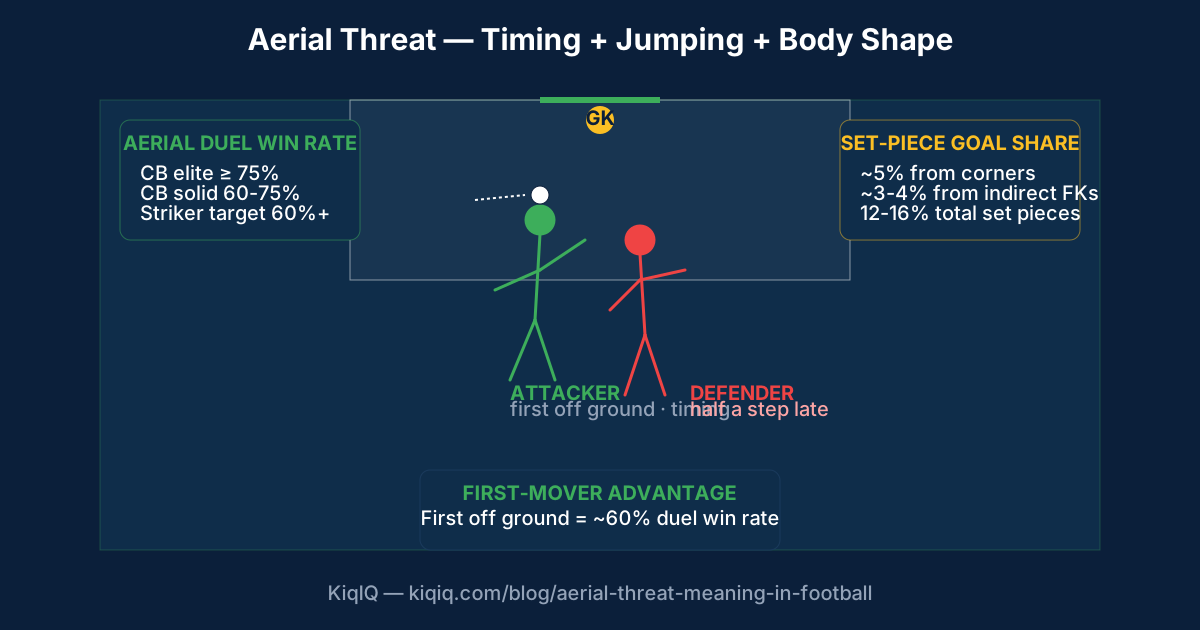
Aerial threat in football is a player's effectiveness in winning headers — both attacking (from crosses, corners, free kicks) and defending (from opposition deliveries). It combines jumping ability, timing, body shape, contact technique, and reading of the ball flight. 12-16% of all professional football goals come from set pieces, where aerial threat is the decisive factor.
What "aerial threat" actually measures
There are two related but distinct metrics:
- Aerial duel win rate. Percentage of contested headers won. Top centre-backs hit 75%+; aerial-target strikers like Erling Haaland hit 60%+ as attackers.
- Aerial goal threat. Per-90 expected goals from headed shots. The headline number for an attacker; below 0.05 xG per 90 is poor for a target striker, 0.15+ is elite.
- Defensive aerial ability. Headers won inside own penalty area on opposition crosses + corners. The signature defensive metric — Virgil van Dijk consistently posts 80%+.
How aerial threat is measured
Match-data providers (Opta, StatsBomb) track every aerial duel — moments where two players contest the ball in the air at roughly equal proximity. Each is recorded as won, lost, or drawn. Drawn duels (where neither player gains clear control) are typically excluded from the win-rate calculation.
Per-90 normalisation matters: a player with 100 wins from 150 duels (66.7% win rate) is more aerial-threatening than one with 200 wins from 350 (57.1%). The latter has more total wins but is less efficient and less reliable.
12-16% of professional football goals come from set pieces. The team with stronger aerial threat usually wins the set-piece battle, which compounds across a season into 5-8 league points.
Aerial threat technique
Three technique fundamentals separate elite aerial players:
- Time the jump from the ball, not the opponent. Watch the ball's flight, not the marker's movement. Players who time off the opponent get baited.
- First mover advantage. Get airborne half a step before the opponent — first-mover wins ~60% of contested headers regardless of physical advantage.
- Direct the header purposefully. Don't just connect — direct the ball to a teammate, into the danger zone, or out for safety. Elite headers are decisions, not reflexes.
Most aerial-threatening players in modern football
Top-flight aerial threats by archetype:
- Centre-backs. Virgil van Dijk (~80% career duel win rate), William Saliba, Antonio Rüdiger, Leonardo Bonucci, Sergio Ramos.
- Strikers (target archetype). Olivier Giroud, Wout Weghorst, Romelu Lukaku, Erling Haaland, Niclas Füllkrug.
- Set-piece specialists (attacking from corners). Virgil van Dijk (also a top-3 scorer from set pieces), Joel Matip, Antonio Rüdiger, Cristhian Mosquera.
- Set-piece-only goalscorers. Marco Reus on his Dortmund peak years had a notable cluster of headed goals despite being a winger; Eric Bailly has a similar profile.
Set pieces — where aerial threat decides matches
Set-piece goal frequency by source:
- Corners. ~5% of all goals, primarily headed.
- Direct free kicks. ~3% of goals (not aerial — usually shots).
- Indirect free kicks / lofted free kicks. ~3-4% — primarily headed.
- Penalties. ~10-12% of goals (not aerial).
Coaching aerial threat
Three coaching focuses for aerial improvement:
- Vertical jump training. Plyometrics, depth jumps, hip-power work. Aerial threat correlates strongly with vertical leap.
- Set-piece routines. Rehearsed near-post / far-post / second-ball patterns. Brentford under Thomas Frank built a set-piece coaching culture that lifts a mid-tier squad's xG ceiling.
- Cross-defending drills. Specific work on attacking the cross at the highest reachable point, clearing to the safe zone, communicating with the goalkeeper.
When aerial threat doesn't win
A team with weak aerial threat can still excel — by avoiding aerial situations. Pep Guardiola's Barcelona were among the smallest sides in football and won everything by playing through, not over. Their aerial duel volume was 25% below league average; their possession dominance meant they didn't need to win in the air.
Modern football is bifurcating: short-pass possession sides (City, De Zerbi's sides, late Pep Bayern) minimise aerial volume; direct sides (Liverpool early Klopp, Brentford) maximise it. Both are valid; choosing one and recruiting accordingly is the principle.
Frequently asked questions
- What does aerial threat mean in football?
- Aerial threat is a player's effectiveness in winning headers — both attacking (from crosses, corners, free kicks) and defending (from opposition deliveries). It combines jumping ability, timing, body shape, contact technique, and reading of the ball flight. Measured by aerial duel win rate (% of contested headers won) and aerial xG per 90.
- What is a good aerial duel win rate?
- For centre-backs, 60% is solid for a Premier League regular, 75% is elite. For target-striker forwards, 60%+ is elite (against shorter, more agile defenders). For midfielders, 50%+ is strong. Virgil van Dijk consistently posts 80%+ — the gold standard.
- How do players improve aerial threat?
- Three coaching focuses: vertical jump training (plyometrics, depth jumps, hip-power work), rehearsed set-piece routines (near-post / far-post patterns, second balls), and cross-defending drills (attacking the cross at highest reachable point, clearing to safe zones, goalkeeper communication). Aerial threat correlates strongly with vertical leap.
- How much do aerial set pieces matter?
- Approximately 12-16% of all professional football goals come from set pieces, the majority of which are aerial. A team with stronger aerial threat consistently wins the set-piece battle, compounding into roughly 5-8 league points over a season. Brentford under Thomas Frank built a competitive identity primarily on set-piece coaching.
References
- Aerial Duel Methodology — StatsBomb — StatsBomb
- Set-Piece Goal Statistics — Opta — Opta
- Brentford's Set-Piece Coaching Culture — The Athletic
- Virgil van Dijk Aerial Profile — The Analyst
Key terms in this article
Ask KiqIQ a follow-up
Get a live, data-driven answer powered by api-football + KiqIQ's Poisson model. Try one of these prompts or write your own.
Try the calculators
Apply the concepts from this article with KiqIQ's free calculators.
Part of pillar
Tactical Intelligence
See every article in this knowledge pillar →
Related
Reviewed by a KiqIQ editor before publication. Spotted an error? Email editor@kiqiq.com — we follow our Corrections Policy.