
How Tall Is a Football Goal? Official Dimensions and Why They Matter
A standard football goal is 8 feet (2.44m) tall and 8 yards (7.32m) wide. We explain the IFAB Law 1 dimensions, smaller-format goal sizes, and why goal-size choices affect the game.
 Tap to enlarge
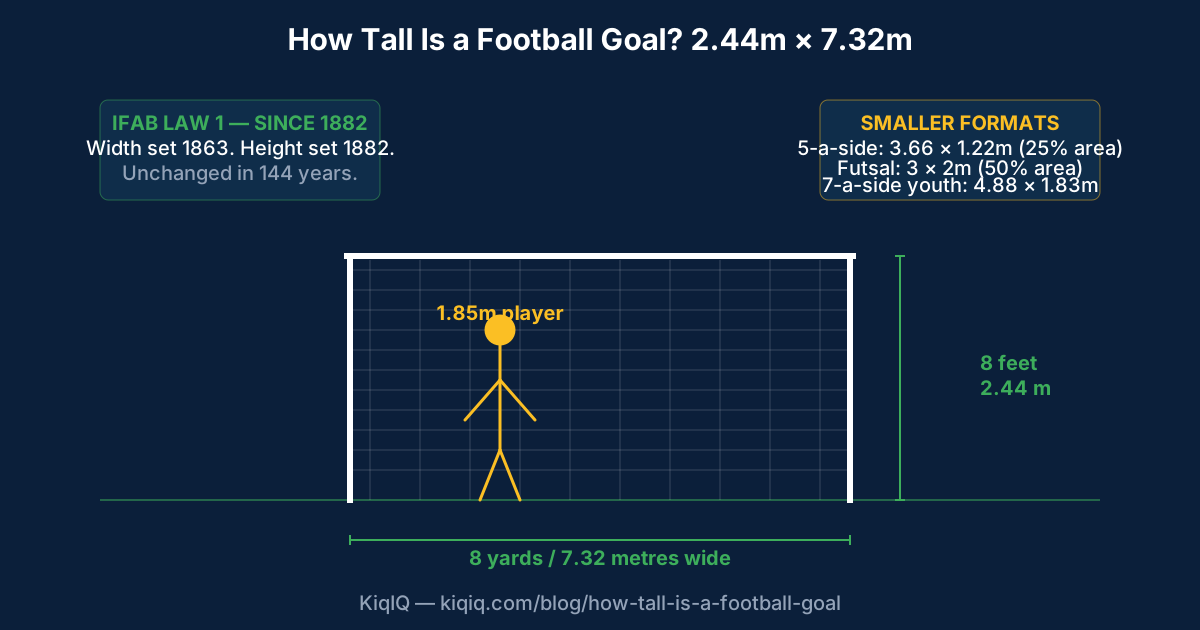
A regulation football goal is 8 feet (2.44 metres) tall and 8 yards (7.32 metres) wide under IFAB Law 1. The dimensions have been unchanged since 1863 (width) and 1882 (height). Smaller-format football (5-a-side, 7-a-side, futsal, women's and youth grades) uses smaller goals, which materially changes shooting, goalkeeping, and tactics.
The official dimensions — IFAB Law 1
Under IFAB Law 1 (The Field of Play), the dimensions of a goal are exact:
- Height (top of crossbar to ground): 2.44 metres / 8 feet.
- Width (inside of post to inside of post): 7.32 metres / 8 yards.
- Post and crossbar thickness: Maximum 12 cm / 5 inches. Posts and crossbar must be the same width.
- Post material: Wood, metal, or other approved material. Posts must be white.
- Net: Optional under the Laws but mandatory in all senior competition. Must be attached to posts, crossbar, and ground without interfering with play.
7.32m × 2.44m is the rectangle every senior football match has been played against since 1882. It has not changed in 144 years.
Why these dimensions and not others
The 8-yard width was set by the FA in 1863 (the founding year of the modern Laws). The 8-foot height was added in 1882 — until then, goals had no crossbar, just two posts with tape stretched between, and goals could be scored at any height.
The dimensions have proven remarkably durable because they balance two competing needs: the goal must be small enough that goalkeepers can defend it (a 10-yard-wide goal would be impossible for one keeper), but big enough that scoring requires real skill and creates excitement. The roughly 17.85m² of goal area produces a ~1.0 goals-per-90-minutes average across senior football — a number game theorists consider near-optimal for spectator interest.
Smaller-format goal sizes
Different football formats use different goals:
- Futsal: 3 metres wide × 2 metres tall (10 ft × 6.5 ft). Approximately 50% of the area of a regulation goal.
- 5-a-side: 3.66m wide × 1.22m tall (12 ft × 4 ft). Roughly 25% of regulation area — explains the high-scoring nature of 5-a-side.
- 7-a-side youth: 4.88m wide × 1.83m tall (16 ft × 6 ft). About 50% of regulation area.
- 9-a-side youth: 5.5m wide × 1.83m tall — used in U10-U11 in many federations.
- Beach soccer: 5.5m wide × 2.2m tall — slightly wider than 7-a-side, slightly taller.
| Format | Width | Height |
|---|---|---|
| 11-a-side (regulation) | 7.32 m (8 yd) | 2.44 m (8 ft) |
| 9-a-side (youth) | 5.5 m | 1.83 m |
| 7-a-side (youth) | 4.88 m (16 ft) | 1.83 m (6 ft) |
| 5-a-side | 3.66 m (12 ft) | 1.22 m (4 ft) |
| Futsal | 3 m | 2 m |
| Beach soccer | 5.5 m | 2.2 m |
How goal size affects the game
Smaller goals fundamentally change tactics and skill emphasis:
- Goalkeeper distribution becomes shorter. With a smaller goal, the keeper handles the ball less often and stays closer to the line.
- Shooting accuracy beats shot power. A 12cm post difference means precision matters more than blasting.
- Attacking play involves more close-range combinations. Long-range shots are rarely worthwhile when the goal is small; teams build closer to the box.
- Goalkeepers are typically shorter. Smaller-goal football rewards reflexes over reach; futsal goalkeepers average ~1.78m vs ~1.90m for outdoor 11-a-side.
Have IFAB ever considered changing goal size?
Yes, occasionally. Sepp Blatter publicly floated enlarging goals around 2007-2010, arguing that goalkeepers had become too physically large to be beaten regularly. The proposal went nowhere — IFAB voted against any change because the game was producing healthy goal volumes already and changing dimensions would invalidate every competitive record.
The more recent debate has been around the 9.15m / 10-yard wall distance for free kicks rather than goal size. IFAB has historically been very conservative about Law 1 — almost nothing about pitch geometry has changed since 1937.
Goal-size data and player advantage
For reference, a 1.85-metre outfield player can comfortably reach the crossbar with arm fully extended. A 1.95-metre tall player (Virgil van Dijk, Erling Haaland) can clear the crossbar with vertical-leap practice. This is why aerial centre-backs are so valuable on attacking corners — they routinely reach above the crossbar level for headers.
Frequently asked questions
- How tall is a football goal?
- A regulation football goal is 8 feet (2.44 metres) tall — measured from the ground to the underside of the crossbar. The dimension has been unchanged since 1882, when the crossbar replaced the original tape stretched between two posts.
- How wide is a football goal?
- A regulation football goal is 8 yards (7.32 metres) wide — measured between the inside of the two posts. The width was set by the FA in 1863 and has not changed since.
- Are 5-a-side goals the same size as full-size goals?
- No. 5-a-side goals are 3.66m wide × 1.22m tall (12 ft × 4 ft) — roughly 25% of the area of a full-size goal. Futsal goals are 3m × 2m. 7-a-side youth goals are 4.88m × 1.83m. The smaller dimensions explain the higher-scoring nature of small-sided football.
- Has FIFA ever considered making goals bigger?
- Yes. Sepp Blatter floated enlarging goals around 2007-2010, arguing that goalkeepers had become too physically large to be beaten regularly. The proposal failed — IFAB voted against changing dimensions because goal output was healthy and altering Law 1 would invalidate every competitive record. No formal proposals have advanced since.
References
Ask KiqIQ a follow-up
Get a live, data-driven answer powered by api-football + KiqIQ's Poisson model. Try one of these prompts or write your own.
Part of pillar
Fundamentals
See every article in this knowledge pillar →
Related
Reviewed by a KiqIQ editor before publication. Spotted an error? Email editor@kiqiq.com — we follow our Corrections Policy.