
Are All Football Pitches the Same Size? IFAB Rules and Variation
No — football pitches are not all the same size. IFAB Law 1 specifies a range, not a fixed value. We explain the rules, the famous-pitch dimensions, and why size affects tactics.
 Tap to enlarge
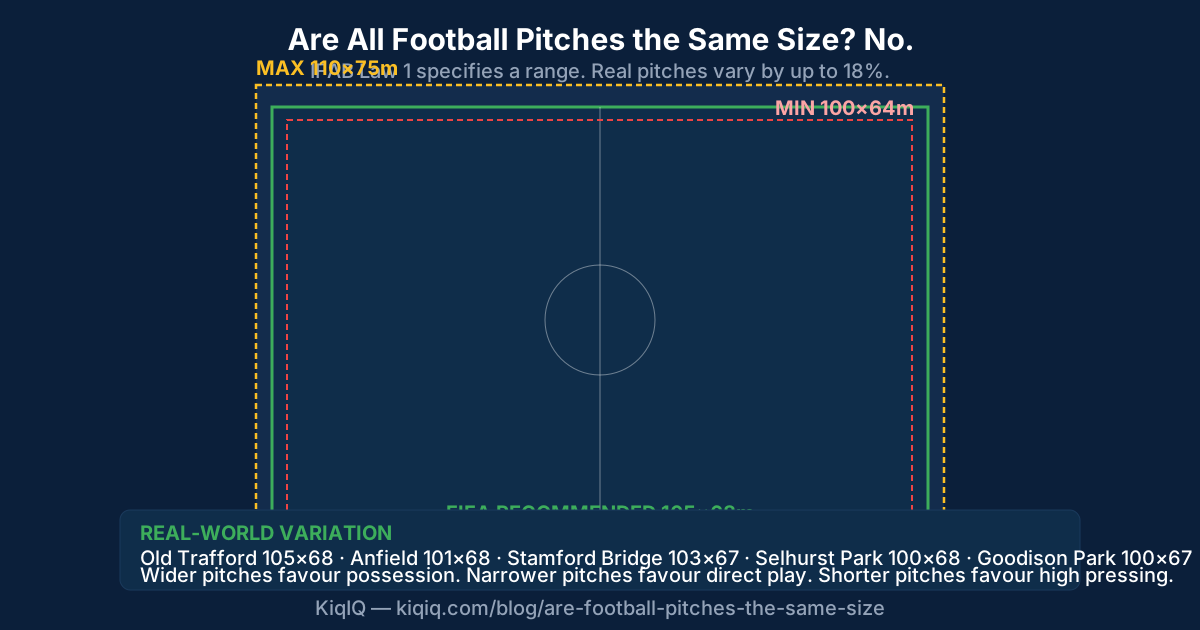
No — football pitches are not all the same size. IFAB Law 1 specifies a range: length 90-120 metres and width 45-90 metres for non-international matches, narrowed to 100-110 × 64-75 metres for FIFA-organised internationals. The official FIFA recommended size is 105 × 68 metres. Real-world pitches vary within these limits, and the differences materially affect tactics — wide pitches favour passing teams, narrow pitches favour direct teams.
IFAB Law 1 — the rules
Under IFAB Law 1 (The Field of Play), the dimensions of a football pitch are specified as ranges:
- Non-international matches: 90-120m long × 45-90m wide.
- International matches: 100-110m long × 64-75m wide.
- FIFA recommended (and most modern stadiums): 105m × 68m. This is the dimension used at most Premier League grounds, the Champions League final venue requirements, and the FIFA World Cup specification.
FIFA's recommended 105×68 has been adopted by virtually every modern professional stadium. Older grounds often deviate.
| Measurement | Non-international | FIFA international | FIFA recommended |
|---|---|---|---|
| Length (touchline) | 90 to 120 m | 100 to 110 m | 105 m |
| Width (goal line) | 45 to 90 m | 64 to 75 m | 68 m |
How real Premier League pitches vary
Approximate Premier League pitch dimensions (some 2024-25 measurements):
- Old Trafford — 105 × 68m (FIFA standard).
- Anfield — 101 × 68m. Slightly shorter than standard.
- Emirates Stadium — 105 × 68m.
- Tottenham Hotspur Stadium — 105 × 68m.
- Etihad Stadium — 105 × 68m.
- Stamford Bridge — 103 × 67m. Slightly smaller (constrained by the West Stand and the Shed End building footprint).
- Selhurst Park (Crystal Palace) — 100 × 68m. The narrowest dimension on the boundary side.
- Goodison Park (Everton) — 100 × 67m. Among the smallest in the Premier League.
- St Mary's Stadium (Southampton) — 105 × 68m.
How pitch size affects play
Pitch dimensions materially affect tactical choices:
- Wider pitches favour possession football. More space to circulate the ball; more passing angles; harder for opposition to compress space. Manchester City and Liverpool, both with regulation 105×68 pitches, exploit this.
- Narrower pitches favour direct football. Less space for opposition to spread out; quicker route from goal to goal; aerial duels and crosses convert more often. Selhurst Park's tight dimensions explain why Crystal Palace under Roy Hodgson (and now Oliver Glasner) favour direct attacking patterns.
- Shorter pitches favour high pressing. Less ground for the keeper to clear over; press triggers more turnovers. Anfield (101m long) was the press-heavy stage that Klopp's Liverpool exploited.
Notable famous pitch dimensions
Some historically significant grounds and their dimensions:
- Wembley Stadium — 105 × 68m. FIFA standard, England's home.
- Camp Nou (Barcelona) — 105 × 68m. FIFA standard.
- Santiago Bernabéu (Real Madrid) — 105 × 68m.
- San Siro (AC Milan / Inter) — 105 × 68m.
- Maracanã (Rio de Janeiro) — 105 × 68m.
- The widest legal pitch ever: 90m wide pitches existed pre-1997 in some non-international competitions. These were so wide that fullbacks couldn't cover the touchlines on their own.
Pitch slope and surface
Pitch dimensions are one variable; pitch slope and surface are others. Some grounds have a measurable slope:
- Yeovil Town's Huish Park — historically a 1.4m slope across the length of the pitch (~1.1% gradient). Modernised since.
- Brisbane Road (Leyton Orient) — slight slope.
- Most modern Premier League pitches — engineered to be flat with high-precision drainage to avoid uneven bounces.
Smaller-format pitch sizes
Different formats use different pitches:
- Futsal (5v5): 38-42m long × 18-25m wide. Hard surface, smaller goals.
- 5-a-side outdoor: 40-50m × 25-30m. Smaller goals (3.66 × 1.22m).
- 7-a-side youth: 60m × 40m typical. Smaller goals (4.88 × 1.83m).
- Beach soccer: 35-37m × 26-28m. Sand surface, smaller pitch reflects the energy cost of running on sand.
Frequently asked questions
- Are all football pitches the same size?
- No. IFAB Law 1 specifies ranges, not a fixed size. Non-international pitches can be 90-120m long × 45-90m wide. International pitches are narrower at 100-110m × 64-75m. FIFA recommends 105 × 68m, which most modern professional grounds adopt — but older Premier League grounds vary.
- What is the standard football pitch size?
- The FIFA recommended size is 105 metres long × 68 metres wide. Most modern professional stadiums (Wembley, Camp Nou, Bernabéu, Old Trafford, Emirates, Etihad) use exactly this. Older grounds with constrained footprints sometimes deviate — Anfield (101 × 68), Stamford Bridge (103 × 67), Selhurst Park (100 × 68), Goodison Park (100 × 67).
- Does pitch size affect tactics?
- Yes — significantly. Wider pitches favour possession football (more passing angles, harder to compress). Narrower pitches favour direct, aerial play (less space to spread out). Shorter pitches favour high pressing (press triggers turnovers more often). Crystal Palace at Selhurst Park and Roy Hodgson's direct style benefited from the narrow dimensions.
- What is the smallest legal football pitch?
- Under IFAB Law 1 the minimum legal pitch for non-international football is 90m × 45m — much smaller than any modern professional stadium. For international matches the minimum is 100m × 64m. FIFA recommends 105m × 68m and almost all top-flight stadiums use that exactly or close to it.
References
- IFAB Laws of the Game — Law 1: The Field of Play — IFAB
- FIFA Stadium Specifications — FIFA
- Premier League Pitch Dimensions Database — Premier League
- How Pitch Size Affects Tactics — The Athletic — The Athletic
Key terms in this article
Ask KiqIQ a follow-up
Get a live, data-driven answer powered by api-football + KiqIQ's Poisson model. Try one of these prompts or write your own.
Part of pillar
Fundamentals
See every article in this knowledge pillar →
Related
Reviewed by a KiqIQ editor before publication. Spotted an error? Email editor@kiqiq.com — we follow our Corrections Policy.