
Football Penalty Rules: A Complete Guide to How Penalties Work
Penalty rules in football cover how penalties are awarded, taken, and resolved. We walk through IFAB Law 14, VAR penalty review, retakes, and the goalkeeper movement rules.
 Tap to enlarge
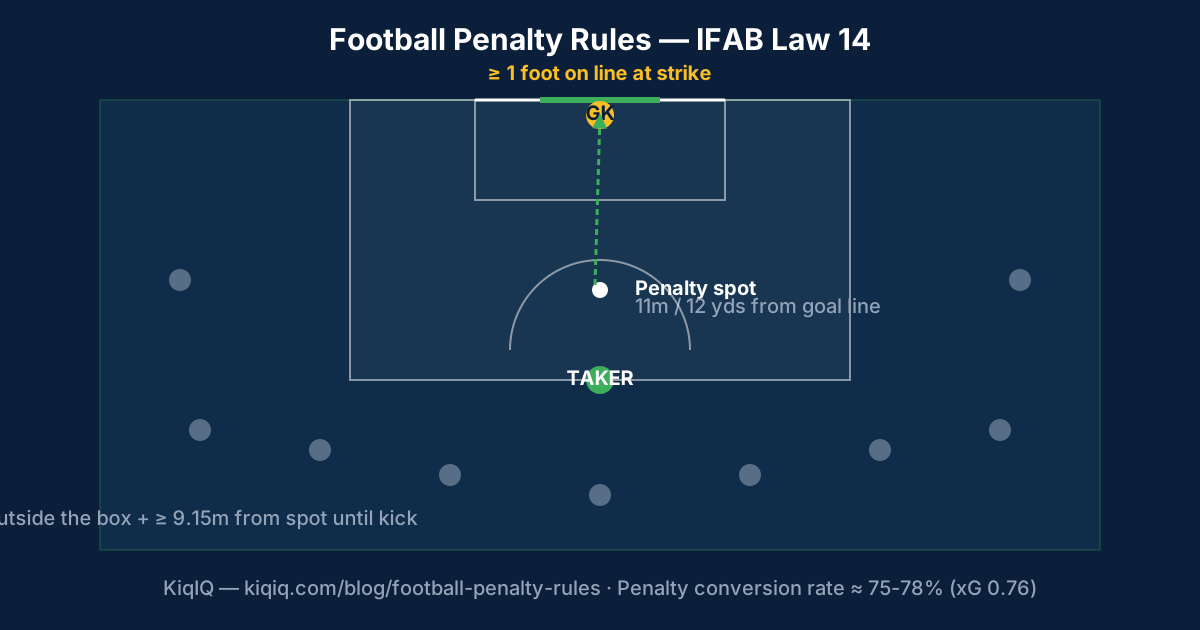
A penalty kick in football is a free shot from the penalty spot — 11 metres (12 yards) from goal — awarded when a defender commits a foul or handball inside their own penalty area. Only the taker and the goalkeeper are inside the penalty area at the moment of the kick. The keeper must have at least one foot on the goal line. The taker has one strike — though rebounds remain in play if the keeper saves.
When a penalty is awarded
Penalties are awarded under IFAB Law 14 (The Penalty Kick) for any direct-free-kick offence committed by a defender inside their own penalty area. The most common penalty-triggering offences:
- Tripping or kicking an opponent.
- Pushing or holding an opponent inside the box.
- A deliberate handball (or any handball that gives a clear advantage).
- A challenge that endangers the safety of an opponent.
- A goalkeeper handling a deliberate back-pass from a teammate (technically an indirect free kick, not a penalty).
The location of the foul matters, not the location of the ball. If a defender fouls an attacker just inside the box but the attacker stumbles outside before falling, it's still a penalty.
How the penalty is set up
Pre-kick procedure (IFAB Law 14):
- Ball placed on the penalty spot — 11m / 12 yards from the goal line, central.
- The taker is identified to the referee. Only the taker may approach the ball.
- The goalkeeper stands on or in front of the goal line, facing the taker, with at least one foot on or behind the line.
- All other players stand outside the penalty area, behind the ball, and at least 9.15m / 10 yards from the spot (i.e. outside the penalty arc).
- The referee whistles to signal the kick may be taken.
How the kick must be taken
The kick must be a deliberate forward strike of the ball. Three rules govern the taker:
- Forward only. The ball must move forward — backward strikes are illegal.
- One strike, then in play. The taker may not touch the ball a second time before another player touches it. A taker who pushes the ball forward and runs onto it for a second touch concedes an indirect free kick.
- Stutter-step / feint allowed during run-up, not at strike. Modern Law 14 allows a stutter or pause in the run-up but bans feinting at the actual moment of striking the ball — that draws a yellow card and an indirect free kick.
Goalkeeper rules — the recent changes
IFAB updated Law 14 in 2019 to address goalkeepers stepping forward off the line before the strike. The current rule: the goalkeeper must have at least one foot on or behind the goal line at the moment the ball is kicked. Two feet off the line = encroachment.
If the goalkeeper encroaches AND saves the penalty, VAR can recommend a retake. If the goalkeeper encroaches AND the kick is missed or scored, no retake — the result stands. The asymmetry has been controversial; some leagues apply it inconsistently.
The goalkeeper may move side-to-side and dive at any time before the kick — but cannot step forward off the line.
Encroachment by other players
If a defender encroaches into the box before the kick AND the penalty is missed or saved, the kick is retaken. If the penalty is scored despite defender encroachment, the goal stands.
If an attacker encroaches AND the penalty is scored, the kick is retaken. If it is missed, an indirect free kick is awarded to the defending team.
Both teams encroach simultaneously? Retake regardless of outcome.
After the kick — what happens to rebounds
A penalty is in active play after the strike. If the goalkeeper saves and pushes the ball into the field of play, any player (including the original taker) may attempt to score the rebound. If the ball comes off the post or crossbar, again live and rebound-eligible.
The exception: if the taker takes a "two-touch" penalty (one push, one strike) — like the famous Cruyff-Olsen penalty — without an intermediate touch by another player, the indirect-free-kick rule fires. The penalty has to involve another player's touch before the original taker touches the ball again.
VAR and penalties
VAR can review four things on a penalty: the awarded foul (was it really a foul?), goal-line clearance (did the ball cross the line on a save?), goalkeeper encroachment (did the keeper step forward?), and offside if the lead-up phase included an offside.
VAR cannot review encroachment AFTER the kick has scored — only before. Once the ball is in the net, the goal stands unless the foul itself is overturned.
Penalty conversion rates
Across professional football, penalties convert at approximately 75-78%. The corresponding xG value of a penalty is 0.76. Top takers (Cristiano Ronaldo, Harry Kane, Bruno Fernandes) convert at 85%+ over hundreds of attempts. Goalkeepers save approximately 15-20% on average; elite penalty-saving keepers like Emiliano Martínez, Kasper Schmeichel, and Diego Alves push past 25%.
Frequently asked questions
- How far is a football penalty from the goal?
- 11 metres or 12 yards from the goal line. The penalty spot is centrally placed within the penalty area.
- Can a goalkeeper move off the line before a penalty?
- No. Under IFAB Law 14 (updated 2019), the goalkeeper must have at least one foot on or behind the goal line at the moment the ball is kicked. Two feet off the line is encroachment. If the keeper encroaches and saves the penalty, VAR can recommend a retake.
- Can the penalty taker score on a rebound?
- Yes — but only if another player touches the ball first. After the strike, the ball is in active play. If the goalkeeper saves and pushes the ball back into open play, any player including the original taker can score the rebound — provided the taker waits for another player's touch first.
- What is the conversion rate of a football penalty?
- Across professional football, penalties convert at approximately 75-78%. The expected-goals (xG) value of a penalty is 0.76. Top takers convert at 85%+ over hundreds of attempts; elite penalty-saving keepers save above 25%.
References
Ask KiqIQ a follow-up
Get a live, data-driven answer powered by api-football + KiqIQ's Poisson model. Try one of these prompts or write your own.
Try the calculators
Apply the concepts from this article with KiqIQ's free calculators.
Part of pillar
Fundamentals
See every article in this knowledge pillar →
Related
Reviewed by a KiqIQ editor before publication. Spotted an error? Email editor@kiqiq.com — we follow our Corrections Policy.