
How Long Is Half-Time in Football? IFAB Law 7 Explained
Half-time in football lasts a maximum of 15 minutes, fixed by IFAB Law 7 since 1995. We cover the rule, what changed, what happens during the break, and how it compares to NFL, NBA, rugby, and cricket.
 Tap to enlarge
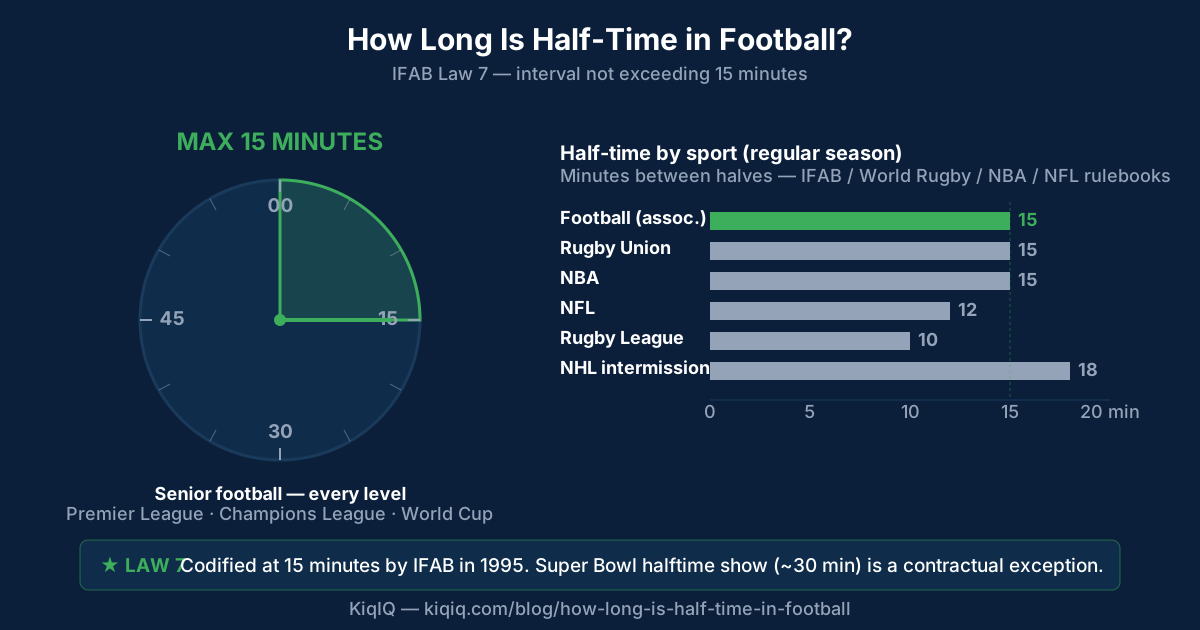
Half-time in association football is a maximum of 15 minutes, set by IFAB Law 7 — The Duration of the Match. The rule reads *"Players are entitled to an interval at half-time, not exceeding 15 minutes"*, with the length agreed before kick-off and recorded in the competition rules. The 15-minute cap has been the universally enforced standard since the 1995 IFAB amendment that codified it; before then, half-time length was at the referee's discretion.
IFAB Law 7 — what the rulebook actually says
The Laws of the Game are written by the International Football Association Board (IFAB) — the body that has held authority over football's rules since 1886 — and adopted by FIFA, UEFA, and every national association. Law 7 governs the duration of the match.
The key clause on the half-time interval reads: *"Players are entitled to an interval at half-time, not exceeding 15 minutes; a short drinks break (which should not exceed one minute) is permitted at the interval of extra time. Competition rules must state the duration of the half-time interval. The duration of the half-time interval may be altered only with the referee's permission."*
Two things follow from that wording. First, 15 minutes is a maximum, not a fixed length — competitions are free to specify a shorter break, and many grassroots matches do (5–10 minutes is common in youth football). Second, the competition rule book sets the duration, not the referee on the day; the referee can only alter it once the match is under way, and only for cause (e.g. a serious injury that needs longer attention before play resumes).
IFAB Law 7: half-time interval not exceeding 15 minutes. The competition rules state the duration; the referee can only alter it during the match.
How the 15-minute rule was codified
Half-time is older than the codified rules around it. The first FA Laws of 1863 mention changing ends but not a formal interval; in the late-Victorian era, half-time was usually whatever the referee or captains agreed on — sometimes as short as five minutes, sometimes longer if the weather or pitch needed attention.
Through the 20th century the 15-minute interval became the de-facto standard in Football League, FIFA, and UEFA competition, but Law 7 itself referred only to *"an interval at half-time"* without specifying a length. IFAB amended Law 7 in 1995 to add the explicit *"not exceeding 15 minutes"* cap, eliminating ambiguity and giving referees a clear ceiling to enforce. The 1995 amendment is what most modern reference sources cite when they describe half-time as a 15-minute rule.
The wording has been refined since — the current version, in IFAB's 2024-25 Laws of the Game, makes it explicit that the competition (not the referee) sets the duration before kick-off, with the referee only able to alter it mid-match.
What actually happens during half-time
Fifteen minutes is enough time for three things, in roughly this order:
- Physical recovery. Players cool down, rehydrate, change kit if soaked, and get any minor injuries strapped or assessed. A typical Premier League player covers 5–6 km in the first half; the break lets heart rate and core temperature drop before the second-half sprint load resumes.
- Tactical adjustments. The manager and assistants review what happened — usually with a tablet showing tagged clips from the in-house analyst — and brief the squad on shape changes, marking assignments, or specific opponents to target. Substitutions decided at the break are made before the restart so the new player has full warm-up time.
- Mental reset. Captains and senior players lead a short verbal reset; psychology staff at top clubs sometimes use the break for individualised cues (e.g. a striker who missed two chances getting a confidence prompt before going back out).
Late returns and Law 7 enforcement
If the second half is delayed because a team has not returned to the pitch, the referee can caution (yellow card) the captain or coach for delaying the restart of play under Law 12 — though in practice this is rare; referees usually issue a verbal warning first.
Television broadcasters' commercial slots are not a justification for extending half-time. Broadcast contracts with FIFA, UEFA, and the Premier League are written around the 15-minute cap; they don't override it. The Super Bowl-style extended halftime show does not exist in association football precisely because Law 7 forbids it.
Extra time, drinks breaks, and cooling breaks
Three related breaks often confused with the half-time interval:
- Half-time of extra time. When a knockout match goes to extra time (two periods of 15 minutes), Law 7 allows only a drinks break of up to one minute between the two extra-time halves — not a second 15-minute interval. Teams change ends and resume.
- Cooling breaks. Introduced for the 2014 World Cup in Brazil and now standard in hot conditions, cooling breaks of up to three minutes can be taken in each half (typically around the 30th and 75th minutes) when wet-bulb temperatures cross the threshold set by the competition's medical protocol. They are separate from half-time and are added to stoppage time.
- Drinks breaks. A 60-second drinks break can be granted by the referee during play in lieu of a full cooling break — common in pre-season friendlies and some senior cup ties played in summer heat.
Extra-time interval ≠ half-time. Only one minute is permitted between the two extra-time halves under Law 7.
How football half-time compares to other sports
Half-time length varies considerably across sports, driven mostly by broadcast economics and the physical demands of each game. The numbers below are the standard regular-season interval; major-event finals (e.g. the Super Bowl) often run longer.
- Football (association) — 15 minutes. IFAB Law 7. Same length at every level from grassroots to the Champions League final.
- Rugby Union — up to 15 minutes. World Rugby Law 5.4 (Time): the half-time interval shall not exceed 15 minutes. Often shorter at amateur level (10 minutes is typical).
- Rugby League — 10 minutes. RFL operational rules. Shorter than union, reflecting the league's tighter overall match length (80 minutes plus a 10-minute interval).
- NFL (American football) — 12 minutes regular season. NFL Rule 4, Section 1, Article 4. The Super Bowl extends to roughly 30 minutes for the halftime show — a contractual special case, not the league standard.
- NBA (basketball) — 15 minutes. NBA Rule 5, Section II. Same length as football despite a much shorter playing clock (48 game minutes).
- Cricket (Test match) — 40-minute lunch + 20-minute tea. Two intervals per day rather than a single half-time, since a Test day is split into three sessions of two hours.
- Ice hockey (NHL) — two 18-minute intermissions. Three periods of 20 minutes with two intermissions between them; functionally the equivalent of two half-times.
| Sport | Interval | Governing rule |
|---|---|---|
| Football (association) | 15 minutes maximum | IFAB Law 7 |
| Rugby union | Up to 15 minutes | World Rugby Law 5.4 |
| Rugby league | 10 minutes | RFL operational rules |
| NFL (American football) | 12 minutes (regular season) | NFL Rule 4 |
| NBA (basketball) | 15 minutes | NBA Rule 5 |
| Cricket (Test) | 40-minute lunch, 20-minute tea | ICC playing conditions |
| Ice hockey (NHL) | Two 18-minute intermissions | NHL rules |
A note on terminology — "football" in the US vs the UK
In the UK, Australia, and most of the world, *football* means association football (soccer) — the IFAB-governed sport this article describes. In the US, *football* typically means the NFL — and the half-time of a US football game is 12 minutes in the regular season under NFL Rule 4, with the Super Bowl as a contractual exception running ~30 minutes for the halftime show.
If you arrived here looking for the NFL number, the short answer is 12 minutes regular season, ~30 minutes Super Bowl. For everywhere else in the world — and for any soccer match, MLS included — the answer is 15 minutes maximum under IFAB Law 7.
Frequently asked questions
- How long is half-time in football?
- Half-time in association football (soccer) is a maximum of 15 minutes, set by IFAB Law 7 — The Duration of the Match. The rule reads "Players are entitled to an interval at half-time, not exceeding 15 minutes." The 15-minute cap applies at every level from the Champions League final to grassroots youth football, though competitions can choose a shorter interval and many youth leagues do.
- When did half-time become 15 minutes officially?
- IFAB amended Law 7 in 1995 to add the explicit "not exceeding 15 minutes" cap. Before then, Law 7 referred only to "an interval at half-time" without a specified length, and 15 minutes was the de-facto standard but not formally enforced. The 1995 amendment is the date most reference sources cite when describing half-time as a codified 15-minute rule.
- Is half-time the same length in the Premier League and the Champions League?
- Yes. The Premier League, EFL, FA Cup, Champions League, Europa League, World Cup, and every other senior FIFA-affiliated competition use the same 15-minute maximum set by IFAB Law 7. Competition rules can specify a shorter interval (rare at senior level) but cannot exceed 15 minutes. The half-time length is recorded in each competition's rule book before kick-off.
- How long is half-time in extra time?
- There is no full half-time during extra time. Under IFAB Law 7, when a knockout match goes to extra time (two periods of 15 minutes), teams are entitled only to a drinks break of up to one minute between the two extra-time halves. Teams change ends and resume play; there is no second 15-minute interval.
- How long is half-time in NFL football?
- NFL half-time is 12 minutes during the regular season under NFL Rule 4, Section 1. The Super Bowl is a contractual exception, with the halftime show typically running close to 30 minutes. NFL half-time is shorter than the 15 minutes used in association football, basketball, and rugby union.
References
- IFAB Laws of the Game 2024/25 — Law 7: The Duration of the Match — The International Football Association Board
- FIFA — Laws of the Game (PDF distribution) — FIFA
- World Rugby Laws of the Game — Law 5: Time — World Rugby
- NFL Rulebook — Rule 4 Game Timing — NFL Football Operations
- NBA Official Rulebook — Rule 5: Scoring and Timing — NBA
- IFAB — History of the Laws of the Game — The International Football Association Board
Ask KiqIQ a follow-up
Get a live, data-driven answer powered by api-football + KiqIQ's Poisson model. Try one of these prompts or write your own.
Part of pillar
Fundamentals
See every article in this knowledge pillar →
Related
Reviewed by a KiqIQ editor before publication. Spotted an error? Email editor@kiqiq.com — we follow our Corrections Policy.