
The Football Coin Toss: What It Decides and Why It Still Matters
The football coin toss decides which team kicks off and which end each team attacks first. We explain the IFAB rules, what the captain choice actually decides, and why it persists.
 Tap to enlarge
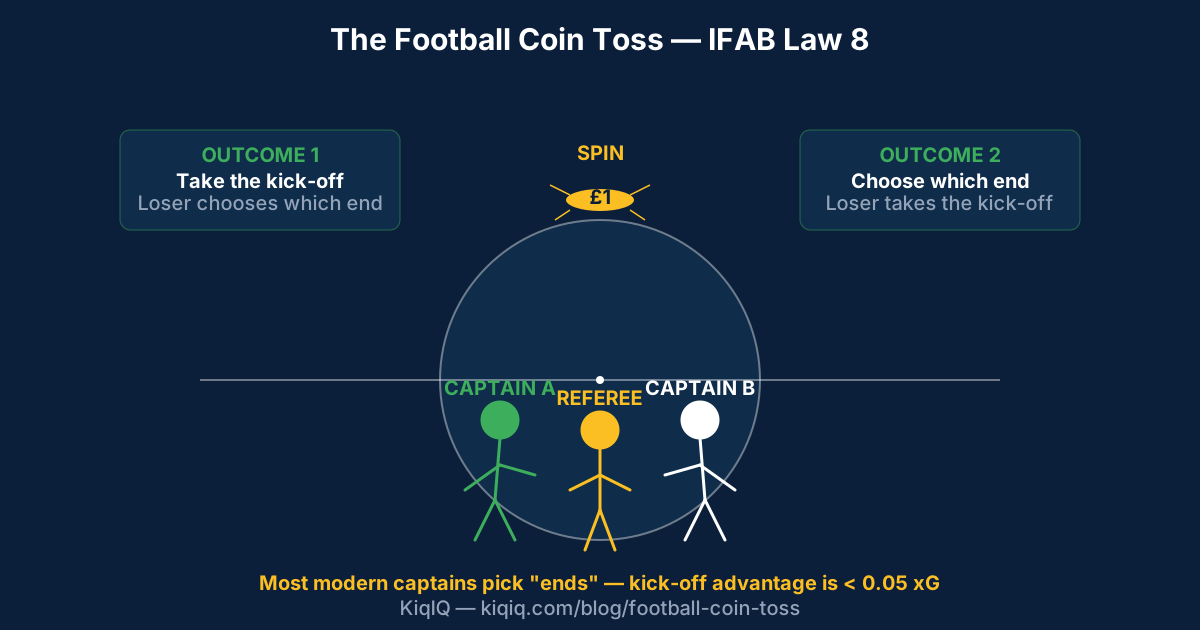
The football coin toss is the pre-match ritual where two team captains meet the referee in the centre circle and a coin is flipped. The winning captain chooses either to take the kick-off or to choose which end of the pitch their team attacks first. The other captain gets the remaining choice. It is a moment that lasts under 30 seconds but can shape the first half of the match.
What the coin toss actually decides
Under IFAB Law 8 (The Start and Restart of Play), the coin toss decides one of two things — not both:
- Option 1 — Kick-off. The winning captain elects to take the kick-off in the first half. The losing captain then chooses which end of the pitch their team attacks (the "ends" choice).
- Option 2 — Ends. The winning captain elects which end their team attacks in the first half. The losing captain then takes the kick-off.
The winning captain doesn't get both. They get one choice — kick-off OR ends. The losing captain takes the leftover.
Why the ends choice matters more than kick-off
Kick-off doesn't confer much advantage. The team kicking off plays the ball from the centre, but possession is rarely retained for long — most kick-offs are passed back and the team has the ball at midfield, with no special positional benefit.
Ends, however, can matter significantly:
- Wind direction. A strong wind toward one goal can affect long-range shots, goal kicks, and crosses. A captain often picks ends to play *into* the wind in the first half (so they have the wind behind them in the second half when fatigue matters more).
- Sun position. In an early-evening kick-off, sun in a goalkeeper's eyes can be a real factor. Picking ends to put the sun behind the team in the first half is common.
- Slope. Some pitches (notably Yeovil's old ground) have a measurable slope. Picking the downhill direction first lets you build a lead before the harder second half.
- Crowd location. Some captains prefer to attack toward their own fans in the second half (when goals matter more for closing out wins). They pick ends to attack the away end first.
Why most modern captains pick "ends"
Nearly all modern captains in professional football pick ends rather than kick-off. The reason is statistical: kick-off advantage is negligible (modelled at < 0.05 expected goals over the match), but the second-half ends choice can be tactically meaningful, especially with weather or sun in play.
Only when conditions are perfectly neutral and the captain is genuinely indifferent does kick-off become a defensible choice. A few captains pick kick-off to assert ceremonial dominance — a 'we'll start the match' signal — but that's superstition, not strategy.
The second-half switch
At half-time, the teams switch ends. The captain who didn't kick off in the first half now does in the second. So the kick-off and ends choices reset — both captains will have had one of each by full-time.
This 50/50 split of conditions across the two halves is what the laws preserve. Neither team gets a full-match weather or sun advantage; whatever benefit one side has in the first half, the other gets in the second.
Coin tosses for tournaments and shootouts
The coin toss has a different role in two specific contexts:
- Penalty shoot-outs. In a knockout shoot-out, a separate coin toss decides which goal the shoot-out is taken at AND which team takes the first kick. The first-kick advantage is measurable (~58% win rate historically), so the toss carries real consequence.
- Tournament group-stage tiebreakers. When teams are level on points, goal difference, head-to-head, and goals scored — a coin toss can be the final tiebreaker for advancement. Used most famously in the 1968 European Championship semi-final between Italy and the Soviet Union (Italy won the toss and went through).
Coin-toss customs and superstitions
Various customs surround the toss. The home captain typically calls (often heads or tails on the local currency). FIFA World Cup matches use a special tournament coin. Some referees flip the coin while others let one captain do it. The Premier League uses a specific protocol where the referee flips and one captain calls in mid-air.
Superstitions abound: some captains never call heads, others always call after looking at the coin face-up, others insist on flipping themselves. Wayne Rooney famously preferred to call last so he could see if his opposite number had a tell.
Frequently asked questions
- What does the coin toss decide in football?
- The coin toss decides one of two things — not both. The winning captain chooses either to take the kick-off in the first half, OR which end their team attacks first. The losing captain takes the remaining option.
- Why do captains usually pick ends rather than kick-off?
- Kick-off advantage is statistically negligible (< 0.05 expected goals over the match). The ends choice, by contrast, can be tactically meaningful — picking to play into wind or sun first means having those conditions favourable in the second half when fatigue matters more.
- Does the coin toss decide who takes the first penalty in a shoot-out?
- Yes — a separate coin toss before a penalty shoot-out decides which team takes the first kick (and at which goal). The first-kick advantage is measurable historically, with the team kicking first winning roughly 58% of shoot-outs. The IFAB has experimented with alternating-order rules to remove the bias.
- Has a coin toss ever decided a major tournament match?
- Yes. The most famous case is the 1968 European Championship semi-final between Italy and the Soviet Union. After 0-0 and no penalty shoot-outs at the time, the captains went to a coin toss. Italy won the toss and advanced — they went on to win the tournament. UEFA introduced penalty shoot-outs partly in response.
References
- IFAB Laws of the Game — Law 8: The Start and Restart of Play — IFAB
- Penalty Shoot-Out First-Kick Advantage Research — Journal of Sports Sciences
- Italy vs USSR 1968 — The Coin-Toss Semi-Final — UEFA
- The Athletic — Why Captains Choose Ends — The Athletic
Key terms in this article
Ask KiqIQ a follow-up
Get a live, data-driven answer powered by api-football + KiqIQ's Poisson model. Try one of these prompts or write your own.
Part of pillar
Football Culture
See every article in this knowledge pillar →
Related
Reviewed by a KiqIQ editor before publication. Spotted an error? Email editor@kiqiq.com — we follow our Corrections Policy.