
North London Football Teams: A Complete Guide to the Clubs
North London is home to two Premier League giants — Arsenal and Tottenham Hotspur — plus a dozen non-league and grassroots clubs. We map them, their grounds, and the North London Derby.
 Tap to enlarge
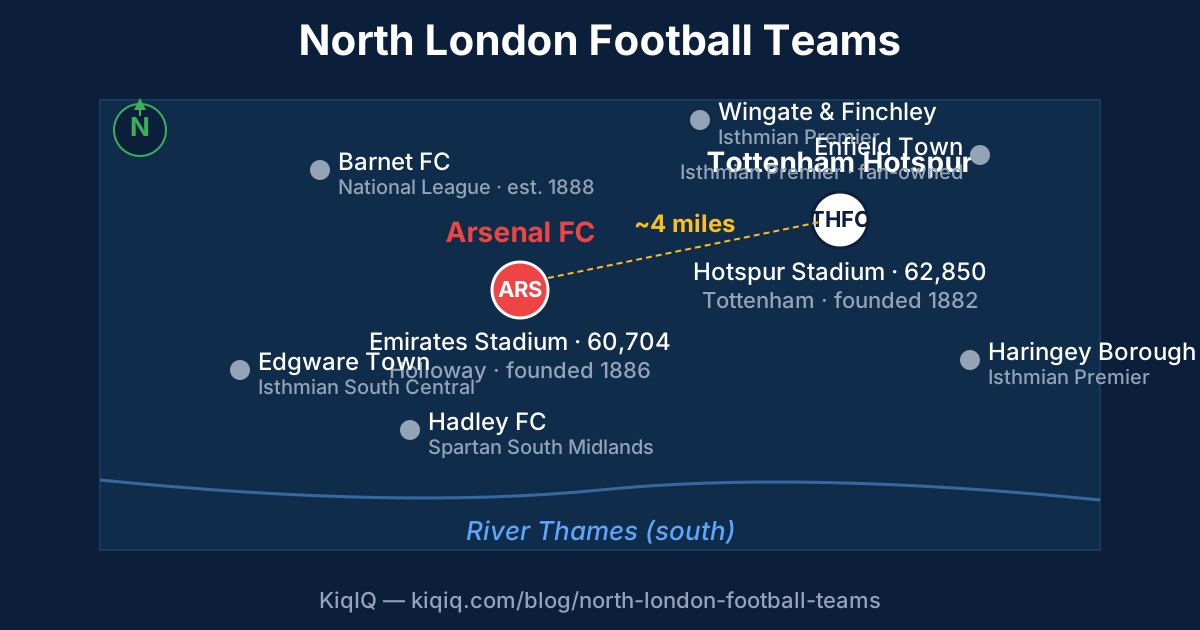
North London is home to two Premier League giants — Arsenal (founded 1886) and Tottenham Hotspur (founded 1882) — plus a network of non-league, semi-pro, and grassroots clubs. The two big clubs are roughly four miles apart and contest the North London Derby, one of English football's most fiercely contested rivalries.
Arsenal
Arsenal Football Club was founded in 1886 in Woolwich, South London, as Dial Square. The club moved to Highbury in North London in 1913 and have remained in the area since. They moved from Highbury to the Emirates Stadium (60,704 capacity) in 2006.
Arsenal are based in Holloway, in the London Borough of Islington. They are 13-time English league champions, the most recent title in 2003-04 (the unbeaten Invincibles season). They have won the FA Cup a record 14 times and reached the Champions League final in 2006.
Tottenham Hotspur
Tottenham Hotspur was founded in 1882 — predating Arsenal by four years. They have always been based in the Tottenham area of the London Borough of Haringey. They moved from White Hart Lane to the Tottenham Hotspur Stadium (62,850 capacity) in 2019.
Tottenham have won the league title twice (1950-51, 1960-61) and the FA Cup eight times. They were the first British club to win a European trophy (the 1963 Cup Winners' Cup) and reached the Champions League final in 2019.
The North London Derby
Arsenal vs Tottenham is one of English football's defining rivalries. The two clubs are separated by roughly four miles. The first North London Derby was contested in 1887 (when Arsenal were still in Woolwich); the modern rivalry intensified after Arsenal's controversial 1919 First Division promotion ahead of Tottenham, who finished above them in the previous Second Division season.
Arsenal lead the all-time Premier League head-to-head, but recent seasons have been more competitive. The fixture is one of the few Premier League matches that retains its derby intensity into the modern era — almost every meeting features yellow cards, late drama, or controversy.
The North London Derby has produced 11 red cards in Premier League era and 5+ goals in 8 of the last 20 meetings. It is the highest-tension fixture on Arsenal's and Tottenham's calendars.
Non-league and grassroots clubs in North London
Beyond the two Premier League sides, North London hosts a thriving network of non-league clubs:
- Barnet FC. Hendon-based, plays in the National League. Historic club, founded 1888.
- Wingate & Finchley. Plays in the Isthmian League Premier Division. Notable for its Jewish heritage and community focus.
- Haringey Borough. Plays in the Isthmian Premier; based in Tottenham.
- Enfield Town. Plays in the Isthmian Premier; one of the first fan-owned clubs in England.
- Edgware Town. Plays in the Isthmian South Central; community-focused.
- Hadley FC. Plays in the Spartan South Midlands League.
Grounds geography
A North London football pilgrimage map covers a roughly 10-mile area. From south to north: Emirates Stadium (Arsenal, Holloway, N7); Tottenham Hotspur Stadium (Tottenham, N17); The Hive (Barnet's old ground at Edgware before they relocated); Bishop's Stortford grounds further out.
Public transport to both Premier League grounds is well-served. Emirates Stadium is closest to Arsenal Underground (Piccadilly Line) and Highbury & Islington (Victoria Line + Overground). Tottenham Hotspur Stadium is served by White Hart Lane Overground and Northumberland Park.
North London football culture
The two big clubs have distinct cultural identities. Arsenal's identity is intertwined with Highbury and Islington — a borough that has gentrified significantly since the 1980s. The fan base skews more middle-class and globally distributed; the Emirates is one of football's most-international stadiums by attendance.
Tottenham's identity remains rooted in the working-class history of Tottenham proper. The club's Jewish-supporter heritage (the term "Yid Army" is contested but historically used by Spurs fans in defiance of opposition antisemitic chants) is a defining cultural marker.
Both fan bases produce some of the loudest atmospheres in English football. The North London Derby is the moment that culture peaks.
Frequently asked questions
- What are the main football teams in North London?
- The two main clubs are Arsenal (founded 1886, based in Holloway, Emirates Stadium) and Tottenham Hotspur (founded 1882, based in Tottenham, Tottenham Hotspur Stadium). Both currently play in the Premier League. North London also hosts non-league sides including Barnet FC, Wingate & Finchley, Haringey Borough, and Enfield Town.
- How far apart are the Arsenal and Tottenham stadiums?
- The Emirates Stadium and Tottenham Hotspur Stadium are roughly four miles apart in a straight line. Both are in north London — Arsenal in the London Borough of Islington (Holloway) and Tottenham in the London Borough of Haringey (Tottenham proper).
- When did the North London Derby start?
- The first North London Derby was contested in November 1887, when Arsenal were still based in Woolwich. The rivalry intensified after Arsenal's controversial 1919 promotion to the First Division, when they were placed in the top flight ahead of Tottenham despite finishing below them in the previous Second Division season.
- Are there other professional clubs in North London?
- Barnet FC plays in the National League — the fifth tier of English football. Wingate & Finchley, Haringey Borough, and Enfield Town play in the Isthmian Premier Division (seventh tier). Below those, there are dozens of grassroots clubs in the Spartan South Midlands and other regional leagues.
References
- Arsenal FC History — Arsenal FC
- Tottenham Hotspur Club History — Tottenham Hotspur
- The North London Derby — A Cultural History — BBC Sport
- English Non-League Football Pyramid — The Football Association
Ask KiqIQ a follow-up
Get a live, data-driven answer powered by api-football + KiqIQ's Poisson model. Try one of these prompts or write your own.
Part of pillar
Football Culture
See every article in this knowledge pillar →
Related
Reviewed by a KiqIQ editor before publication. Spotted an error? Email editor@kiqiq.com — we follow our Corrections Policy.