
Diving in Football: Meaning, Rules, and Why It Persists
Diving in football — also called simulation — is the act of feigning a foul to win a free kick, penalty, or get an opponent booked. We explain the rules, the punishments, and why it persists.
 Tap to enlarge
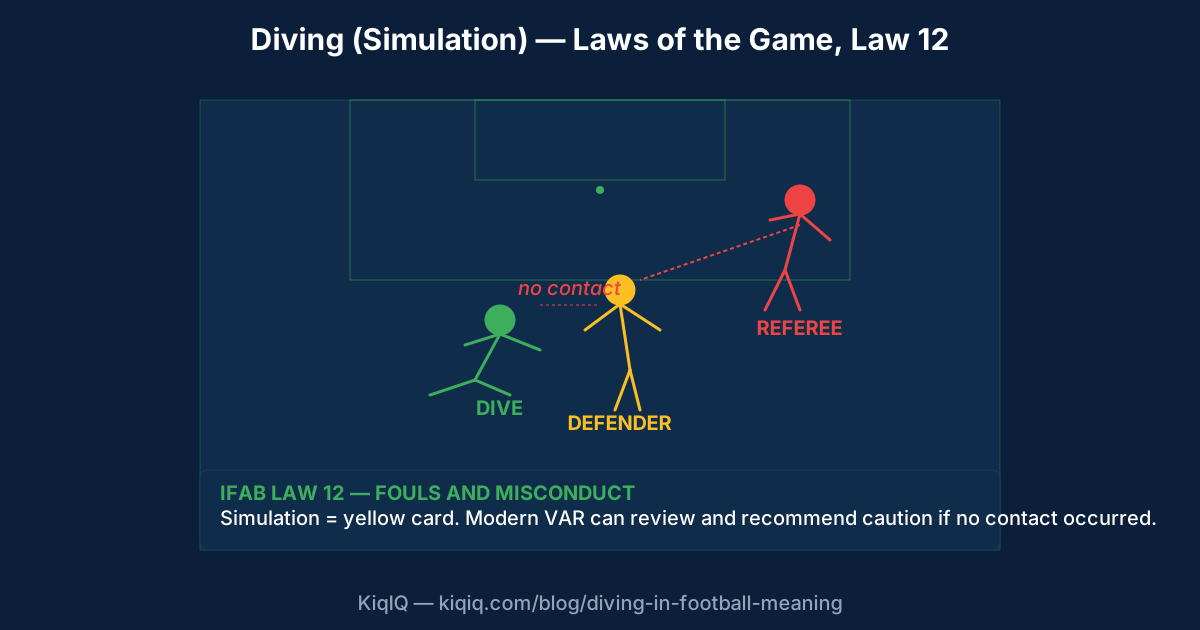
Diving in football — formally called simulation in the Laws of the Game — is when a player feigns or exaggerates contact to deceive the referee into awarding a free kick, penalty, or yellow card to an opponent. It is a yellow-card offence under IFAB Law 12. Despite that, it persists because the cost-benefit ratio for the diver remains favourable in many situations.
What the Laws of the Game say
Under IFAB Law 12 (Fouls and Misconduct), simulation is one of seven yellow-card offences. The exact wording: "attempting to deceive the referee, e.g. by feigning injury or pretending to have been fouled (simulation)."
In practice, "simulation" covers three behaviours: a clear dive (no contact at all), an exaggerated reaction to minimal contact, and feigning injury after a legitimate but trivial contact. All three are technically yellow-card offences.
Why diving persists
The economics of diving favour the diver. A successful penalty conversion is worth ~0.76 expected goals. A successful dive that leads to a penalty earns ~0.7 xG in expectation. A failed dive that gets booked costs the booked player roughly 0.05 xG worth of caution effects.
On those numbers a player who succeeds at converting half their dives is rational to keep diving. This is why diving has not declined despite increased post-match VAR review and TV scrutiny — the in-match incentives still reward the behaviour.
VAR has reduced penalty-area dives somewhat, but theatrical reactions outside the box (where VAR review is rare) have arguably increased.
How VAR has changed diving
Since VAR introduction (2018-19 in major leagues), penalty-area dives have come under heavier scrutiny. VAR can review penalty awards and recommend a yellow card for simulation if no contact occurred. Statistically, the success rate of penalty-area dives has dropped — but theatrical reactions outside the box, particularly in midfield, remain hard to police.
Two unintended VAR consequences: players now hold their faces after minor head contact (which gets VAR involvement faster), and players who do not go down even when fouled are sometimes punished by referees who prefer to let play continue if the attacker stays up. The "honest player" tax is real.
Famous diving incidents
Three high-profile examples illustrate the spectrum:
- Jürgen Klinsmann's response. When accused of constant diving as a Tottenham striker (1994-95), Klinsmann scored a goal and theatrically dived to celebrate it, defusing the controversy with humour.
- Rivaldo at the 2002 World Cup. Held his face after the ball clearly hit his thigh in a Brazil-Turkey match. Got Hakan Ünsal sent off. Subsequently fined by FIFA.
- Cristiano Ronaldo at Real Madrid. Frequently accused of going down easily in his early years; managed to flip the narrative by 2018-22 when his "stays-on-feet" finishing became a praised attribute. Player development matters.
Diving and culture
Diving is culturally framed differently across countries. English football historically treated it as the worst sin a player could commit, framing it as moral cowardice. Italian and Spanish football accepted it as part of the gamesmanship — "furbizia" in Italian translates as cleverness, and includes diving.
These cultural lines have blurred. The Premier League now has plenty of British divers; Italian football has cleaned up significantly under stricter refereeing standards. The economics — not the culture — drive the behaviour.
How can diving be reduced?
Three policy levers, each with trade-offs:
- Retrospective bans. Some leagues (Premier League since 2017, Bundesliga more recently) review post-match and ban offenders for 1-2 matches. Effective at deterrence; criticised for inconsistent application.
- Stricter VAR. Lowering the threshold for VAR-recommended yellow cards on simulation. Has reduced penalty dives; less effective for outside-the-box theatrics.
- No-call advantage tax. Some have proposed treating clear dives as yellow cards plus a one-step territory penalty against the diving team. No major league has implemented.
Frequently asked questions
- What does diving mean in football?
- Diving — formally called simulation — is when a player feigns or exaggerates contact to deceive the referee into awarding a free kick, penalty, or yellow card to an opponent. It is a yellow-card offence under IFAB Law 12 (Fouls and Misconduct).
- What is the punishment for diving?
- A yellow card under IFAB Law 12 if detected by the referee in real time. Some leagues (Premier League since 2017) also apply retrospective 1-2 match bans after panel review of clear simulations missed by referees. VAR can review penalty-area incidents and recommend cautions.
- Why do players still dive?
- The cost-benefit ratio still favours the diver. A successful penalty is worth ~0.76 expected goals; a successful dive in the box yields ~0.7 xG in expectation. Yellow cards for simulation cost the booked player roughly 0.05 xG worth of caution effects. Players who convert even half their dives are rational to keep doing it.
- Has VAR reduced diving in football?
- It has reduced penalty-area dives in major leagues — VAR can review and recommend yellow cards for simulation when no contact occurred. But theatrical reactions outside the penalty area, where VAR is rarely consulted, remain hard to police and may have increased.
References
- IFAB Laws of the Game — Law 12 — IFAB
- Premier League Retrospective Action Panel — Premier League
- VAR Effects on Penalty Decisions — The Athletic
- Football and the Economics of Diving — The Analyst
Key terms in this article
Ask KiqIQ a follow-up
Get a live, data-driven answer powered by api-football + KiqIQ's Poisson model. Try one of these prompts or write your own.
Part of pillar
Football Culture
See every article in this knowledge pillar →
Related
Reviewed by a KiqIQ editor before publication. Spotted an error? Email editor@kiqiq.com — we follow our Corrections Policy.