
What Happens If a Goalkeeper Gets a Red Card?
If a goalkeeper is sent off, the team must put a substitute keeper in goal — usually swapping out an outfielder. We explain the rules, the famous incidents, and the rare emergency-keeper scenarios.
 Tap to enlarge
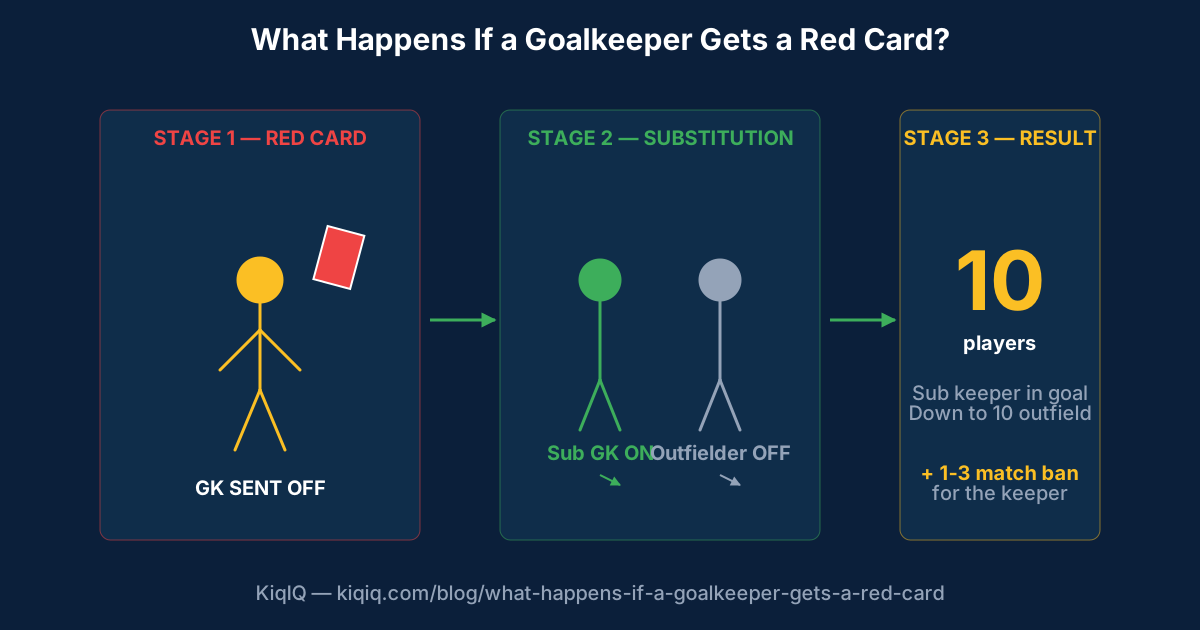
If a goalkeeper is sent off (red card) during a football match, the team must put a substitute goalkeeper in goal. The team is reduced to 10 players because an outfielder must be substituted off to make room for the substitute keeper. The sent-off goalkeeper serves an immediate suspension (typically 1-3 matches depending on the offence), and any goals conceded after the red card count as normal.
The standard procedure
When a goalkeeper is sent off:
- The referee shows the red card. The keeper must leave the field immediately — they cannot return.
- The manager makes a substitution. A substitute goalkeeper comes on; an outfield player goes off. This counts as one of the team's permitted substitutions for the match (max 5 in most modern competitions).
- The team plays with 10 players. The dismissed keeper's team plays the rest of the match a player short.
- The substitute keeper takes the position. They wear the keeper jersey and gloves; they have the goalkeeper's rights (handle the ball in the area, etc.).
- Goals conceded count. Any goals after the red card count as the substitute keeper's; the dismissed keeper has no further match involvement.
An outfielder *must* go off, even if the manager doesn't want to make a tactical substitution. This is the rule — the team plays with 10, with one of those 10 being a goalkeeper.
When a team has used all subs
If a team has already used all their substitutions and the goalkeeper is sent off, an outfield player must go in goal. They wear a goalkeeper jersey and gloves but have no time to prepare. This is the "emergency keeper" scenario.
Famous emergency-keeper moments include: Cesc Fàbregas going in goal for Barcelona in 2010 vs Hércules; John O'Shea going in goal for Manchester United in 2007 vs Tottenham (he saved the resulting penalty). The emergency keeper has the same rights as a goalkeeper but typically lacks any goalkeeping training — most concede multiple goals.
The post-match suspension
A goalkeeper red card carries the same automatic suspensions as any outfield red card:
- Standard 1-match ban — for accumulating two yellow cards in the match (second-yellow → red).
- Standard 1-match ban — for serious foul play.
- Standard 3-match ban — for violent conduct.
- Match-specific extensions. A "professional foul" (denying a goal-scoring opportunity, or DOGSO) is now typically just a yellow if the keeper made a genuine attempt for the ball — the 2016 IFAB rule change. Otherwise it's a 1-match ban.
The "denying an obvious goal-scoring opportunity" (DOGSO) rule
Under IFAB Law 12, a goalkeeper can be sent off for DOGSO — handling the ball outside the area, fouling an attacker through-on-goal, or otherwise denying a goal-scoring chance. Until 2016, this was an automatic red.
The 2016 IFAB amendment changed this: if the keeper made a genuine attempt to play the ball, the punishment is now a yellow card + a free kick (or penalty if inside the area). This change was made to reduce the "triple punishment" of penalty + red + suspension. Outside-the-box fouls remain straight reds.
Famous goalkeeper red cards
Five recent high-profile goalkeeper red cards:
- Vincent Janssen (Tottenham) → David De Gea's save (2017). A late winner from a goalkeeper red-card-induced reshuffle.
- Jordan Pickford (Everton) vs Liverpool 2020. Yellow upgraded to red after VAR review for endangering an opponent.
- Asier Riesgo (Real Sociedad) 2010. Sent off for handball outside the area in a Champions League match.
- Karl Darlow (Newcastle) 2019. Sent off for a deliberate handball outside the area against Crystal Palace — the team played 75 minutes with 10 men.
- Caoimhin Kelleher (Liverpool) 2024. Sent off for a foul on a through-ball; Liverpool used substitute keeper Adrián.
Tactical implications
A goalkeeper red card is among the worst tactical events in a match for three reasons:
- Loss of an outfielder to make room. The team is now down to 10, AND the outfielder removed is typically a creative or attacking player (managers prioritise keeping defensive shape).
- Loss of distribution. The substitute keeper is often less comfortable with the build-up patterns the team has been using. Pep-style possession football collapses with a backup keeper.
- Loss of communication. The first-choice keeper directs the back-line constantly. A substitute does not have the same trust or rapport.
- Loss of confidence. Teams often concede more goals after a goalkeeper red card than the simple 10v11 disadvantage would predict.
Frequently asked questions
- What happens when a goalkeeper gets a red card?
- The goalkeeper must leave the field immediately. The manager substitutes a backup keeper in (using one of the team's permitted substitutions, typically 5 max). An outfield player must come off to make room — the team plays the rest of the match with 10. The dismissed keeper serves a 1-3 match ban depending on the offence.
- Can an outfield player go in goal after a goalkeeper red card?
- Only if the team has used all its substitutions. In normal circumstances, a substitute keeper comes on and an outfielder goes off. If subs are exhausted, an outfielder takes over goalkeeping duties wearing a keeper jersey and gloves. They have the same goalkeeper rights but no goalkeeping training.
- What's the suspension for a goalkeeper red card?
- Same as any other red card: 1-match ban for second-yellow or serious foul play; 3-match ban for violent conduct. The 2016 IFAB rule change means a goalkeeper who makes a genuine attempt for the ball but fouls an attacker through-on-goal in the area now receives a yellow + penalty rather than a red — reducing the "triple punishment" of penalty + red + suspension.
- Why is a goalkeeper red card especially tactically damaging?
- Three reasons: an outfielder must come off to make room (the team loses the outfielder AND a player overall), the substitute keeper is less familiar with the team's build-up patterns (Pep-style possession football collapses with a backup), and the keeper's match-day communication with the back-line drops sharply. Statistically, teams concede more goals after a goalkeeper red card than the simple 10v11 disadvantage would predict.
References
- IFAB Laws of the Game — Law 12 + Law 5 — IFAB
- DOGSO Rule Update 2016 — IFAB
- Premier League Disciplinary Procedures — Premier League
- Goalkeeper Red-Card Statistical Analysis — The Analyst
Key terms in this article
Ask KiqIQ a follow-up
Get a live, data-driven answer powered by api-football + KiqIQ's Poisson model. Try one of these prompts or write your own.
Part of pillar
Fundamentals
See every article in this knowledge pillar →
Related
Reviewed by a KiqIQ editor before publication. Spotted an error? Email editor@kiqiq.com — we follow our Corrections Policy.