
Footgolf Explained: Rules, Scoring, and Where to Play
Footgolf combines football and golf — kick a size-5 ball into oversized golf-style holes in fewest strokes. We cover the rules, scoring, etiquette, and how to find a course.
 Tap to enlarge
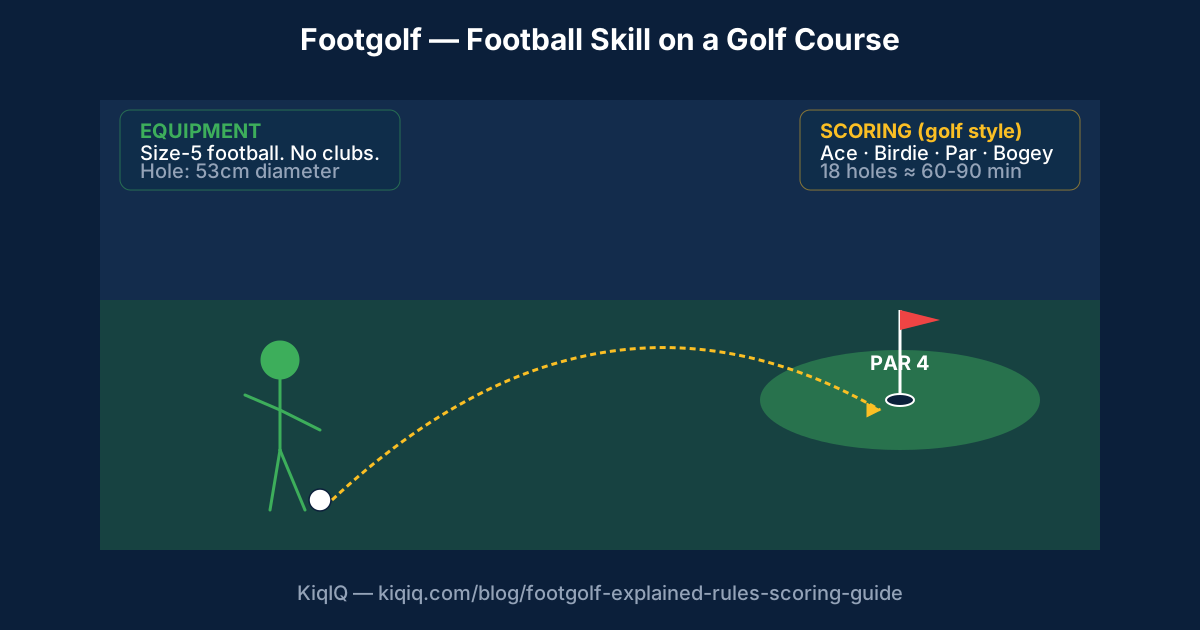
Footgolf is a hybrid sport combining football and golf. Players kick a size-5 football toward 53-centimetre-diameter holes on a modified golf course, aiming to complete 9 or 18 holes in the fewest strokes. The Federation for International FootGolf (FIFG) governs the sport globally; the British Footgolf Federation runs the UK competitive circuit. Most golf courses now offer footgolf-modified rounds for casual play.
Footgolf rules in one minute
Footgolf rules borrow from both parent sports:
- Equipment: A standard size-5 football. No clubs.
- Course: 9 or 18 holes on a modified golf course. Holes are 53cm diameter — larger than a regular golf hole, smaller than a football goal.
- Tee shots: From a marked tee. Players must keep the ball moving forward toward the green.
- Penalties: Out-of-bounds shots add a stroke. Water hazards add a stroke and require dropping at the entry point.
- Putting: From the green, kicks must roll the ball into the hole. No flicks or chips on the green.
- Scoring: Lowest total strokes wins. Pars on a footgolf hole are typically 3-4 strokes.
A footgolf round takes 60-90 minutes for 18 holes — about half the time of a golf round, because the ball travels much further per kick than per club shot.
How long is a footgolf course?
Footgolf courses are shorter than golf courses but longer than mini-golf:
- Total length for 18 holes: typically 1,800-2,400 metres (vs ~6,000m for golf).
- Hole length: 50-200 metres each.
- Course time: 60-90 minutes for 18 holes.
- Par: Total course par is usually 60-72 for 18 holes.
Footgolf scoring
Standard golf scoring terms apply:
- Hole-in-one (ace): 1 stroke. Rare but possible on short par-3 holes.
- Eagle: 2 strokes under par. Usually requires a hole-in-one on a par-3 or a brilliant approach on a par-5.
- Birdie: 1 stroke under par.
- Par: Equal to par. The standard score.
- Bogey: 1 stroke over par.
- Double bogey: 2 strokes over par.
Who plays footgolf
Three demographics dominate:
- Casual recreational players. The biggest group. People who like football but don't want to commit to a full football match. Birthday parties, work outings, family days.
- Former footballers. Players who can't play full football because of age or injury. The slower pace + no impact + outdoor walking is appealing.
- Competitive footgolfers. Smaller group of dedicated players who play in the BFF (UK) or FIFG (international) competitive circuit. Tournaments are typically free to enter or low-cost.
Footgolf etiquette
Footgolf etiquette borrows heavily from golf:
- Quiet during shots. Don't talk while another player is preparing to strike.
- Repair your divots. Replace any turf you displace.
- Walk between shots. Most footgolf courses are walking-only (no carts).
- Pace of play. Keep moving. A group of four should clear a hole in 8-10 minutes.
- Don't play through other players unless invited.
Where to play
Three pathways to play:
- Standard golf courses with footgolf hours. Many regular golf courses now offer footgolf rounds in late afternoon / evening when golfers have finished. Search "footgolf" + your city.
- Dedicated footgolf courses. Some venues are footgolf-only. The UK has 50+ dedicated courses; the USA has 200+; Brazil has hundreds.
- Tournament play. The British Footgolf Federation runs UK tournaments. The Federation for International FootGolf (FIFG) runs continental and world events. The FootGolf World Cup happens every 2-3 years.
How footgolf differs from football
Footgolf isn't football with kicking-only rules. It's a separate sport that uses a football. Three differences:
- Distance is more important than speed. A great footgolfer can put a ball 80-100 metres from a single tee shot. Pace matters less than swing technique.
- Approach control. The skill of making the ball stop near the hole — far harder than just kicking it long.
- Mental discipline. Like golf, footgolf is a mental game. A bad tee shot doesn't cause a fast counter-attack — but it does add strokes that follow you all round.
Frequently asked questions
- What is footgolf?
- Footgolf is a hybrid sport combining football and golf. Players kick a size-5 football toward 53-centimetre-diameter holes on a modified golf course, aiming to complete 9 or 18 holes in the fewest strokes. Standard golf scoring terms apply (par, birdie, eagle, bogey). The Federation for International FootGolf (FIFG) governs the sport globally.
- How many strokes is a footgolf par?
- A par on a footgolf hole is typically 3-4 strokes (vs 3-5 for golf). Total course par for an 18-hole footgolf round is usually 60-72. A complete 18-hole round takes 60-90 minutes — about half the time of a golf round because the ball travels further per kick than per club shot.
- Where can I play footgolf?
- Many regular golf courses now offer footgolf rounds in late afternoon / evening hours. The UK has 50+ dedicated footgolf courses; the USA has 200+; Brazil has hundreds. Search "footgolf" plus your city to find local options. The British Footgolf Federation runs the UK competitive circuit; the FIFG runs international tournaments.
- Is footgolf hard?
- Footgolf is easier than golf for most beginners (size-5 football is easier to control than a small golf ball with a club) but harder than people expect for distance precision. The scoring is similar to mini-golf for casual players (5-15 over par for a round) but committed competitors aim for under-par scoring across 18 holes.
References
- Federation for International FootGolf (FIFG) — FIFG
- British Footgolf Federation — BFF
- Footgolf Rules Reference — Wikipedia (verified)
- Hybrid Sports Growth Research — Sport Management Research
Key terms in this article
Ask KiqIQ a follow-up
Get a live, data-driven answer powered by api-football + KiqIQ's Poisson model. Try one of these prompts or write your own.
Part of pillar
Football Culture
See every article in this knowledge pillar →
Related
Reviewed by a KiqIQ editor before publication. Spotted an error? Email editor@kiqiq.com — we follow our Corrections Policy.