

What Is Offside in Football? The Rule, Examples, and Edge Cases
Offside in football is a Law 11 rule preventing attackers from gaining unfair advantage by being beyond the second-last defender at the moment a teammate plays the ball. We explain it with examples.
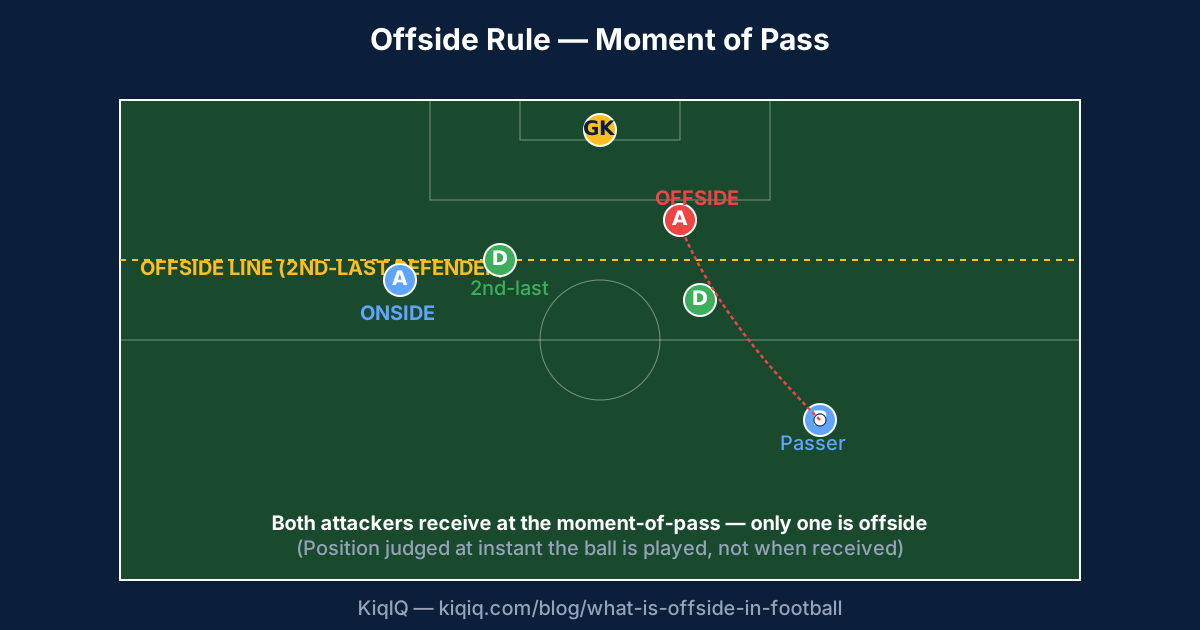
Offside in football is a Law 11 rule that prevents attackers from gaining an unfair advantage by being too close to the opposition goal at the moment a teammate plays the ball. An attacker is offside if any part of their body that can score (head, body, feet) is closer to the goal than both the ball and the second-last defender at the moment-of-pass — and they then become involved in active play.
The exact rule (Law 11)
IFAB Law 11 has two halves. Position and involvement. A player is in an offside position if all three of these are true at the moment a teammate plays the ball:
- They are in the opposition half. A player cannot be offside in their own half.
- They are closer to the goal-line than the ball. Level with the ball is not offside.
- They are closer to the goal-line than the second-last defender (which is typically the deepest defender excluding the goalkeeper).
Being in an offside position is NOT in itself an offence. The player must then become involved in active play — receiving the ball, interfering with an opponent, or gaining advantage from being there.
When offside is NOT called
Even an attacker in an offside position can avoid being penalised in three situations:
- Goal kick. No player can be offside from a goal kick.
- Throw-in. No player can be offside from a throw-in.
- Corner kick. No player can be offside from a corner kick.
How "involvement" is judged
Three forms of involvement that turn an offside position into an offence:
- Receiving the ball. The most obvious — the attacker plays / touches the ball after a teammate played it.
- Interfering with an opponent. Blocking the goalkeeper's line of sight, challenging an opponent, or making a movement that affects an opponent's ability to play the ball.
- Gaining advantage. A typical example: an attacker in an offside position rebounds off the post or off a defender, then plays the ball — they have gained advantage.
The moment-of-pass principle
Offside is judged at the moment the ball is played by a teammate — not the moment the receiver plays it. This is the most-misunderstood part of the rule.
Example: An attacker is in an onside position when their teammate kicks the ball, then runs into an offside-position area to receive it. This is NOT offside — they were onside at the moment-of-pass.
Sammy Nuñez of FIFA reformulated the offside graphics for VAR in 2018 to emphasise the moment-of-pass timestamp. SAOT (Semi-Automated Offside Technology) automates this for elite tournaments.
Common offside scenarios
Five offside scenarios fans should recognise:
- Through-ball offside. A through-ball is played to a striker who has run beyond the back line; the ref / VAR judges body parts at the moment-of-pass.
- Last-defender offside. A defender plays the attacker onside by being deeper than the attacker. If the second-last defender steps up just before the moment-of-pass, the attacker is offside.
- Phase-of-play offside. An attacker initially in offside position becomes involved later in the same phase — still offside.
- Deflected ball offside. A defender deflects a pass to an offside-position attacker. The attacker is still offside (not "played onside" by the deflection).
- Chip-over-the-defender offside. A common goal-line scenario where the attacker times their run; SAOT routinely catches small offsides here.
Offside and VAR / SAOT
How modern technology adjudicates offside:
- VAR. Manual line-drawing on a freeze-frame at the moment-of-pass. Took 60-90 seconds historically.
- SAOT (Semi-Automated Offside Technology). Multi-camera tracking + AI body-point detection automates the line at the moment-of-pass. Decisions take 25-30 seconds.
- Daylight test. Some leagues use a "daylight" margin — if there's no clear daylight between the attacker and the last defender, the on-field decision stands.
- IFAB review. IFAB has discussed introducing a "thickness" margin to avoid 1cm offsides; not yet implemented.
Offside throughout history
Three key historical changes:
- 1925. Number of defenders required between attacker and goal reduced from 3 to 2. This change is what created the modern WM formation and increased goal-scoring.
- 1990. "Level with" the second-last defender no longer counted as offside — the attacker just had to not be ahead of the line.
- 2005-2013. Definition of "active" / "interfering" tightened multiple times to make the rule simpler for referees.
- 2022. SAOT first used at a senior World Cup (Qatar 2022), automating moment-of-pass decisions.
Frequently asked questions
- What is offside in football?
- Offside is a Law 11 rule that prevents attackers from gaining unfair advantage by being too close to the opposition goal when a teammate plays the ball. An attacker is offside if any body part that can score is closer to the goal-line than both the ball AND the second-last defender at the moment-of-pass, and they then become involved in active play.
- When is a player not offside?
- A player can never be offside (1) in their own half, (2) from a goal kick, (3) from a throw-in, or (4) from a corner kick. Also, being level with the ball or with the second-last defender is not offside (changed in 1990 — previously level was offside).
- How does VAR decide offside?
- VAR draws lines on a freeze-frame at the moment a teammate plays the ball — one line through the attacker's furthest body part (excluding hands/arms), one through the second-last defender's furthest body part. If the attacker's line is closer to the goal, it's offside. SAOT (Semi-Automated Offside Technology) at elite tournaments automates this within ~25-30 seconds.
- Why is the moment-of-pass important for offside?
- Offside is judged at the exact moment the ball is played by a teammate, not the moment it's received. So an attacker who is onside when the pass is kicked, then runs forward to receive in an offside-position area, is NOT offside. This is the most commonly misunderstood part of the rule.
References
- IFAB Laws of the Game — Law 11 (Offside) — IFAB
- FIFA — VAR Protocol — FIFA
- The FA — Offside Rule Explained — The FA
- PGMOL — Premier League Match Officials — Premier League
Part of pillar
Fundamentals
See every article in this knowledge pillar →
Related
Reviewed by a KiqIQ editor before publication. Spotted an error? Email editor@kiqiq.com — we follow our Corrections Policy.