
FIFA 3D Player Avatars + SAOT at the 2026 World Cup
FIFA's 2026 World Cup will use 3D player avatars and Semi-Automated Offside Technology (SAOT) for broadcast graphics and refereeing. We explain both, the data backbone, and the implications.
 Tap to enlarge
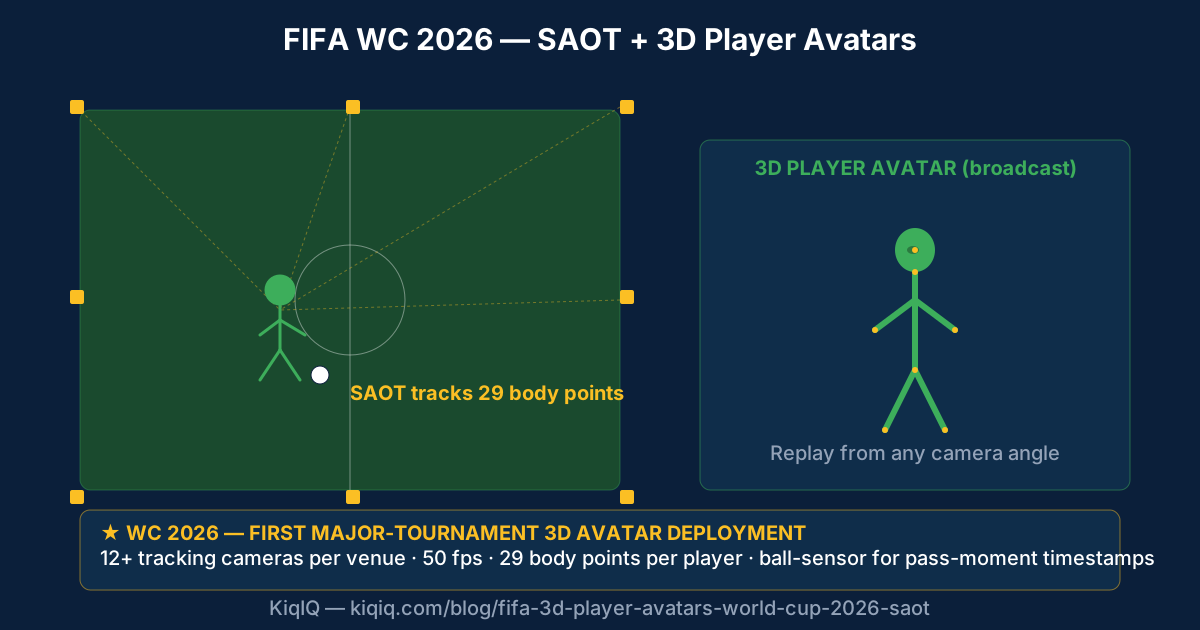
FIFA's 2026 World Cup (US, Canada, Mexico) will be the first major tournament to combine 3D player avatars for broadcast graphics with Semi-Automated Offside Technology (SAOT) for refereeing. Both rely on the same multi-camera + ball-sensor tracking infrastructure. The result: faster offside decisions, richer in-match graphics, and an unprecedented depth of broadcast data. Trialled at Qatar 2022 and Euro 2024; fully deployed at WC 2026.
What is SAOT?
Semi-Automated Offside Technology (SAOT) is FIFA-approved refereeing tech that automates offside detection:
- Multiple cameras around the stadium. Typically 12+ cameras tracking every player at 50 frames per second.
- Ball-sensor. A small sensor inside the match ball records the exact moment of contact (the moment of pass).
- Computer vision + skeletal tracking. AI tracks 29 body points per player to determine the precise position of any limb that could be offside.
- Real-time alert to VAR. When a goal is scored, SAOT replays the alleged offside moment within 25-30 seconds with the ball-pass timestamp aligned to player positions.
SAOT removes the manual line-drawing that VAR offside decisions previously required. Decisions take 25-30 seconds vs the 60-90 seconds that manual VAR averaged.
How 3D player avatars work
FIFA's 3D player avatar system uses the same tracking data for broadcast graphics:
- Player skeletons. The 29-body-point skeletal tracking from SAOT maps onto pre-built 3D avatar models for each player.
- Real-time animation. Player avatars move in 3D space matching the live match action.
- Tactical replays. Broadcasters can replay key moments from any camera angle (overhead, behind goalkeeper, sideline-low) — including angles never captured live.
- Performance metrics overlay. Sprint speed, distance covered, heart-rate-derived load indicators displayed alongside the avatar animation.
Where SAOT has been used
Major tournaments using SAOT:
- FIFA Club World Cup 2021. First competitive deployment.
- FIFA Arab Cup 2021. Wider Group-stage trial.
- FIFA World Cup Qatar 2022. First senior World Cup deployment. Several high-profile decisions.
- Euro 2024. UEFA adopted SAOT.
- FIFA Women's World Cup 2023. Used.
- FIFA World Cup 2026. Full deployment expected. 3D avatars first major-tournament use.
Stadiums + infrastructure
WC 2026 venues will all be SAOT + 3D-avatar-equipped:
- 16 venues across 3 countries. USA (11), Canada (2), Mexico (3).
- Camera infrastructure per venue. 12+ tracking cameras, plus broadcast cameras, plus sensor mounts for the ball-receiving system.
- Cost per venue. ~$8-15 million in tracking infrastructure for full SAOT + 3D avatar capability.
- Legacy use post-tournament. MLS clubs in WC 2026 venue cities will inherit the infrastructure for permanent SAOT use.
Broadcast graphics applications
3D avatars enable broadcasting features that weren't possible before:
- Tactical-board live overlay. A live tactical view showing all 22 players plus the ball in 3D, replayable from any angle.
- Player-following replays. Replay a goal from the perspective of a specific player throughout the move.
- Real-time formation analysis. Live formation visualisations evolving with the match.
- Augmented-reality stadium experience. Stadium fans see broadcast graphics overlaid on the pitch via app + AR.
Concerns and criticisms
Three recurring concerns:
- SAOT precision is millimetre-level. A 1cm offside is now a goal vs no-goal — many feel this over-rewards micro-precision.
- Player consent. Players are tracked extensively; how the data is used (and whether it can be sold to recruitment models or third parties) is contested.
- Cost barrier for lower competitions. $8-15m infrastructure means SAOT is restricted to elite tournaments. Some argue this widens the gap between elite and grass-roots refereeing standards.
Frequently asked questions
- What is SAOT in football?
- Semi-Automated Offside Technology — a FIFA-approved refereeing system that automates offside detection. Uses multiple stadium cameras tracking 29 body points per player at 50 frames per second, plus a ball-sensor recording the exact moment of pass. Reduces VAR offside decision time from 60-90 seconds (manual line-drawing) to 25-30 seconds. Trialled at Qatar 2022 and Euro 2024; fully deployed at WC 2026.
- What are 3D player avatars at the World Cup?
- Real-time 3D avatar animations of every player on the pitch, generated from the same skeletal-tracking data that powers SAOT. They enable tactical replays from any camera angle (overhead, behind goalkeeper, etc.), real-time formation visualisations, and augmented-reality stadium experiences. First major-tournament use is FIFA World Cup 2026.
- Where has SAOT been used?
- FIFA Club World Cup 2021, Arab Cup 2021, FIFA World Cup Qatar 2022, FIFA Women's World Cup 2023, Euro 2024 (UEFA adoption), and FIFA World Cup 2026 (full deployment with 3D avatars). Several Premier League and La Liga seasons have run trials. The Champions League has used SAOT since 2022-23.
- How accurate is SAOT?
- Millimetre-level accuracy in tracking 29 body points per player. The ball-sensor records the exact moment of pass to within a few milliseconds. Offside decisions are now technically more accurate than the human eye — but this has raised the question of whether 1cm offsides should be treated the same as 30cm offsides. IFAB has discussed introducing a "thickness" margin but has not implemented it.
References
- FIFA — SAOT Methodology — FIFA
- FIFA World Cup 2026 — Technology — FIFA
- IFAB Laws of the Game — VAR Protocol — IFAB
- Hawk-Eye — Tracking Technology — Hawk-Eye
Key terms in this article
Ask KiqIQ a follow-up
Get a live, data-driven answer powered by api-football + KiqIQ's Poisson model. Try one of these prompts or write your own.
Part of pillar
Data and Systems
See every article in this knowledge pillar →
Related
Reviewed by a KiqIQ editor before publication. Spotted an error? Email editor@kiqiq.com — we follow our Corrections Policy.