
How Many Players Are on a Football Team? Squad Size + On-Pitch Rules
A football team has 11 players on the pitch and a squad of typically 18-25. We explain the on-pitch rules, substitution allowances, and the difference between match-day squad and full squad.
 Tap to enlarge
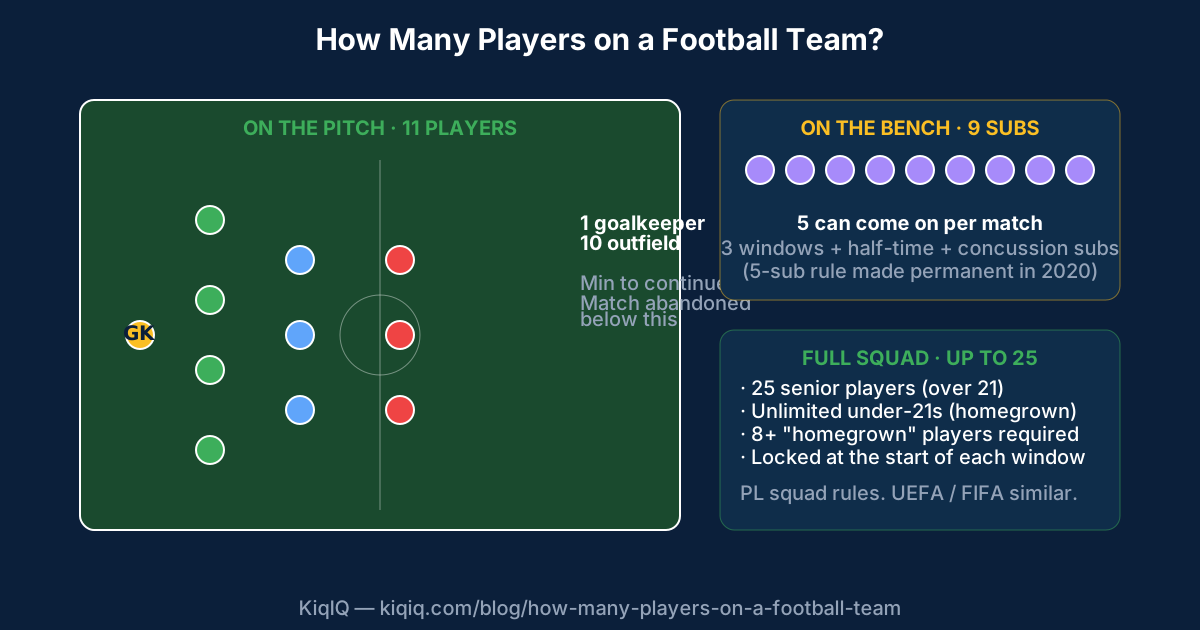
A football team has 11 players on the pitch at the start of a match — including the goalkeeper. The match-day squad typically has up to 9 substitutes on the bench (5 of whom can come on under modern rules). Most senior leagues allow a full squad of 25 players registered to play across a season. Below 7 players on the pitch, a match cannot continue and is abandoned.
On the pitch: 11 players
Per Law 3 of the IFAB Laws of the Game, a match is contested between two teams of 11 players each, including a goalkeeper.
- 1 goalkeeper. Distinguished by a different shirt colour; only player allowed to use hands inside their own penalty area.
- 10 outfield players. Distributed across defence, midfield, and attack — the exact distribution depends on the formation chosen.
- Minimum to continue. A match cannot continue if a team falls below 7 players (typically due to red cards or injuries with no substitutes available).
If a team has fewer than 7 players (e.g. multiple red cards), the match is abandoned. The result is decided by the tournament authority — usually a 3-0 forfeit win to the opposition.
On the bench: substitutes
Match-day squad sizes have grown since 2020:
- Pre-2020. Most leagues allowed 7 substitutes on the bench, of whom 3 could come on.
- 2020 IFAB rule change. Permanent change to allow 5 substitutions per team in elite competitions (Premier League adopted 2022-23).
- Modern bench. Most major leagues now allow 9 substitutes on the bench, of whom 5 can come on. Substitutions can be made in 3 stoppages plus half-time (the "3-window" rule prevents tactical disruption).
- Concussion subs. Additional substitutions specifically for concussion are permitted — separate from the standard 5.
The full squad
Beyond match-day, leagues regulate the total squad size:
- Premier League squad limit. 25 senior players over age 21, plus unlimited under-21 players who count as homegrown.
- UEFA competitions. 25-man squad lists submitted to UEFA, with home-grown player quotas (4 club-trained + 4 association-trained).
- International squads. Tournaments like the World Cup have permitted 26 players since 2022 (up from 23 historically).
- EFL Championship. No firm limit but 25-player squads are standard; younger players typically not counted.
Other formats with different team sizes
Football has multiple formats with different team sizes:
- 11-a-side. Standard adult football. Pitch ~100-110m × 64-75m.
- 9-a-side. Common at U11-U12 youth level. Smaller pitches.
- 7-a-side. Common at U7-U10 youth level + adult walking football. Pitches further reduced.
- 5-a-side. Indoor / futsal-style; high pace; shorter halves. Used at very young youth + adult casual leagues.
- 3-a-side. Used in some training drills + casual / street formats.
Goalkeeper rules
The goalkeeper has unique status in Law 3:
- Mandatory. Every team must have one goalkeeper on the pitch at all times. If the GK is injured or sent off, an outfield player must take over (or a substitute GK comes on).
- Outfield substitution permitted. A goalkeeper can be substituted by another goalkeeper without using a substitution slot if there's an injury.
- Different kit. The goalkeeper must wear a kit that distinguishes them from outfield players, opposition players, the opposition GK, and the referees.
How team-size rules differ across leagues
Some leagues / competitions have specific variations:
- MLS (USA). Specific roster rules including international slots, designated players, and roster cap of 30.
- FIFA Club World Cup. 35-player squads to manage rotation across the tournament.
- Lower leagues. Match-day squad of typically 16-18 (5 substitutes on the bench).
- Cup competitions. Sometimes allow more substitutes (e.g., 7 in extra time of a cup tie).
Frequently asked questions
- How many players are on a football team?
- A football team has 11 players on the pitch — 1 goalkeeper and 10 outfield players. The match-day squad typically has up to 9 substitutes on the bench, of whom 5 can come on per match. The full registered squad is usually capped at 25 senior players (Premier League rules), plus unlimited under-21s who count as homegrown.
- How many substitutes are allowed in football?
- Since the 2020 IFAB rule change (permanently adopted for top-flight football), teams are allowed to make 5 substitutions per match across a maximum of 3 windows plus half-time. Most leagues allow 9 substitutes on the bench. Concussion substitutions are permitted in addition to the standard 5.
- What is the minimum number of players to continue a football match?
- A match cannot continue if a team has fewer than 7 players on the pitch — meaning that with 4 or more red cards or simultaneous injuries (with no substitutes available), the match is abandoned. The result is then decided by the tournament authority, typically a 3-0 forfeit win to the opposition.
- How big is a Premier League squad?
- Premier League clubs can register up to 25 senior players (over age 21) per season, plus unlimited under-21 players who count as homegrown. Of the 25 senior slots, at least 8 must be 'homegrown' players (developed in the English / Welsh football pyramid for at least 3 years before age 21). UEFA squad rules are similar but have their own homegrown requirements.
References
- IFAB Laws of the Game — Law 3 (The Players) — IFAB
- Premier League — Squad Rules — Premier League
- FIFA — Tournament Squad Rules — FIFA
- UEFA — Squad Composition Regulations — UEFA
Ask KiqIQ a follow-up
Get a live, data-driven answer powered by api-football + KiqIQ's Poisson model. Try one of these prompts or write your own.
Part of pillar
Fundamentals
See every article in this knowledge pillar →
Related
Reviewed by a KiqIQ editor before publication. Spotted an error? Email editor@kiqiq.com — we follow our Corrections Policy.