
Football Positions Explained: Every Role on the Pitch
Football has 11 positions across goalkeeper, defence, midfield, and attack — but each can split into multiple specialised roles. We map every position with modern responsibilities and examples.
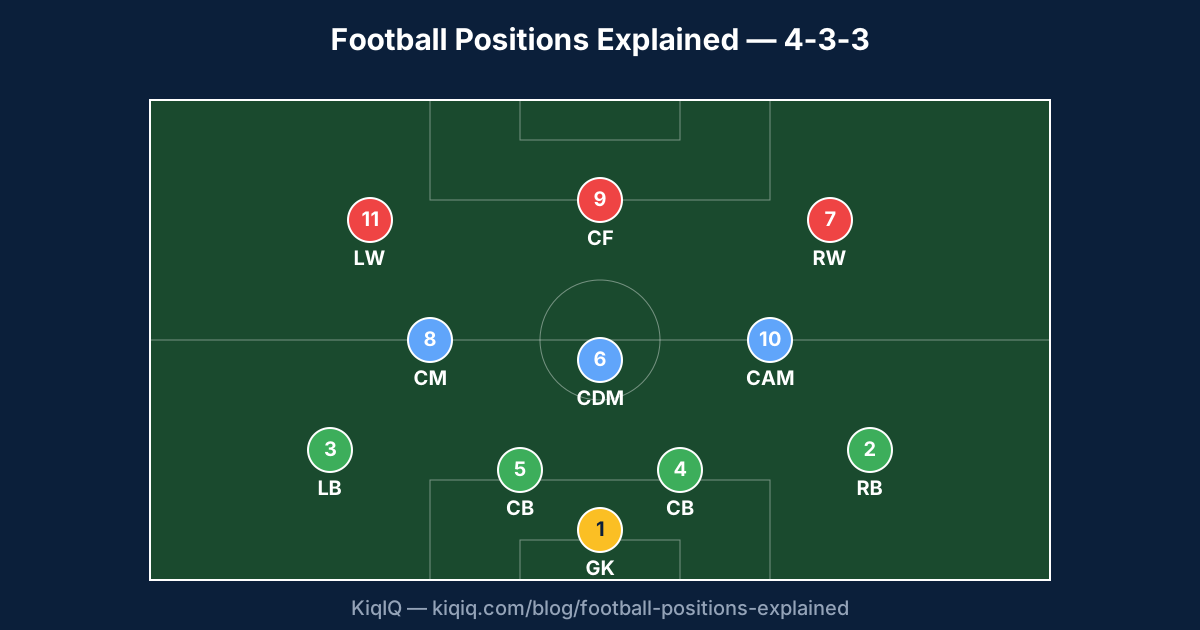 Tap to enlarge
Football has 11 starting positions split across four zones: goalkeeper, defence, midfield, and attack. Each zone subdivides into specialised roles — full-back, wing-back, centre-back, libero, holding midfielder, box-to-box, attacking midfielder, winger, inverted winger, second striker, target forward, false 9. Modern football has 12+ specialised role variants on top of the 11 classical positions.
The 4 zones of a football team
Every team — regardless of formation — splits into four zones: goalkeeper, defence, midfield, attack. Modern football has subdivided each zone into specialised roles, but the four-zone structure is universal.
- Goalkeeper. 1 player. Last line of defence; only player allowed to use hands inside the penalty area.
- Defence. Typically 4 players (back-four) or 3 players (back-three). Centre-backs + full-backs / wing-backs.
- Midfield. Typically 3 or 4 players. Distribution, ball progression, defensive screening.
- Attack. Typically 1, 2, or 3 forwards depending on formation. Goal scoring, link-up play, pressing.
Goalkeeper roles
The goalkeeper position has split into two modern variants:
- Traditional shot-stopper. Reactive — saves shots, claims crosses, controls the box. Examples: David De Gea, Kasper Schmeichel.
- Sweeper-keeper. Proactive — pushes high up the pitch, distributes from the back, acts as an outfield 11th player. Examples: Manuel Neuer, Ederson, Alisson.
The sweeper-keeper revolution since 2010 has changed goalkeeper recruitment fundamentally — distribution is now scouted as heavily as shot-stopping.
Defensive roles
Defence has six distinct modern roles:
- Centre-back (CB). The two central defenders in a back-four. Responsibilities: aerial duels, marking, blocking shots, ball-playing distribution.
- Stopper centre-back. Aggressive, physical CB who follows attackers and wins challenges. Example: Virgil van Dijk, Kim Min-jae.
- Cover centre-back. Reads play, positions deeper, provides safety net. Example: William Saliba, John Stones.
- Full-back (FB). Wide defender who supports both attack and defence. Example: Trent Alexander-Arnold, Andy Robertson.
- Wing-back (WB). A full-back in a 3-5-2 / 5-3-2 / 3-4-3 formation, with much higher attacking responsibility. Example: Reece James, Ben Chilwell.
- Libero / sweeper. A free-roaming defender behind the defensive line. Used in classical 5-3-2 systems; rare in modern football. Example: Franz Beckenbauer (historical).
Midfield roles
Midfield has the most specialisation. Modern football has at least 7 distinct midfield roles:
- Defensive midfielder (CDM). Sits in front of the back-four; screens defence; recovers loose balls. Examples: Rodri, Casemiro.
- Holding midfielder / "the 6". Same area as CDM but with more playmaking responsibility. Examples: Sergio Busquets, Declan Rice.
- Box-to-box midfielder (B2B). Covers the entire midfield; defensive cover + attacking runs. Examples: Yves Bissouma, Jude Bellingham.
- Deep-lying playmaker / regista. Drops deep, controls tempo, dictates play. Examples: Andrea Pirlo, Toni Kroos.
- Attacking midfielder (AM / "the 10"). Operates between midfield and attack; creative, takes shots, plays final pass. Examples: Kevin De Bruyne, Kai Havertz.
- Mezzala / wide-8. Free-roaming midfielder who drifts wide and arrives in the box late. Example: Henderson at Liverpool.
- Number 8. Catch-all label for box-to-box midfielders with attacking output. Example: Pedri at Barcelona.
Attacking roles
Attack has 5+ modern variants:
- Centre-forward / Number 9. The orthodox striker — operates centrally, finishes attacks. Example: Erling Haaland.
- Target forward. Physical CF who occupies CBs, wins aerial duels. Example: Olivier Giroud.
- False 9. A nominal CF who drops deep into midfield to draw out defenders. Example: Lionel Messi at Barcelona; Roberto Firmino at Liverpool.
- Second striker / "the 10". Plays just behind the CF in 4-4-2 diamond or 3-4-2-1. Example: Bruno Fernandes at Manchester United.
- Winger. Wide forward who beats full-backs on the outside; crosses + cuts inside. Example: Vinicius Jr.
- Inverted winger. A right-footed left-winger (or vice versa) who cuts inside to shoot. Example: Mohamed Salah.
How modern football changed the position taxonomy
Three trends have multiplied the role list:
- Tactical specialisation. Coaches now scout for specific role variants — a "mezzala" is a different recruit profile to a "deep-lying playmaker".
- Positional fluidity. Players move between roles within a match (a winger drops to wing-back; a CB inverts to CDM in possession). Modern formations are temporary, not fixed.
- Data-driven scouting. Companies like Statsbomb and Wyscout label players by playing-style cluster (creator, ball-playing CB, target forward). These taxonomies have become industry standard.
How positions are numbered
Football traditionally uses shirt numbers 1-11 to denote positions in a 2-3-5 formation that has long been obsolete. The "the 6" or "the 10" terminology comes from this:
- 1. Goalkeeper.
- 2. Right-back.
- 3. Left-back.
- 4 / 5. Centre-backs.
- 6. Defensive midfielder.
- 7. Right-winger.
- 8. Box-to-box midfielder.
- 9. Centre-forward.
- 10. Attacking midfielder.
- 11. Left-winger.
Frequently asked questions
- How many football positions are there?
- There are 11 starting positions (one team), split across four zones: goalkeeper (1), defence (typically 3-4), midfield (typically 3-4), and attack (typically 1-3). Modern football has 12+ specialised role variants on top of the 11 classical positions, including sweeper-keeper, wing-back, regista, mezzala, false 9, target forward, and inverted winger.
- What does "the 6" or "the 10" mean in football?
- The numbering comes from the historical 2-3-5 formation: the 6 is a defensive midfielder and the 10 is an attacking midfielder. Modern football still uses these numbers as shorthand for the roles even though the formation that created them is obsolete. "The 6" → CDM; "the 8" → box-to-box midfielder; "the 10" → AM.
- What is a false 9 in football?
- A false 9 is a nominal centre-forward who drops deep into midfield to draw centre-backs out of position. The space behind is then exploited by wingers or attacking midfielders. Famous examples: Lionel Messi at Barcelona under Pep Guardiola, and Roberto Firmino at Liverpool under Jürgen Klopp.
- What is the difference between full-back and wing-back?
- Full-backs play in a back-four (the wide defenders), while wing-backs play in a back-three formation (3-5-2, 3-4-3, etc.) and have much more attacking responsibility — they're effectively wingers as well as defenders. Wing-backs often cover ~12-13km a match versus 11-12km for full-backs.
References
- Statsbomb — Position and Role Taxonomy — StatsBomb
- The Coaches' Voice — Player Roles — Coaches' Voice
- IFAB Laws of the Game — Positions — IFAB
- The Athletic — Tactical Glossary — The Athletic
Key terms in this article
Ask KiqIQ a follow-up
Get a live, data-driven answer powered by api-football + KiqIQ's Poisson model. Try one of these prompts or write your own.
Try the calculators
Apply the concepts from this article with KiqIQ's free calculators.
Part of pillar
Fundamentals
See every article in this knowledge pillar →
Related
Reviewed by a KiqIQ editor before publication. Spotted an error? Email editor@kiqiq.com — we follow our Corrections Policy.