
The Football Number 6: What the Position Means and Who Plays It
The number 6 in football is the deep-lying defensive midfielder — the screen in front of the back line. We explain the role, its evolution, and the modern profile.
 Tap to enlarge
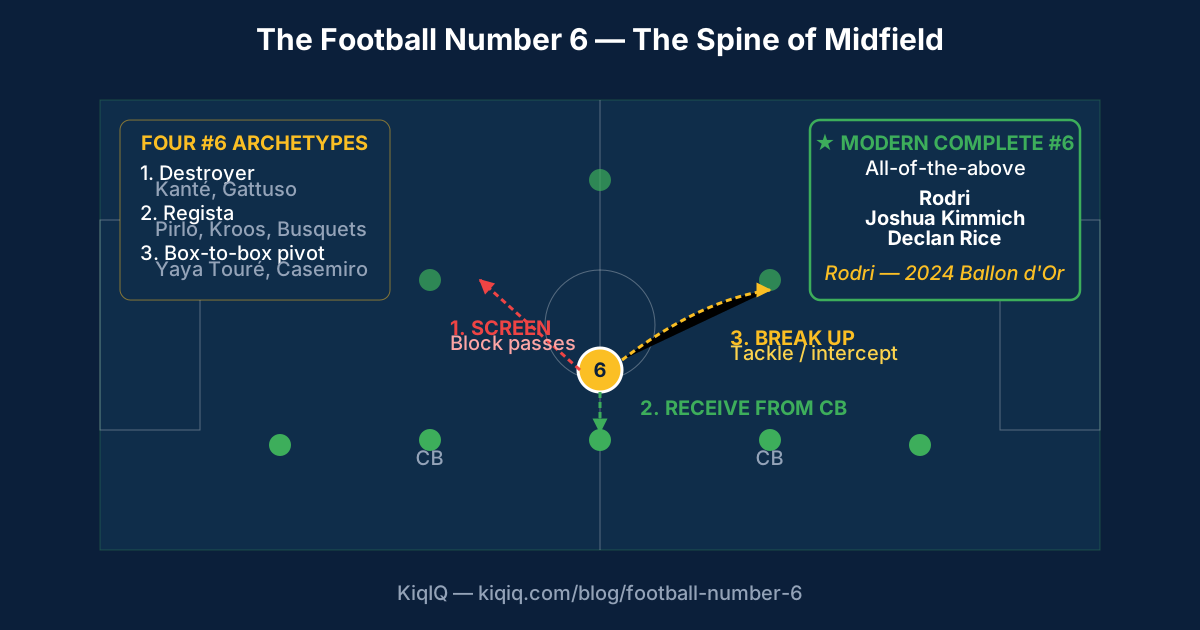
The number 6 in football is the deep-lying defensive midfielder — the player who screens the space between the back line and the rest of midfield. The role evolved from the classic stopper-CB through Pirlo's playmaking #6, the Busquets press-resistant pivot, and now Rodri's complete two-way profile. A great #6 is the spine of any side that wants to control matches.
What the number 6 actually does
The #6 has three core roles, each demanding different skills:
- Screen. Positions in front of the centre-backs to break up opposition passes and prevent through-balls into dangerous zones.
- Receive. Drops to receive from the CBs under pressure, then plays the line-breaking pass forward. Build-up enabler.
- Break up. Wins second balls, intercepts loose passes, fouls when needed (the "tactical foul" stopping a counter-attack).
The four #6 archetypes
Modern football has converged on four distinct #6 profiles:
- Destroyer. Pure ball-winner. Reads passes, intercepts, tackles, but limited passing range. Roy Keane (peak years), N'Golo Kanté (early Chelsea), Gennaro Gattuso. Becoming rarer in modern build-up-focused football.
- Regista (deep playmaker). Press-resistant passer. Receives from CBs, dictates tempo, hits line-breaking diagonals. Andrea Pirlo, Toni Kroos, Sergio Busquets. Dominated 2010s elite football.
- Box-to-box pivot. Combines screening with attacking output. Yaya Touré (peak Manchester City), Paul Pogba (rare flashes), Casemiro at his best. Higher physical demands; rarer profile.
- Modern complete #6. All-of-the-above. Rodri (Manchester City), Joshua Kimmich (Bayern), Declan Rice (Arsenal). The single-position unicorn — destroyer skills + regista passing + box-to-box mobility.
The complete modern #6 is the rarest and most-valuable midfielder profile in football. Rodri's 2024 Ballon d'Or reflected this — he's the prototype.
Why the role has become harder
Three pressures have increased the demand on the #6:
- High pressing. Modern teams press the #6 specifically — the keeper plays out, opposition forwards close down on the deep midfielder. Press-resistance is now mandatory.
- Build-up complexity. Inverted full-backs, dropping #9s, and false-9s all require the #6 to recognise and adjust to constantly-shifting positional structures.
- Defensive transition. When possession is lost, the #6 is the first defender between the ball and goal. They must read the threat and either commit to a tackle or buy time for the back-line to set.
How #6 quality is measured
Three statistical signatures of an elite #6:
- Press-resistance metric. Successful pass rate when within 3 metres of an opposition player. Above 80% is elite. Rodri sits at 86%+.
- Progressive passes per 90. Line-breaking passes from a deep position. Top deep-lying playmakers post 7-9 progressive passes per 90.
- Defensive-action zones. A heat-map of interceptions + tackles. Elite #6s show a tight cluster centred just in front of the centre-backs.
- Recovery time. Average seconds from team possession-loss to next defensive action. Elite #6s post 4-5 seconds.
The #6 in different systems
How systems use the #6:
- Single pivot (4-3-3). One #6 sits in front of the back four. Pep Guardiola's base setup at Manchester City — Rodri.
- Double pivot (4-2-3-1). Two #6-types working as a partnership; one usually more defensive, one more progressive. Casemiro + Toni Kroos at Real Madrid.
- Inverted full-back into #6. A full-back tucks centrally to support the lone #6 in possession. João Cancelo did this at City.
- Three at the back system. The #6 has more cover behind, but also more ground to cover horizontally as wing-backs push high.
Famous number 6s in history
Generation-by-generation snapshot:
- Lothar Matthäus — 1980s-90s Germany; box-to-box pivot, 1990 Ballon d'Or.
- Andrea Pirlo — 2000s-10s Italy; the regista template, made deep-lying playmaking glamorous.
- Sergio Busquets — 2008-22 Barcelona; press-resistant possession lung, 3 Champions League winner.
- Xabi Alonso — Liverpool, Real Madrid, Bayern; long-range diagonals, modern coaching career.
- N'Golo Kanté — 2015-22 Leicester + Chelsea; pure destroyer, Premier League title with both clubs.
- Rodri — 2019- Manchester City; modern complete #6, 2024 Ballon d'Or.
- Joshua Kimmich — Bayern; equally elite as RB or #6, complete two-way profile.
- Declan Rice — Arsenal; modern complete #6, late-window summer 2023 transfer at £105m reflected the position's value.
Why your team's #6 is the most important midfielder
If you watch one player on a side that wants to play possession-based football, watch the #6. They touch the ball more than anyone except the goalkeeper. They start every build-up sequence. Their press-resistance dictates whether the team can play out or has to go long. Their reading determines whether transitions are caught or break through.
Manchester City without Rodri were a different team in his injury layoff (2024-25). Real Madrid's pre-Casemiro era and post-Casemiro era look like different teams. The #6 is the spine of the spine.
Frequently asked questions
- What does the number 6 mean in football?
- The number 6 in football refers to the deep-lying defensive midfielder — the player positioned just in front of the back line who screens passes, receives from the centre-backs, and breaks up opposition build-up. It's a positional shorthand from continental European football, distinct from the #4 (typically central defender) and #8 (more attacking midfielder).
- What are the four types of #6 in modern football?
- Destroyer (pure ball-winner like Kanté), regista or deep playmaker (press-resistant passer like Busquets, Pirlo, Kroos), box-to-box pivot (combining screening with attacking like Yaya Touré), and the modern complete #6 (all-of-the-above like Rodri, Kimmich, Declan Rice). The complete #6 is the rarest and most valuable.
- Who is the best number 6 in modern football?
- Rodri (Manchester City) is the consensus pick as of the mid-2020s — he won the 2024 Ballon d'Or as a #6, reflecting his complete two-way profile (press-resistance, progression, defensive output). Joshua Kimmich and Declan Rice are the closest peers. The decline of City when Rodri was injured (2024-25) underlined his individual importance.
- Why is the number 6 so important?
- The #6 touches the ball more than any outfield player and starts every build-up sequence. Their press-resistance determines whether the team can play possession football or must go long. Their reading determines defensive transition outcomes. They're the bridge between defence and attack — a poor #6 breaks both phases of the team.
References
- Number 6: The Evolution of the Defensive Midfielder — The Athletic
- Press-Resistance Metrics — StatsBomb — StatsBomb
- Rodri 2024 Ballon d'Or Profile — The Analyst
- UEFA Coaching Curriculum — Defensive Midfielder — UEFA
Key terms in this article
Ask KiqIQ a follow-up
Get a live, data-driven answer powered by api-football + KiqIQ's Poisson model. Try one of these prompts or write your own.
Part of pillar
Tactical Intelligence
See every article in this knowledge pillar →
Related
Reviewed by a KiqIQ editor before publication. Spotted an error? Email editor@kiqiq.com — we follow our Corrections Policy.