
The Attacking Full-Back: How a Defender Becomes the Extra Player
The modern full-back has been quietly rewritten from a defensive specialist into the structural device most teams use to create numerical superiority in the final third. Here's how the role actually works.
 Tap to enlarge
Two decades ago the full-back's default role was defensive cover with selective forays forward. Today the full-back is, in most professional teams, the structural device the system relies on to generate numerical superiority in attack. The shift wasn't cosmetic — it reorganised how teams build, how wingers function, and what the defensive line actually looks like in possession. Understanding the modern full-back means understanding the two specific mechanisms by which a deep player becomes the extra attacker.
Football is about creating numerical, positional, or qualitative superiority
Coaches talk about three kinds of advantage when they're trying to attack: numerical (more players than the opponent in a given zone), positional (a player in space the opponent's shape doesn't cover), and qualitative (a 1v1 match-up the team can reliably win). The full-back, by virtue of starting deeper than most outfield players, is the cheapest source of all three. They're typically unmarked during the build-up phase, they're mobile enough to occupy whichever zone the system needs, and their entry into attacking thirds is unannounced — defenders are tracking forwards, not defenders.
That positional setup is why the role is so productive. The forward arrives in a duel pre-committed; the full-back arrives with a runway. Used well, the full-back doesn't just join the attack — they remake the team's attacking shape entirely.
Mechanism 1 — Becoming the extra attacker
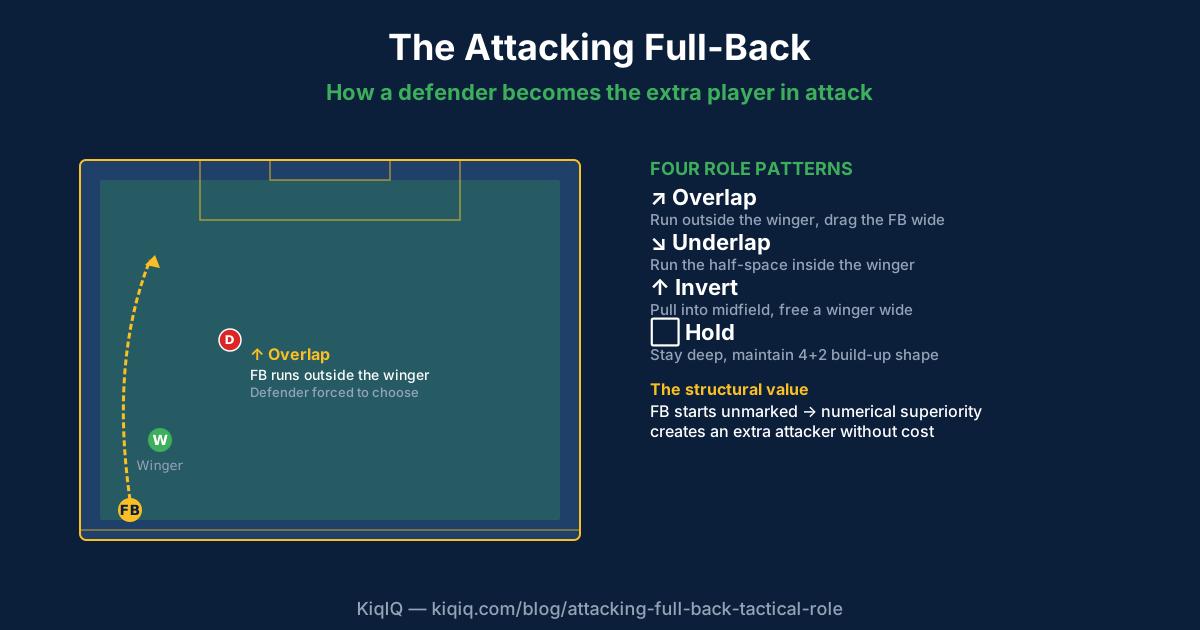
The overlap is the canonical example. The winger receives the ball with the touchline tight to their right; the full-back runs the outside lane behind them. The opposition full-back now has two threats and one body. If they follow the overlap, the winger has space inside to cut and shoot. If they stay with the winger, the overlapping run completes and the full-back is free in the half-space with a crossing angle. The defence has been pulled into a two-options-one-defender decision under speed, which is the structural definition of a numerical advantage in the attacking third.
The underlap is the same mechanism rotated inside: the full-back runs the channel between the winger and the centre-forward instead of outside the winger. The interaction with opposition defenders is the same — they're forced to commit, and either choice leaves space for someone. Modern systems often coach both options out of the same build-up trigger, with the full-back's read of the opposition shape deciding which lane to run.
Mechanism 2 — Creating space for others
The second mechanism is subtler. The full-back doesn't need to receive the ball to influence the attack. By pushing high and wide, they stretch the opposition's defensive width — and that stretch creates central space that a midfielder, a number 10, or a forward dropping deep can exploit. The attacking pattern is "full-back pulls the opposition full-back wide; central midfielder steps into the gap behind". The ball never touches the attacking full-back, but the pattern depends on their movement.
In some systems the same effect is achieved by the full-back inverting into central midfield — Guardiola's use of John Stones, then later Joško Gvardiol, as in-possession midfielders is the highest-profile version. The full-back's starting position vacates the wide channel, which a winger now occupies; their arrival in midfield gives the team a 3+2 build-up structure that resists pressing. Different shape, same mechanism: the full-back's relocation creates space for someone else.
The attacking full-back doesn't need the ball to matter. Their movement reshapes the opposition's defensive geometry; the goal-scoring moment often comes from a player they never passed to.
The risk-reward balance
The role is high-risk in transition. When the full-back is in the opposition box and the ball is lost, the team is defending a backline of three with the wide channel exposed. Modern systems mitigate this in three ways: a covering centre-back rotates out to the wide channel; the holding midfielder drops between the centre-backs; or the opposite full-back stays deliberately deep to maintain a back four during build-up. None are free — each costs one of the team's attacking options.
The trade-off has produced a generation of hybrid players whose defensive technique looks more like a centre-back's than a winger's. The best modern attacking full-backs — Alexander-Arnold, Hakimi, Theo Hernández, Lucy Bronze — combine the offensive output of an inside-forward with the recovery profile of a midfielder. The recruitment market reflects it: full-back is now the most expensive defensive position to fill at the elite level, by some distance.
What to coach in a developing full-back
For a young player learning the role, the development priority is decision-making under three specific conditions: when to overlap (when the winger is occupying the defender narrowly), when to underlap (when the half-space is open and the winger has the touchline), and when to hold (when the team has lost build-up shape and a deeper position is needed). Coaching purely on physical engine — recovery sprints, repeated high-intensity runs — produces full-backs who can do the work but don't know when to do it.
The other under-coached habit is the final-action repertoire. The best full-backs deliver early crosses, driven crosses, cut-backs and chipped balls to the back post depending on the run pattern in front of them. A full-back whose only delivery is the same arcing cross from the touchline is solving one problem the system asks; teams now ask four. Final-third decision quality, more than physical output, is what separates the £80m full-back from the £25m one.
- Overlap — outside the winger, drags the opposition full-back wide.
- Underlap — inside the winger, attacks the half-space between FB and CB.
- Invert — pull into central midfield, vacate the wide channel for a winger.
- Hold — stay deep to maintain build-up shape when the team needs a 4+2.
- Cover — recover hard when possession is lost; the wide channel is the vulnerability.
Frequently asked questions
- Why are full-backs so important in modern football?
- Because they're the cheapest source of numerical superiority in the attacking third. Full-backs start deeper than most outfield players, are typically unmarked during build-up, and can enter the attacking third without being tracked. Whether they receive the ball or simply pull defenders wide, their movement is the structural device most modern teams use to generate attacking advantages.
- What is the overlap in football?
- An overlap is when the full-back runs outside the winger after the winger has received the ball. It creates a two-versus-one against the opposition full-back, forcing them to choose between defending the winger's cut inside or tracking the overlap. Either choice opens space for someone — that's the mechanism that makes the overlap so effective.
- What is an inverted full-back?
- An inverted full-back moves into central midfield during the build-up phase instead of staying in the wide channel. Pep Guardiola popularised the role at Manchester City (John Stones, Joško Gvardiol). The pattern vacates the wide channel for a winger to occupy and gives the team a 3+2 build-up shape that resists high pressing.
- What skills does a modern attacking full-back need?
- Decision-making more than physical output. The best full-backs read whether to overlap, underlap, invert or hold based on the shape ahead of them, deliver a varied crossing repertoire (early, driven, cut-back, back-post chip), and combine the offensive output of an inside-forward with the recovery technique of a centre-back. Final-third decision quality separates elite full-backs from competent ones.
References
- The Athletic — Tactical analysis of the modern full-back — The Athletic
- Spielverlagerung — Full-back evolution — Spielverlagerung
Key terms in this article
Ask KiqIQ a follow-up
Get a live, data-driven answer powered by api-football + KiqIQ's Poisson model. Try one of these prompts or write your own.
Part of pillar
Tactical Intelligence
See every article in this knowledge pillar →
Related
Reviewed by a KiqIQ editor before publication. Spotted an error? Email editor@kiqiq.com — we follow our Corrections Policy.