
Flanks in Football: Why the Wings Decide Modern Matches
The flanks — the wide channels between the touchline and the half-space — are where most modern attacks build and most defences are stretched. We explain how top teams attack and defend the wings.
 Tap to enlarge
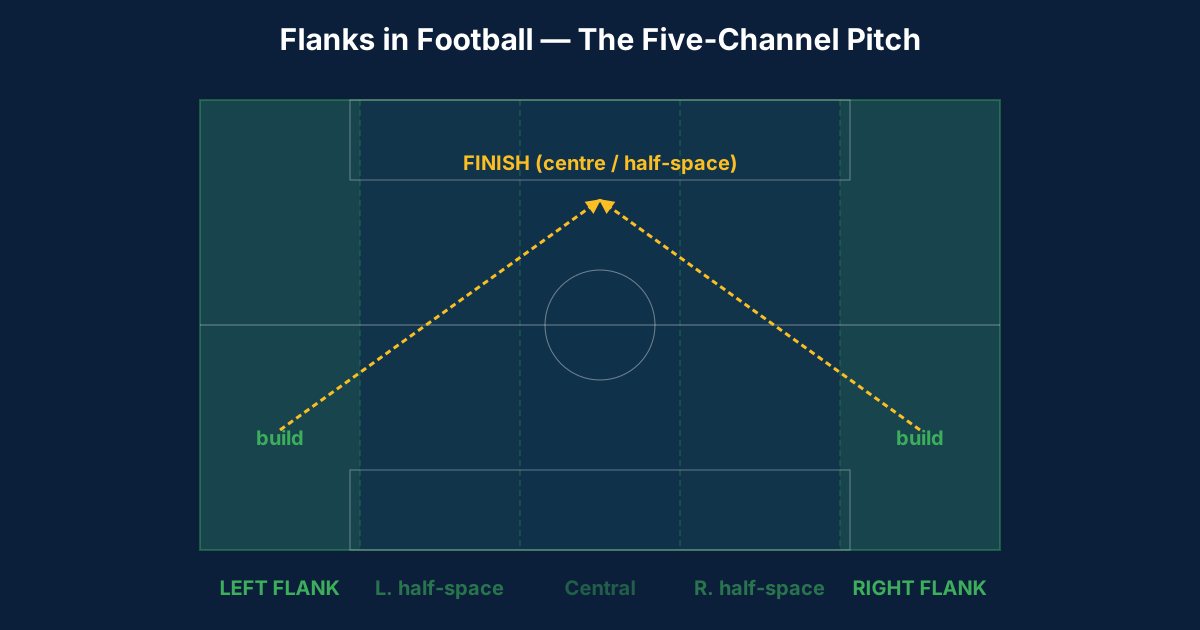
The flanks in football are the two outermost vertical channels of the pitch — the strips between each touchline and the half-space. Modern football divides the pitch into five vertical channels: two flanks, two half-spaces, and the centre. The flanks are where most attacks are built, where most crosses originate, and where defensive shape is most often stretched.
The five-channel model
The pitch is divided into five vertical channels in modern positional play, popularised by Pep Guardiola at Barcelona and Bayern: left flank, left half-space, central channel, right half-space, right flank. Each channel is roughly 13.6 metres wide on a 68-metre-wide pitch.
Each channel has a tactical purpose: flanks for stretching the defence horizontally and providing crossing platforms; half-spaces for line-breaking passes and inside-shooting opportunities; central channel for combination play and final-third penetration.
The flanks are where attacks are *built*. The half-spaces are where they *finish*. Modern football moves the ball through the flanks before striking through the half-spaces.
Why flanks matter more than ever
Two structural changes since the 2010s have elevated flank importance:
- The compact mid-block. Most defences now sit in a 4-4-2 or 4-5-1 mid-block, narrowing the central channel. With the centre congested, the flanks become the only viable build-up route.
- The inverted full-back. Pep's tactical innovation — full-backs tucking into central midfield in possession — moves bodies *off* the flank, intentionally creating space wide for the winger to attack 1v1.
How top teams attack the flanks
Three repeating patterns:
- Overload to isolate. Three players combine on one flank to drag two opposition defenders, then switch the ball quickly to the other flank where the opposite winger is now 1v1 with their full-back. Manchester City under Pep is the canonical exponent.
- Inside-forward + overlapping full-back. A right-footed winger plays on the left, cutting inside; the left-back overlaps to provide the width. Arjen Robben at Bayern, Mohamed Salah at Liverpool, Bukayo Saka at Arsenal.
- Direct cross from deep. A right-back hitting an early cross from the half-space-flank boundary into the back-post. Trent Alexander-Arnold, Joshua Kimmich.
How top teams defend the flanks
Defending the flank involves three interlocking principles:
- The full-back doesn't engage alone. The wide midfielder or wing-back drops to double-team the opposition winger, denying the 1v1. The back four shifts across to maintain the back-line shape.
- Cover behind. The near-side centre-back covers diagonally behind the full-back. If the full-back is beaten, the centre-back is the first cover.
- Funnel toward the line. Force the winger toward the touchline — the touchline is a defender. Once on it, the winger has fewer options.
Crosses from the flank — what works
Not all crosses are equal. The data on cross-to-goal conversion is unforgiving:
- Cut-back crosses (low, pulled back from byline) convert at ~7-9% — the highest rate of any cross type.
- Early crosses from outside the area convert at ~3-4%.
- Aimless crosses against a packed back-six convert at ~1-2% — barely above league-average from open play.
Famous flank specialists
Modern football has fewer pure wingers and more inside-forwards, inverted full-backs, and hybrid wing-backs. The classic flank archetypes:
- Touchline winger: Cristiano Ronaldo (early Manchester United), Eden Hazard at Chelsea — pace + dribbling on the chalk.
- Inverted winger: Mohamed Salah, Bukayo Saka, Vinícius Júnior — right-footed left or left-footed right, cutting inside.
- Crossing full-back: Trent Alexander-Arnold, Achraf Hakimi, Reece James — long-passing range from deep wide.
- Inverted full-back: João Cancelo, Joshua Kimmich, Oleksandr Zinchenko — full-back who plays as a midfielder in possession.
- Wing-back: Antonio Rüdiger's Inter contemporaries — full-flank coverage, ball-carrying, occasional crossing.
Statistical signature of flank dominance
A team that dominates the flanks shows a recognisable statistical fingerprint:
- Higher than league-average crosses per match (12+ vs 8-9 average).
- Asymmetric possession by zone — significantly more time in the wide channels than the centre.
- High final-third entries from wide (vs through the middle).
- Above-average cut-back conversion (the high-quality flank-attack signal).
Frequently asked questions
- What are the flanks in football?
- The flanks are the two outermost vertical channels of the pitch — the strips between each touchline and the half-space. Most modern attacks are built through the flanks before being finished through the half-spaces or centre.
- How is the pitch divided into channels?
- Modern positional play divides the pitch into five vertical channels: left flank, left half-space, central channel, right half-space, right flank. Each is roughly 13.6 metres wide on a 68-metre pitch. This model was popularised by Pep Guardiola.
- Which type of cross is most likely to score?
- Cut-back crosses (low, pulled back from the byline) convert at the highest rate — roughly 7-9% of cut-backs lead to goals, compared to 3-4% for early crosses from outside the area and 1-2% for aimless crosses into a packed defence.
- Why do modern teams use inverted full-backs?
- Inverted full-backs (full-backs who tuck into central midfield in possession) clear the flank for the winger to attack 1v1, while adding numerical superiority in midfield. The technique was popularised by Pep Guardiola at Bayern and Manchester City; players like João Cancelo and Joshua Kimmich are exemplars.
References
- Positional Play and the Five Vertical Channels — The Athletic
- Cross Conversion Rates by Type — StatsBomb
- Inverted Full-Backs Explained — The Analyst
- Wide-Play Tactical Trends — UEFA Technical
Key terms in this article
Ask KiqIQ a follow-up
Get a live, data-driven answer powered by api-football + KiqIQ's Poisson model. Try one of these prompts or write your own.
Try the calculators
Apply the concepts from this article with KiqIQ's free calculators.
Part of pillar
Tactical Intelligence
See every article in this knowledge pillar →
Related
Reviewed by a KiqIQ editor before publication. Spotted an error? Email editor@kiqiq.com — we follow our Corrections Policy.