
Low Block in Football: What It Is, How It Works, How to Beat It
A low block is a defensive approach in football where the team defends deep, in numbers, near their own penalty area. We explain when it works and how to break it.
 Tap to enlarge
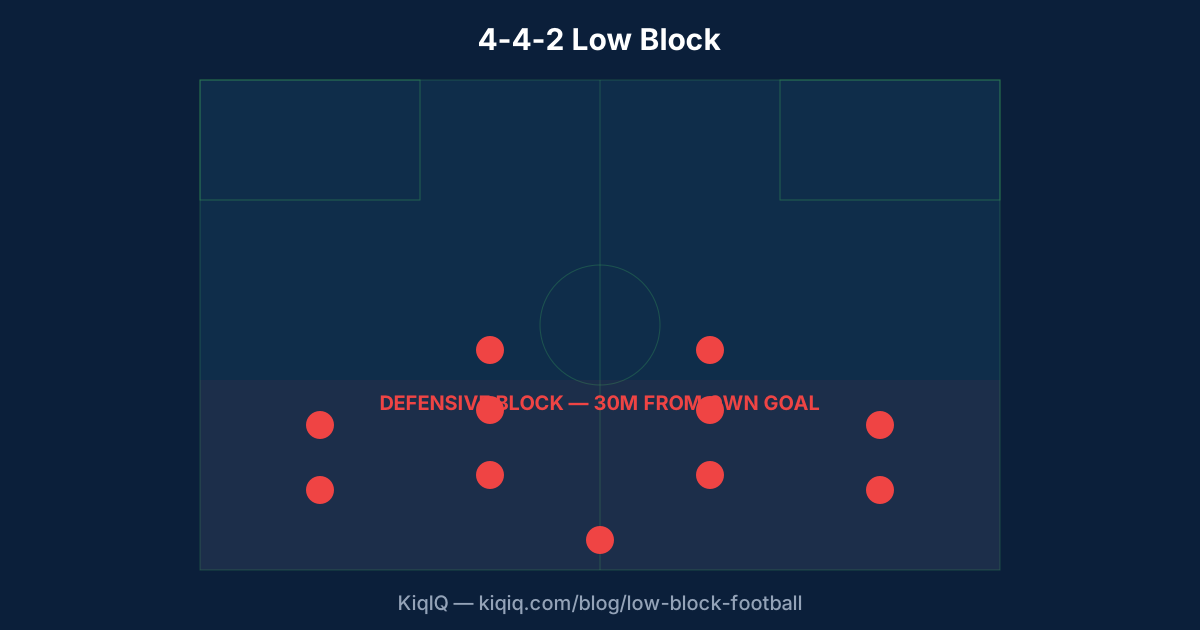
A low block is a football defensive approach in which the team defends deep, with all 10 outfield players within roughly 30 metres of their own goal. The aim is to deny space behind the back line, force opponents to attack from low-percentage areas, and counter-attack when possession is regained.
What does a low block look like?
A textbook low block is a 4-4-2, 4-5-1, or 5-4-1 with both banks of midfielders and defenders compressed into a narrow band 25–35 metres deep, sitting just outside their own penalty area. There is little space between the lines and almost no space behind the defence.
Strikers join the deep block when defending, often dropping to the halfway line or below. The team becomes compact in three dimensions — narrow in width (touchline to touchline cover), short in length (defence to attack distance), and deep in territory.
When sides choose a low block
Three contexts dominate. First, talent gap — when the opposition is stronger, denying them space is more efficient than competing for it. This is why most cup upsets feature low blocks. Second, score state — sides leading late commonly drop into a low block to protect a lead. Third, by design — managers like Diego Simeone (Atlético Madrid) and José Mourinho (Roma, Fenerbahçe) have built careers on planned low-block football.
A low block is rarely a sign of weakness. It is a deliberate trade: cede territory to deny chance quality.
Why a low block can frustrate elite teams
A low block compresses high-xG zones. Without space inside the box, attacking teams are forced to shoot from outside or from tight angles — where xG is sub-0.05 per attempt. A possession-heavy side might rack up 70% possession and 25 shots, but if those shots are all low-xG, the chance count remains modest.
Stat-wise, the low block's signature is high opposition possession + low opposition xG. A well-organised low block can hold a top-flight attack to 1.0 xG over 90 minutes despite conceding 65–70% of the ball.
How to break a low block
There are five repeated themes in elite-level low-block-breaking:
- Stretch laterally with width. Force the block to expand wider than it wants to. Inverted full-backs, wide-overload patterns, and long diagonal switches all work.
- Use third-man combinations. A direct pass to a striker bouncing off the centre-back is hard to defend in a compact shape — the bouncer pulls a defender forward.
- Set pieces. Low blocks concede chance quality from open play but cannot prevent high-xG set pieces. Strong set-piece sides break low blocks via dead balls.
- Patience + circulation. A tired low block is a bad low block. 70+ minutes of possession-based circulation forces concentration lapses.
- Long-range shooting (sparingly). Not high-xG, but sometimes the only available shot. Used as a probe, not a strategy.
Famous low-block performances
Greece at Euro 2004 — Otto Rehhagel's side won the tournament with one of the most disciplined low blocks of the modern era, beating France, Czech Republic, and Portugal. Atlético Madrid, 2013–14 La Liga title — Diego Simeone's 4-4-2 deep block conceded 26 league goals all season. Inter Milan, 2009–10 Champions League final — José Mourinho's deep block beat Bayern in the final after holding Barcelona at the Camp Nou with 10 men.
Each of these sides combined deep defending with a clearly defined transition pattern — they did not just defend, they created counter-attacks from the moment they regained possession.
Risks of a low block
Three. First, set-piece exposure — a deep block concedes more set-piece attempts than a high-press side, increasing variance. Second, individual errors loom larger — when 10 players are inside the box, one player switching off creates a clear chance. Third, mental fatigue — concentrating for 70+ minutes without the ball is exhausting, and most goals against well-organised low blocks come in the final 15 minutes.
Frequently asked questions
- What is a low block in football?
- A low block is a defensive setup where all 10 outfield players sit deep in their own half, within roughly 30 metres of their own goal. The team defends compactly to deny space behind the back line and force opponents into low-quality attacking attempts.
- Is playing a low block negative football?
- It depends on framing. Low-block football accepts territorial dominance to the opposition in exchange for tight chance-quality control. Many famous results — Greece at Euro 2004, Atlético's 2013–14 title, Inter's 2010 Champions League — were built on disciplined low blocks paired with sharp transitions.
- How do top teams break a low block?
- Five proven methods: lateral stretch via width and switches, third-man combinations, set-piece superiority, patient circulation that fatigues defenders, and (sparingly) long-range shooting as a pressure release. Most successful breakdowns combine two or more of these.
- What's the difference between a low block and a mid block?
- Block height. A low block sits 25–35 metres from own goal — just outside the penalty area. A mid block sits roughly halfway, around the centre circle, ready to press if a trigger is met. A high block (or high press) sits in the opposition half.
References
- Defining the Press: Block Heights — StatsBomb
- How to Break a Low Block — Pep Lijnders — The Athletic
- Atlético Madrid 2013–14 Tactical Profile — The Analyst
- Greece at Euro 2004 Tactical Retrospective — UEFA
Key terms in this article
Ask KiqIQ a follow-up
Get a live, data-driven answer powered by api-football + KiqIQ's Poisson model. Try one of these prompts or write your own.
Try the calculators
Apply the concepts from this article with KiqIQ's free calculators.
Part of pillar
Tactical Intelligence
See every article in this knowledge pillar →
Related
Reviewed by a KiqIQ editor before publication. Spotted an error? Email editor@kiqiq.com — we follow our Corrections Policy.