
How to Be a Better Centre-Back: Reading, Positioning, Passing, Tackling
A great centre-back combines four skills: reading the game, positioning before the ball arrives, distribution under pressure, and clean tackling. We break down each skill and how to train it.
 Tap to enlarge
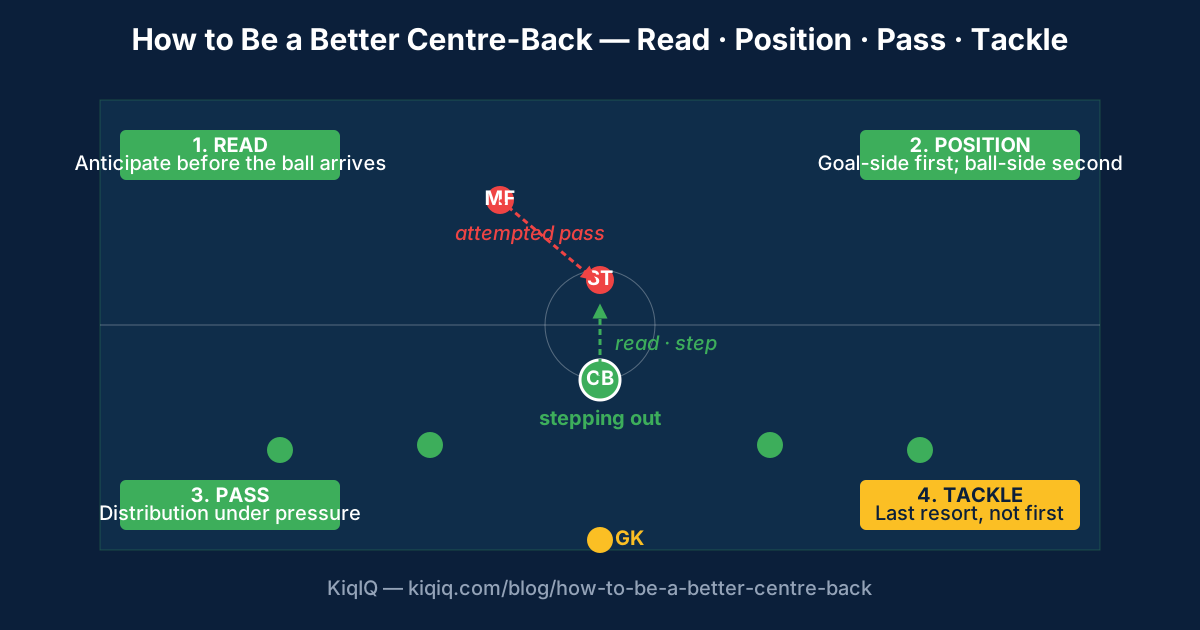
A great centre-back combines four skills: reading the game (anticipating the next pass), positioning (being where the danger is before it arrives), distribution (passing out from the back under pressure), and clean tackling (only when reading and positioning have failed). The best CBs make defending look easy because they've already done the hard work — invisibly.
Skill 1 — Reading the game
Reading is the centre-back's defining skill. It separates a Van Dijk or Rüdiger from an athletic but reactive defender. Reading means anticipating where the ball is going next based on body shapes, runs, and pressure cues — and stepping (or holding) accordingly.
Three reading habits build over time:
- Watch the passer's plant foot. Most ball-carriers telegraph the pass with their plant-foot direction 0.3-0.5 seconds before the ball leaves their boot.
- Track the runners off the ball. A striker drifting wide is a forecast of a wide pass; a midfielder making a third-man run forecasts a through ball.
- Use audio cues. First-touch quality is audible. A heavy first touch on the ball signals an opportunity to step.
An elite centre-back's interception is invisible because it happens before the dangerous pass is even hit. Most fans see only the result, not the read.
Skill 2 — Positioning before the ball arrives
Positioning is anticipation made physical. Three positioning principles dominate:
- Goal-side first, ball-side second. Always between the attacker and goal. Ball-side positioning is secondary.
- Stagger the back line. When defending crosses, the near-side CB attacks the ball; the far-side CB drops 1-2 metres deeper to clear second balls.
- Compactness with the partner CB. 6-12 metres apart in normal play. Wider stretches the line; tighter invites overlaps inside.
Skill 3 — Distribution under pressure
Modern football demands centre-backs who can pass. Build-up systems route 30-50% of the ball through the CBs at some point in possession. Three distribution skills:
- The short pass to the partner CB. Foundational. Calm, firm, weighted to lead the partner away from pressure.
- The line-breaking diagonal. Long-range pass into the half-space, bypassing midfield. Van Dijk, Pau Torres, and Rúben Dias all rate elite at this.
- The progressive carry. Walking the ball 20-30m forward when the press is loose. Forces opposition midfielders to break shape to engage.
Skill 4 — Clean tackling
Tackling is the last resort, not the first option. A centre-back who is tackling a lot is a centre-back who failed to read or position. The article on `/blog/how-to-tackle-in-football` covers technique; here, the centre-back focus is on tackle *selection*:
- Block first, then tackle. Always try a body-block before reaching for the ball. The block is lower-risk and fewer fouls.
- Avoid the slide tackle inside your own box. A slide tackle in the box is a penalty risk. Stay on feet; force the attacker wider.
- Tackle to clear, not to retain. A clearance into the stand is sometimes the right outcome, especially under pressure or in injury time.
Aerial dominance — the unspoken expectation
A centre-back below 50% aerial-duel win rate is below average. 60%+ is solid, 75%+ is elite. Three aerial principles:
- Time the jump from the ball, not the opponent. Watch the ball's flight, not the striker's movement.
- Get airborne first by half a step. First-mover wins ~60% of contested headers regardless of physical advantage.
- Direct the header purposefully. Cleared header to the wing is often better than headed back into the danger zone. Chose direction before the contact.
Communication
A great centre-back is constantly talking. To the goalkeeper (line height, pressure calls), to the partner CB (marking adjustments, switch awareness), to the full-backs (cover and pressure), to the midfielders (track the runner, drop deeper). The talkative CB sets the team's defensive shape; the silent one breaks it.
Three habits to drill weekly
For aspiring or improving centre-backs at any level:
- Bilateral foot drills. Pass with the weaker foot; head from both sides. CBs who can pass equally with both feet are positionally flexible.
- Heading repetitions (low-volume, high-quality). Per FA youth-football guidance, head sparingly and focus on technique. Sub-concussive cumulative impact is real.
- Tactical video review. Watch elite CBs (Van Dijk, Saliba, Rüdiger) and pause before they act. Predict their decision, then resume. Over 50 reps, your prediction accuracy improves measurably.
Frequently asked questions
- What is the most important skill for a centre-back?
- Reading the game. Anticipating where the next pass or run is going lets a centre-back position before the ball arrives, intercept rather than tackle, and avoid the high-risk one-on-one situations where speed advantages favour attackers. Tackling and pace can compensate for poor reading only intermittently.
- How do centre-backs improve at passing?
- Three practical drills: bilateral pass-and-receive sessions (both feet), pressure-resistance work where the CB has to retain possession against an active presser, and progressive-pass repetition into pre-set targets in the half-space. Watching elite CBs (Toni Kroos in his CB cameos, Van Dijk, Pau Torres) and copying their distribution patterns shortens the learning curve.
- What is a good aerial-duel win rate for a centre-back?
- Below 50% is below average. 60%+ is solid for a Premier League regular. 75%+ is elite — the level at which a CB becomes an aerial threat at attacking set-pieces too. Win rate matters more than total duels; some teams shape so the CB takes fewer aerials, but those they take should be won at high rates.
- When should a centre-back slide tackle?
- Rarely. Slide tackles in the penalty area carry penalty risk. Slide tackles in open play cost positional advantage if missed. Use slide tackles only as a last-ditch recovery or when the ball is loose and you arrive first. The 2024 IFAB updates also tightened red-card thresholds for studs-up and two-footed slides.
References
- Centre-Back Per-90 Metrics — Top 5 Leagues — FBref
- Defensive Reading and Reaction Times — StatsBomb
- UEFA Defending Coaching Curriculum — UEFA
- FA Youth Heading Guidance — The FA
Key terms in this article
Ask KiqIQ a follow-up
Get a live, data-driven answer powered by api-football + KiqIQ's Poisson model. Try one of these prompts or write your own.
Part of pillar
Player Development
See every article in this knowledge pillar →
Related
Reviewed by a KiqIQ editor before publication. Spotted an error? Email editor@kiqiq.com — we follow our Corrections Policy.