
Youth Player Development Plan in Football: Ages, Stages, and Priorities
A youth player development plan in football is the structured pathway from age 5 to senior debut. We break down the four UEFA development stages, what to focus on at each age, and red flags.
 Tap to enlarge
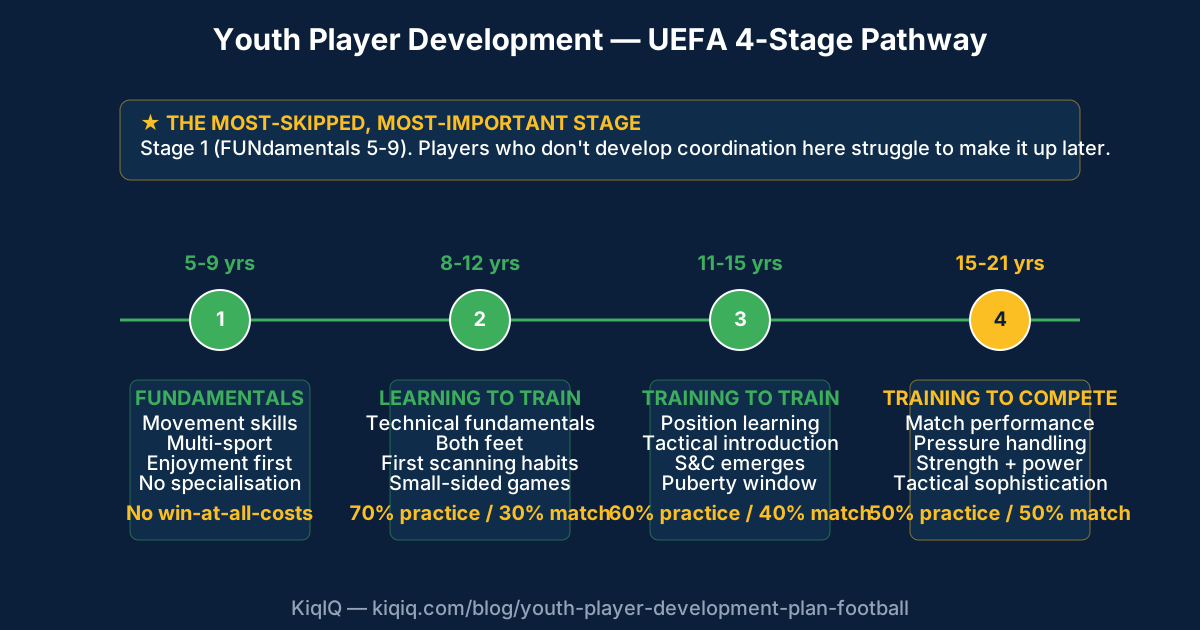
A youth player development plan in football is the structured pathway from age 5 through senior debut, organised into four developmental stages aligned with the UEFA Long-Term Player Development model. Each stage has distinct priorities — from the FUNdamentals stage (ages 5-9, focused on movement skills and enjoyment) through Training to Compete (15-21, where tactical understanding and performance under pressure mature). Skipping stages produces players who plateau in their late teens.
The four UEFA development stages
UEFA and FIFA endorse a four-stage long-term athlete development (LTAD) model. Each stage has distinct priorities:
- Stage 1 — FUNdamentals (ages 5-9). Focus on basic movement skills (running, jumping, balance, coordination), introduction to ball through play, no early specialisation, no win-at-all-costs.
- Stage 2 — Learning to Train (ages 8-12). Skill acquisition. Technical fundamentals (passing, receiving, dribbling, shooting). 70% practice / 30% match time. Small-sided games (4v4, 5v5, 7v7) over 11v11.
- Stage 3 — Training to Train (ages 11-15). Position learning. Tactical introduction. Increased physical training (mobility, strength, anaerobic capacity). 60% practice / 40% match time. The "puberty window" matters here — late developers can catch up.
- Stage 4 — Training to Compete (ages 15-21). Match performance. Tactical sophistication. Pressure-handling. Game-state recognition. Strength + power training. 50% practice / 50% match time.
FUNdamentals is the most-skipped and most-important stage. Players who didn't develop coordination at 5-9 struggle to make up the deficit later, even with elite academy training.
What to focus on at each age
Age-by-age priorities:
- 5-7: Pure play. Multi-sport encouragement. Football should be 1-2 sessions per week, max. ABCs — agility, balance, coordination, speed.
- 8-9: Introduction to small-sided games. Daily ball touches at home (juggling, wall passes). No specialised position; rotate.
- 10-12: Technical fundamentals. Both feet. Receiving with all surfaces. First scanning habits.
- 13-14: Tactical introduction. Position-specific work begins. Strength and conditioning emerges (bodyweight only at this age).
- 15-17: Position commitment but flexibility. Tactical sophistication. Match-state decision-making. Strength training with light loads.
- 18-21: Competitive senior football. Full strength + power programmes. Match-performance under pressure.
Common youth-development mistakes
Three patterns that limit player development:
- Early specialisation. Picking one position at age 8 and never rotating. Limits the all-around understanding that builds tactical IQ.
- Too much 11-a-side too young. Premier League academies use small-sided games (4v4, 5v5) up to age 11 because each player gets more touches and more decisions per minute.
- Win-at-all-costs at U10-U12. Coaching to win at 11 produces unbalanced players. Coaching to develop produces players who win at 18+.
- Ignoring the relative-age effect. Most academies disproportionately recruit early-quartile-birth children. Late developers get filtered out unfairly.
- Skipping mobility / movement work. A player who can't move well at 12 will never sprint well at 18.
How elite academies structure development
A typical Premier League academy weekly schedule by age group:
- U9-U10. 2-3 sessions per week, ~1 hour each. Emphasis on touch and small-sided games.
- U11-U12. 3-4 sessions per week, ~75 mins. Technical drills, tactical introduction, multi-sport encouragement still common.
- U13-U15. 4-5 sessions per week. School + training balance. Strength and conditioning enters.
- U16-U18. 5-6 sessions per week. Full-time development. Match-performance focus.
- U21 / B-team. Daily training. Senior tactical exposure. Competitive league.
Bio-banding and the relative-age effect
Many academies now use "bio-banding" — grouping youth players by skeletal age (bone scan-derived) rather than chronological age. This neutralises the size advantage that early-quartile-birth children have at ages 9-13.
Manchester City and Barcelona have published methodology around bio-banding since 2019. Late-physical-developers who would otherwise have been filtered out of the academy by their early-developing peers can be assessed on technical merit instead.
When parents and players should worry
Three signs that a development pathway is going off-track:
- Player no longer enjoys football. This is the worst red flag. Players who don't love the game don't make it past 16. Force is counterproductive.
- Plateau between 14-17. Some plateauing is normal during growth spurts. A player whose technical level has not progressed in 18+ months past growth completion is plateauing.
- Single-position fixation under 16. A player who can only play one position is half a player. By 16 they should have been competent in 2-3 positions.
For amateur and grassroots — what matters most
Three priorities for parents and grassroots coaches:
- Multi-sport exposure to age 12. Basketball, swimming, tennis, gymnastics — all build the spatial intelligence that football rewards.
- Daily ball touches. Five minutes of juggling or wall passes, every day, beats two hours twice a week.
- Make matches fun, not pressure. Praise effort over results. The 8-year-old who associates football with criticism quits at 14.
Frequently asked questions
- What are the stages of youth football development?
- UEFA endorses four developmental stages: FUNdamentals (ages 5-9, basic movement skills + enjoyment), Learning to Train (8-12, technical fundamentals), Training to Train (11-15, position learning + tactical introduction), and Training to Compete (15-21, match performance + tactical sophistication). Each has distinct priorities; skipping stages produces players who plateau.
- When should a young footballer specialise in one position?
- Not before age 14-15. Earlier specialisation limits all-around tactical understanding and reduces injury resilience. Premier League academies routinely rotate young players through 2-3 positions to age 14, then introduce position-specific work. By 16, players should have developed competence in 2-3 positions.
- What is the most common youth-development mistake?
- Early specialisation combined with a win-at-all-costs match focus. Coaching to win at age 10-12 produces unbalanced players who win short-term but plateau later. Coaching to develop — through small-sided games, multi-position rotation, and emphasis on technical fundamentals — produces players who win at 18+ when results matter.
- What should parents do for a youth football player?
- Three things: encourage multi-sport exposure to age 12 (basketball, swimming, tennis all build spatial intelligence that football rewards), build daily 5-10 min ball touches at home (wall passes, juggling), and protect the love of the game (praise effort over results). The 8-year-old who associates football with pressure or criticism is the 14-year-old who quits.
References
- UEFA Long-Term Player Development Model — UEFA
- FIFA Youth Football Development — FIFA
- Bio-Banding — Manchester City Academy Methodology — The Athletic
- Relative-Age Effect Research — Journal of Sports Sciences
Ask KiqIQ a follow-up
Get a live, data-driven answer powered by api-football + KiqIQ's Poisson model. Try one of these prompts or write your own.
Part of pillar
Player Development
See every article in this knowledge pillar →
Related
Reviewed by a KiqIQ editor before publication. Spotted an error? Email editor@kiqiq.com — we follow our Corrections Policy.