
Talent Identification in Football: How Clubs Find Future Stars
Talent identification (talent ID) in football combines scouting, data analytics, and developmental assessment. We explain the modern process, the relative-age effect, and where clubs go wrong.
 Tap to enlarge
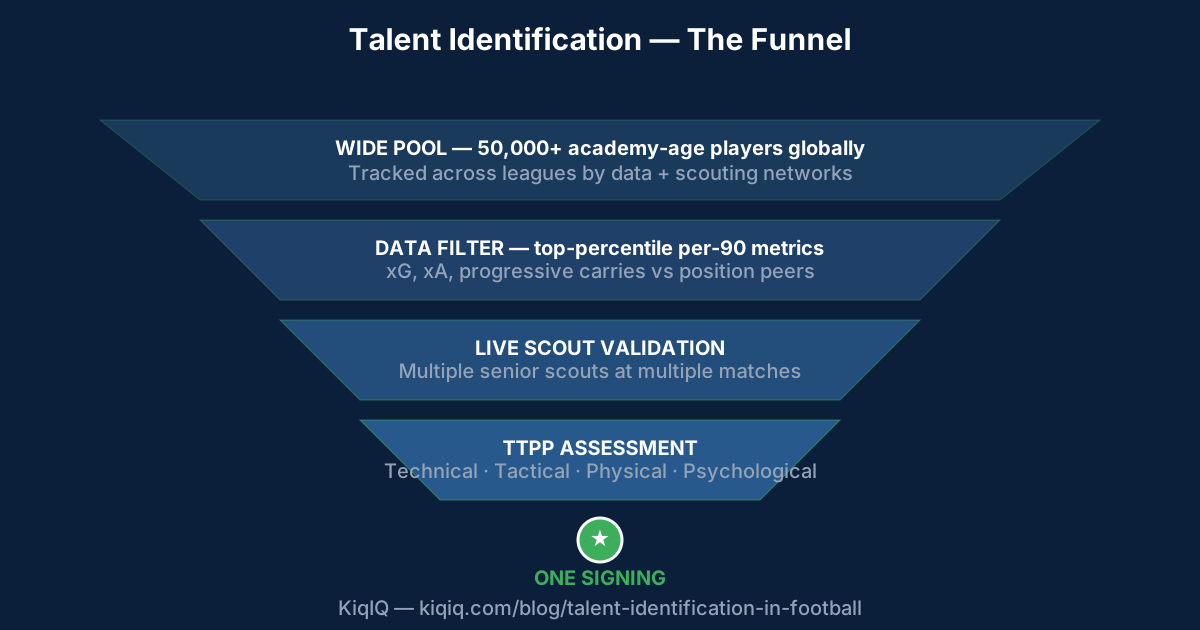
Talent identification (talent ID) in football is the process of finding players with the potential to develop into first-team contributors at a higher level than they currently play. Modern clubs combine traditional scouting (live observation), data analytics (per-90 metrics, percentile ranks), and developmental assessment (technical, tactical, physical, psychological) to filter wide academy-age pools into a few signings.
The four pillars of talent assessment
Modern academies and senior recruitment teams converge on four assessment dimensions, often abbreviated TTPP: Technical, Tactical, Physical, Psychological.
- Technical. First touch, passing range and accuracy, shooting technique, dribbling, weak-foot quality. Measurable via on-pitch drills + video review.
- Tactical. Game intelligence, positional awareness, decision-making under pressure, ability to apply instructions. Measurable via "freeze and predict" video drills + match observation.
- Physical. Speed (acceleration + top-end), endurance (intermittent), strength, jumping, mobility. Measurable via lab + GPS-tracking sessions.
- Psychological. Coachability, competitiveness, resilience to setbacks, leadership traits. Measurable via interviews + observation in adversity (losing games, being benched).
No top academy signs on technical brilliance alone. The mental and physical floors are non-negotiable; the technical ceiling is what differentiates.
How data has changed talent ID
Pre-2010, talent ID was almost entirely scout-led. The tape: a head scout watches 100 matches a year, takes notes, recommends. Bias was structural — scouts saw the players their network exposed them to and missed the rest.
Modern recruitment layers data on top. StatsBomb, Wyscout, InStat, and SciSports cover thousands of leagues and produce per-90 metrics, percentile ranks, and similarity scores against any reference player. A club can shortlist 20 left-backs from 50,000 globally in an afternoon. Then scouts go and watch the shortlist live to validate.
The "Moneyball moment" for football was Brentford's 2014-2020 model under Matthew Benham — building data-led recruitment that produced multiple Premier League starters from low-cost signings (Ivan Toney, Bryan Mbeumo, Yoane Wissa).
The relative-age effect
One of the most studied biases in talent ID. Players born early in the academy intake year (typically September-November in European systems with 1 Sept cutoffs) are physically older than peers born later (June-August). At ages 9-13 those few months mean significant size + speed differences.
Result: clubs disproportionately recruit early-birth-quartile children. The bias persists into senior football — roughly 70% of Premier League academy graduates are born in the first half of the cutoff year. The talent that gets filtered out includes future late-developers who were physically smaller at age 11 but ultimately better.
Some academies have begun using bio-banded sessions (grouping by skeletal age, not birth date) to neutralise the effect. Manchester City and Barcelona have published methodology around this since 2019.
Where modern talent ID goes wrong
Three recurring failure patterns in even well-run academies:
- Premature recruitment. Signing 7-9-year-olds based on early-bloomer physicality. Most don't convert to senior level — the early advantage was relative-age effect.
- Overvaluing one dimension. A blistering pacy winger with poor decision-making rarely becomes a first-team player. A high-IQ midfielder with mediocre pace usually does. Decision-making outweighs raw speed.
- Under-considering the move. A 17-year-old who excels at home in Lille might struggle at Chelsea. The player + environment fit is part of the assessment.
- Missing the late developer. The classic example: Antoine Griezmann, rejected by every French academy as too small and slow at age 13, eventually picked up by Real Sociedad's Spanish academy at 14.
Talent ID at the senior level
Senior recruitment is shorter-horizon talent ID — less developmental projection, more "can this player upgrade our XI now?". The same TTPP framework applies but with statistical evidence of senior performance instead of academy potential.
Brentford's recent senior recruitment template: target undervalued players from second-tier leagues (Championship, Eredivisie, Belgian Pro League, MLS) where data suggests Premier League-translatable performance. Cost: typically £5-15m per signing. Ratio of hits to misses outperforms big-fee transfers.
How fans can spot a future star
Three signals that survive most talent-ID research:
- xG + xA per 90 above the position median for their league. A 17-year-old hitting 0.6 combined per-90 in a Tier-2 league is a real prospect.
- Multiple teams want them. Multiple top-five-league scouts at the same matches is a stronger signal than one big club's "interest".
- They keep developing. A 17-year-old with great metrics who is the same player at 19 is plateauing. A mid-tier 17-year-old who improves monthly is the pick.
Frequently asked questions
- What is talent identification in football?
- Talent identification (talent ID) is the process of finding players with the potential to develop into first-team contributors at a higher level than they currently play. Modern clubs combine traditional scouting, data analytics (per-90 metrics, percentile ranks), and developmental assessment (technical, tactical, physical, psychological).
- What is the relative-age effect?
- It's the well-documented bias toward children born early in the academy intake year, who are physically older than peers born late. At ages 9-13 the size advantage matters; clubs disproportionately recruit those children. About 70% of Premier League academy graduates are born in the first half of the cutoff year. Late-developing talent gets filtered out.
- Has data replaced scouting?
- No — it has layered on top. Data shortlists candidates from thousands of leagues; scouts then validate live. Brentford's 2014-2020 model under Matthew Benham (Toney, Mbeumo, Wissa) is the canonical "Moneyball" example. The combination beats either approach alone.
- How can a fan spot a future star?
- Three signals: xG + xA per 90 above the position median for their league, multiple top-five-league scouts at the same matches over a short window, and a player who keeps improving year-on-year rather than plateauing. Plateau at 17-19 is a red flag; continuous improvement is the strongest positive signal.
References
- TTPP Player Assessment Framework — UEFA
- The Brentford Way — Data-Led Recruitment — The Athletic
- Bio-Banding and the Relative-Age Effect — FIFA Technical
- StatsBomb — Scouting at Scale — StatsBomb
Key terms in this article
Ask KiqIQ a follow-up
Get a live, data-driven answer powered by api-football + KiqIQ's Poisson model. Try one of these prompts or write your own.
Try the calculators
Apply the concepts from this article with KiqIQ's free calculators.
Part of pillar
Player Development
See every article in this knowledge pillar →
Related
Reviewed by a KiqIQ editor before publication. Spotted an error? Email editor@kiqiq.com — we follow our Corrections Policy.