
Football Biomechanics: How the Body Generates Speed, Power, and Skill
Football biomechanics is the science of how the body moves during the game — sprinting, kicking, jumping, changing direction. We break down the basics every coach and player should know.
 Tap to enlarge
Football biomechanics is the study of how the human body produces movement during the game — sprints, kicks, jumps, tackles, and changes of direction. The headline insight is that football movements are kinetic-chain events: power flows from the ground through the hips through the limbs. Understanding the chain is what separates good coaching from cliché.
The kinetic chain
Every football movement is a kinetic chain — a sequence of body segments that transfer force from the ground up. A kick starts at the support-leg foot pressing the ground, transfers force up through the hip, into the shoulder counter-rotation, through the kicking-leg hip, knee, and finally the foot.
The implication is counterintuitive: the foot is the last link, not the first. Stronger feet do not produce harder kicks. Stronger hips and a more efficient chain do. This is why core training and hip-mobility work disproportionately improve shooting power.
Power in football is generated proximally and delivered distally. Train the hip, the ball obeys.
Sprint biomechanics
Football sprints are short (typically 5-30m) and accelerative — players rarely hit top speed before having to decelerate or change direction. The relevant biomechanics are different from track sprinting.
Acceleration is dominated by horizontal force production at the ground. Effective ground-contact time during the first 5 steps determines acceleration. Athletes who push back forcefully into the ground (not just downward) accelerate fastest. Erling Haaland and Mohammed Salah are exemplars.
Deceleration is the under-appreciated half. The ability to decelerate from full sprint in 2-3 steps preserves the option to change direction or strike the ball. Eccentric quad and hamstring strength are the limiting factors.
Kicking biomechanics
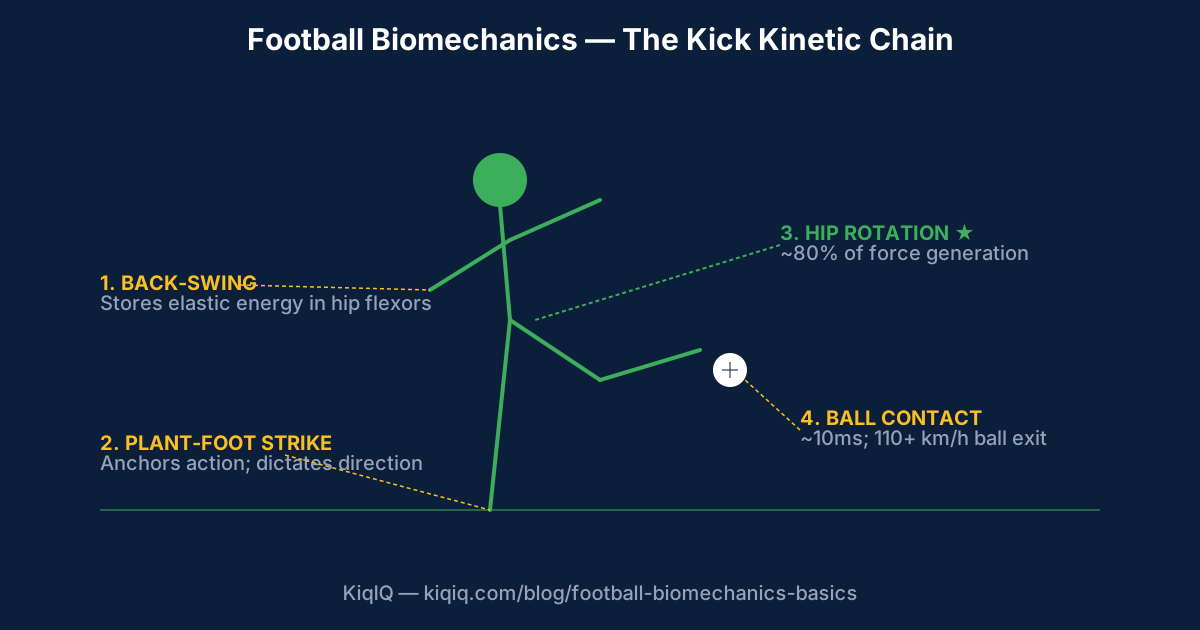
The 4-phase kick: back-swing, plant-foot strike, hip rotation, ball contact + follow-through. Each phase contributes to ball speed:
- Back-swing. Cocks the leg and tensions the hip flexors — stored elastic energy. Bigger back-swing → more potential force, but tradeoff with reaction time.
- Plant-foot strike. Anchors the kicking action. The plant foot lands 5-15cm to the side of the ball; the position dictates kick direction and trajectory.
- Hip rotation. The dominant power source. Pelvis rotates ~90° during the kick. Trained players generate 80% of ball-strike force from hip rotation alone.
- Ball contact + follow-through. Contact lasts ~10ms. Ball speed at boot exit can reach 110+ km/h on long-range strikes. Follow-through dictates spin (curl, knuckleball, dip).
Heading biomechanics
Headers transfer linear momentum from a moving ball to a smaller mass (the head). Two principles dominate: the body must be braced (a relaxed neck cannot redirect ball velocity), and contact must hit the ball squarely on the forehead — the strongest part of the skull.
Recent research on cumulative head impact has shifted heading practice — many academies now restrict heading drills below age 12 and minimise repetitive heading at all youth levels. The biomechanics show why: even sub-concussive impacts accumulate measurable effects on white-matter integrity over thousands of repetitions.
Change of direction (COD)
COD ability — pivoting from one direction to another at speed — is one of the strongest predictors of football effectiveness. Top players combine three biomechanical features:
- Low centre of mass during the cut. Bending knees and dropping the hips reduces the moment arm.
- Wide plant-foot stance. Plant the cutting foot wide of the body to maximise the lateral force vector.
- Trunk lean ahead of the new direction. The body commits before the limbs follow.
Jumping biomechanics
Vertical leap matters most for centre-backs (defending corners), strikers (attacking crosses), and goalkeepers. The biomechanics of an aerial duel jump are: countermovement (quick downward dip to load the legs elastically), explosive triple extension (ankle-knee-hip), and arm swing (adds 5-10cm to vertical leap via momentum).
A standing vertical jump above 60cm is elite for outfield players, 70cm+ for goalkeepers. Bryan Mbeumo, Erling Haaland, Cristiano Ronaldo all clear 60cm.
Practical training implications
Three high-leverage biomechanical interventions for any-level player:
- Single-leg strength. Football is a single-leg sport — most actions occur on one leg. Bulgarian split squats, single-leg RDLs, lateral lunges build the foundations.
- Hip mobility. Restricted hip rotation caps shooting power and turning radius. 90/90 hip drills, hip-flexor stretches, controlled article rotations daily.
- Eccentric hamstring work. Nordic hamstring curls reduce hamstring injury rate by ~50% and improve deceleration. The most-evidenced single intervention in football performance science.
Frequently asked questions
- What is biomechanics in football?
- Football biomechanics is the science of how the body produces movement during the game — sprints, kicks, jumps, tackles, and changes of direction. It studies the kinetic chains that transfer force from the ground through the body to produce these actions, and what training improves them.
- Where does the power in a football kick come from?
- Most of the power comes from hip rotation, not the foot. The kicking action is a kinetic chain that flows from the support-leg ground contact up through the hip, shoulder counter-rotation, and the kicking-leg hip rotation. Trained players generate roughly 80% of ball-strike force from hip rotation alone.
- How can a player improve sprint speed in football?
- Football sprints are short and accelerative. The biggest gains come from horizontal force production at the ground (not just downward), single-leg strength work, plyometrics (skips, bounds, depth jumps), and eccentric strength to support fast deceleration. Top-end track-style speed work matters less than acceleration and direction-change.
- Why are Nordic hamstring curls so important?
- They build eccentric hamstring strength — the muscle's ability to lengthen under load. Multiple meta-analyses show Nordic curls reduce hamstring injuries by approximately 50% and also improve sprint deceleration. They are the most-evidenced single intervention in football performance science.
References
- Biomechanics of Football Kicking — Journal of Sports Sciences
- Nordic Hamstring Curl Meta-Analysis — British Journal of Sports Medicine
- FA Heading Guidance — Youth Football — The Football Association
- UEFA Sports Science — Acceleration Profiles — UEFA
Key terms in this article
Ask KiqIQ a follow-up
Get a live, data-driven answer powered by api-football + KiqIQ's Poisson model. Try one of these prompts or write your own.
Part of pillar
Performance Science
See every article in this knowledge pillar →
Related
Reviewed by a KiqIQ editor before publication. Spotted an error? Email editor@kiqiq.com — we follow our Corrections Policy.