
Football Mental Skills: How Psychology Wins Matches
Mental skills in football — focus, resilience, decision-making, emotional regulation — separate elite players from talented ones. We map the psychological toolkit and how clubs train it.
 Tap to enlarge
Mental skills in football are the cognitive and emotional capacities that turn physical talent into match-winning performance: focus under pressure, resilience after setbacks, fast decision-making, emotional regulation, and confidence. Elite clubs invest as much in psychological preparation as in physical conditioning. Every Premier League club employs at least one sports psychologist; many academies have full mental-skills curricula starting at age 10.
The 5 core mental skills
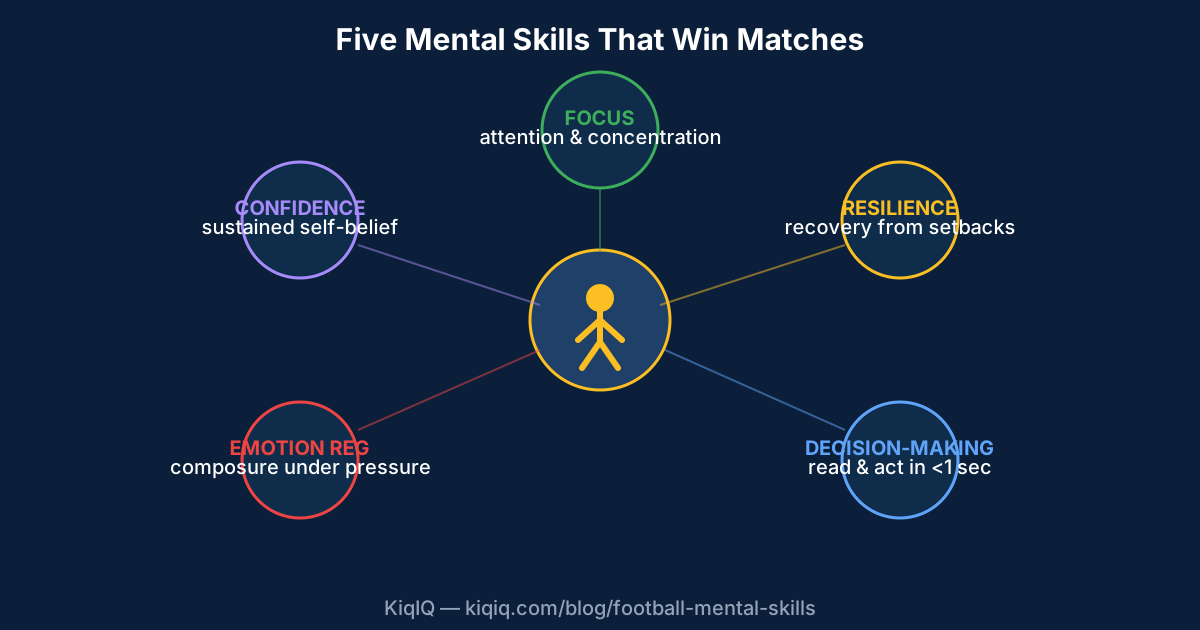
Sports psychology research on football identifies five distinct capacities:
- Focus / attention. Maintaining concentration across 90+ minutes; resisting distraction (crowd noise, off-ball provocations).
- Resilience. Recovering from setbacks within a match (a missed chance, a goal conceded) without performance decline.
- Decision-making speed. Reading game state and choosing the right action in <1 second.
- Emotional regulation. Managing arousal — staying composed under pressure rather than over-aggressive or under-engaged.
- Confidence. Sustained belief in one's ability without arrogance or fragility.
Why mental skills matter more than ever
Three trends have made mental skills a bigger competitive variable:
- Game speed has increased. Decision-making windows in modern football are shorter than 20 years ago. The cognitive demand has risen.
- Margins between elite players have shrunk. Most top-flight footballers are physically and technically excellent; mental capacity now differentiates them.
- Media + social-media pressure. Players face constant scrutiny that previous generations didn't. Mental resilience has become a survival skill.
When Lionel Messi and Cristiano Ronaldo were asked about their primary edge, both cited mental — not physical — preparation. The mental side has become football's underrated competitive advantage.
How clubs train mental skills
Modern clubs use a mix of techniques:
- Sports psychologist sessions. 1-on-1 work + group workshops. Topics: pre-match routines, focus drills, post-match reviews.
- Visualisation training. Players mentally rehearse key match scenarios — penalties, set-piece deliveries, defensive positioning.
- Decision-rehearsal video. Players watch clipped game footage and rehearse what they would do; trains pattern-recognition.
- Pressure simulation in training. Drills designed to simulate high-stakes match situations — small-sided games with consequences for losing.
- Mindfulness / meditation. Increasingly common; some clubs (Liverpool, Manchester City) have in-house mindfulness programmes.
Penalty kicks: the mental-skills laboratory
Penalty kicks are the canonical study of football psychology:
- Conversion rate. Elite players average ~75% from the penalty spot. The variance comes mostly from psychology, not physical skill.
- Approach run. Slower run-up = more pre-shot deliberation = lower conversion. Faster, automatic run-ups perform better under pressure.
- Choice timing. Players who decide their target before the run-up convert more often than those who react to the goalkeeper mid-run.
- Sequencing in shootouts. Going first (vs second) has historically been an advantage of ~5-10% — though research is mixed.
- Goalkeeper psychology. Modern keepers study penalty taker tendencies and use information warfare (movement, eye contact) to disrupt the taker.
Mental skills throughout a player's career
How psychological demands shift across a career:
- Youth (8-15). Building self-confidence; managing parental + coach expectations.
- Late academy (16-21). Coping with rejection (release from academies); resilience after first major setback.
- Senior breakthrough. Adapting to first-team scrutiny; managing first major media attention.
- Peak years (24-30). Sustained performance over multiple seasons; managing minor injuries; maintaining focus during squad rotation.
- Late career (30+). Adjusting role expectations; preparing for retirement.
- Post-retirement. Coping with identity loss — well-documented as a mental-health challenge for ex-professionals.
The most influential sports psychologists in football
A non-exhaustive list of influential figures:
- Dr. Steve Peters. Worked with Liverpool, England rugby, British Cycling. Author of "The Chimp Paradox" — a model of impulse control.
- Dr. Ben Tasker. Worked with several Premier League clubs; specialist in penalty psychology.
- Dr. Steven Sylvester. Sports performance psychologist for elite footballers and managers.
- Dr. Michael Caulfield. Long-standing Premier League and EFL consultant; specialist in dressing-room dynamics.
Mental health vs mental skills
The mental-skills field has expanded into broader mental-health support:
- Depression and anxiety. Acknowledged at higher rates among professional footballers than the general population. PFA + FA both run support services.
- Career-end anxiety. Around 30% of professional footballers report mental-health struggles within 2 years of retirement.
- Off-field stressors. Family pressure, financial stress, social media — all impact on-pitch performance.
- Stigma reduction. Players like Tyrone Mings, Aaron Lennon, and Marvin Sordell have publicly discussed mental health, contributing to increased openness.
Frequently asked questions
- What are the most important mental skills in football?
- Five core skills: focus / attention (sustained concentration), resilience (recovery from setbacks), decision-making speed (reading the game and acting fast), emotional regulation (managing arousal under pressure), and confidence (sustained belief). Modern academies start training these from age 10 onwards.
- Why do top footballers need sports psychologists?
- Modern football game speed has increased, decision-making windows have shrunk, and margins between elite players are tiny. Most top-flight players are physically and technically excellent; mental capacity now differentiates them. When asked, both Lionel Messi and Cristiano Ronaldo cited mental — not physical — preparation as their primary edge.
- How are mental skills trained?
- Through 1-on-1 sports psychologist sessions, visualisation training (mentally rehearsing match scenarios), decision-rehearsal video work, pressure simulation in training (small-sided games with consequences), and mindfulness / meditation programmes. Liverpool, Manchester City, and other top clubs have in-house mindfulness programmes.
- Is mental health different from mental skills in football?
- Yes. Mental skills are performance-oriented (focus, decision-making, etc.). Mental health refers to general wellbeing — depression, anxiety, stress. The two overlap but aren't identical. Career-end anxiety affects roughly 30% of professional footballers within 2 years of retirement; the PFA and FA both run dedicated mental-health support services.
References
Ask KiqIQ a follow-up
Get a live, data-driven answer powered by api-football + KiqIQ's Poisson model. Try one of these prompts or write your own.
Part of pillar
Performance Science
See every article in this knowledge pillar →
Related
Reviewed by a KiqIQ editor before publication. Spotted an error? Email editor@kiqiq.com — we follow our Corrections Policy.