
Why Power Matters in Football: Sprints, Jumps, Shots, and Duels
Power — force × velocity — underpins every explosive football action: sprint accelerations, jumps, shots, tackles, and aerial duels. We explain why power outranks pure strength.
 Tap to enlarge
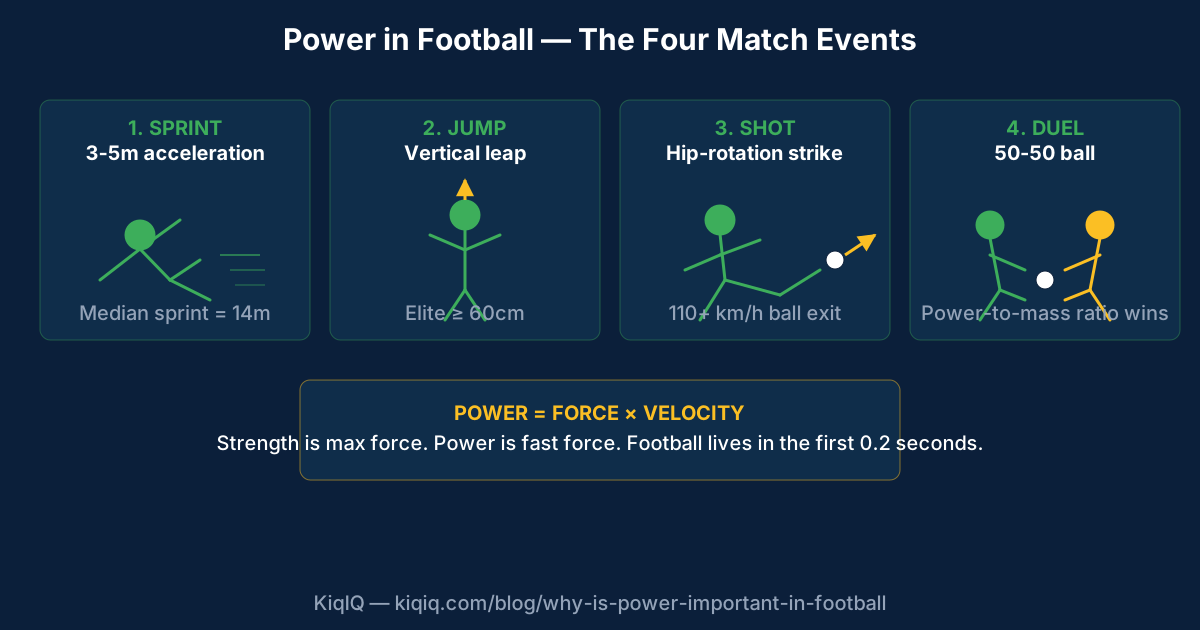
Power in football is the rate at which force is produced — the product of force × velocity. It separates a player who can lift heavy from a player who can sprint, jump, shoot, and win duels. Almost every decisive moment in a match (a sprint, a jump, a shot, a tackle) is a power event lasting under one second. Pure strength matters less; power matters more.
Power vs strength — why the difference matters
Strength is the maximum force you can produce, regardless of speed. A 200kg back-squat is a strength achievement. Power is force × velocity — how fast you can produce that force. A 90cm vertical jump is a power achievement.
Football is a power sport, not a strength sport. Strikers don't have time to grind out a slow shot; defenders don't have time to gradually build into a tackle. Every decisive moment is a fast-twitch event measured in tens of milliseconds. The body that wins is the one that produces force quickly, not the one that produces the most force eventually.
Powerlifters can produce more force than footballers. But they can't deliver it in 0.2 seconds. That window is where football is won.
The four power events of every football match
Match-data filtering identifies four recurring power events:
- Sprint acceleration. Going from a standstill or a jog to full speed in 3-5 metres. Almost all football sprints fit this profile — short, explosive, then immediately decelerating or changing direction.
- Vertical and horizontal jumps. Defending corners, attacking crosses, jumping over slide-tackles. Jumping is the purest expression of lower-body power.
- Shot strike. As covered in the biomechanics article, the shot is a kinetic-chain power event. Hip rotation produces ~80% of the force; the foot is the delivery vehicle.
- Duels — ground and aerial. Winning a 50-50 ball, holding off a defender, blocking a strike. Power-to-mass ratio decides most of these.
How power is trained
Power training has three phases that should run in sequence over a season:
- Strength foundation. Compound lifts (squats, deadlifts, presses) build the maximum force the body can produce. 4-8 weeks pre-season. Without this base, power-training has nothing to convert.
- Velocity conversion. Once the strength base exists, power-specific work converts force into fast force: jump squats, kettlebell swings, plyometrics (bounds, depth jumps), Olympic-lift variations (cleans, snatches). 4-6 weeks.
- Sport-specific power. Plyometric drills shaped like the sport: lateral bounds, broad jumps, single-leg countermovement jumps, ladder + cone agility. In-season maintenance.
Why power declines first as players age
Players don't lose strength quickly with age — many footballers maintain or even improve their squat numbers into their early 30s with proper training. What they lose is power. Fast-twitch muscle fibres atrophy faster than slow-twitch. The decline of explosive sprint speed and vertical leap typically starts at 28-30 even in well-trained players.
Veteran players who keep playing at the top level (Cristiano Ronaldo, Karim Benzema, Lionel Messi) compensate by trading raw power for positioning, anticipation, and timing. They make the same plays without the same first step.
The science of the first 3 metres
Acceleration data from GPS-tracked Premier League matches shows the median sprint length is just 14 metres. The first 3 metres of that sprint determine whether the player gets ahead of their opponent. Top-end speed (the kind track sprinters develop) almost never matters in football because matches don't allow players to reach it.
This explains why short, intense plyometric work outperforms long-distance sprint training for most footballers. The first 3 metres is a power problem, not an aerobic problem.
Power and injury prevention
Power training has a defensive dividend. Plyometric and Olympic-lift work builds the eccentric strength (the muscle's ability to absorb force) that prevents hamstring tears, ACL injuries, and groin strains. The Nordic hamstring curl — covered in the biomechanics article — is a power-eccentric exercise. So is the Bulgarian split squat.
Players who skip lower-body power work to "save their legs" tend to lose more time to soft-tissue injuries than players who train it intelligently. Eccentric power is protective.
Frequently asked questions
- What is power in football?
- Power is the rate at which force is produced — force × velocity. It governs every explosive football action: sprint accelerations, vertical and horizontal jumps, shot strikes, and ground or aerial duels. Almost all decisive match moments are sub-second power events.
- Is power more important than strength in football?
- Yes. Strength is maximum force regardless of speed; power is fast force. Football allows tens of milliseconds for an action — there is no time for slow strength expression. Powerlifters produce more force than footballers but cannot deliver it in 0.2 seconds. That window is where football is decided.
- How is power trained?
- Three phases: a strength foundation (squats, deadlifts, presses) for 4-8 weeks pre-season; velocity-conversion work (jump squats, kettlebell swings, plyometrics, Olympic-lift variations) for 4-6 weeks; and in-season sport-specific power maintenance (lateral bounds, broad jumps, single-leg countermovement jumps).
- Why do players lose pace as they age?
- Power declines before strength because fast-twitch muscle fibres atrophy faster than slow-twitch. Most players keep their max-strength numbers into their early 30s but lose explosive sprint speed and vertical leap from 28-30 onwards. Veteran players compensate with positioning and anticipation rather than first-step pace.
References
- Power Output in Football — GPS Tracking Data — British Journal of Sports Medicine
- Plyometric Training and Football Performance — Journal of Strength and Conditioning Research
- UEFA Sports Science — Sprint Profiles — UEFA
- Eccentric Strength and Soft-Tissue Injury Prevention — British Journal of Sports Medicine
Key terms in this article
Ask KiqIQ a follow-up
Get a live, data-driven answer powered by api-football + KiqIQ's Poisson model. Try one of these prompts or write your own.
Part of pillar
Performance Science
See every article in this knowledge pillar →
Related
Reviewed by a KiqIQ editor before publication. Spotted an error? Email editor@kiqiq.com — we follow our Corrections Policy.