
Why Is Flexibility Important in Football? Performance and Injury Prevention
Flexibility in football enables full range of motion for sprinting, kicking, change of direction, and aerial duels. We explain why it matters, where to focus, and how to train it.
 Tap to enlarge
Flexibility in football is the range of motion through which the joints can move. It enables full sprint stride length, full hip rotation in shooting, full body shape during aerial duels, and full reach in slide tackles. More importantly, restricted flexibility is one of the strongest predictors of soft-tissue injury — particularly hamstring strains, ankle sprains, and groin pulls.
Why flexibility matters in football
Football demands extreme ranges of motion at multiple joints simultaneously. A full-power kick requires hip flexion, hip extension, knee extension, and trunk rotation in the same kinetic-chain action. Restricted flexibility at any point caps the power that can be delivered.
Beyond power, flexibility prevents injury. Tight hamstrings tear under sprint load. Restricted hip flexors compensate via the lower back. Limited ankle dorsiflexion is the strongest single predictor of ACL injury risk.
Flexibility is not the same as stretching. Flexibility is the joint range; stretching is the training intervention. Both matter — but only the range affects performance and injury risk.
Three joints that matter most
Three joint regions disproportionately affect football performance:
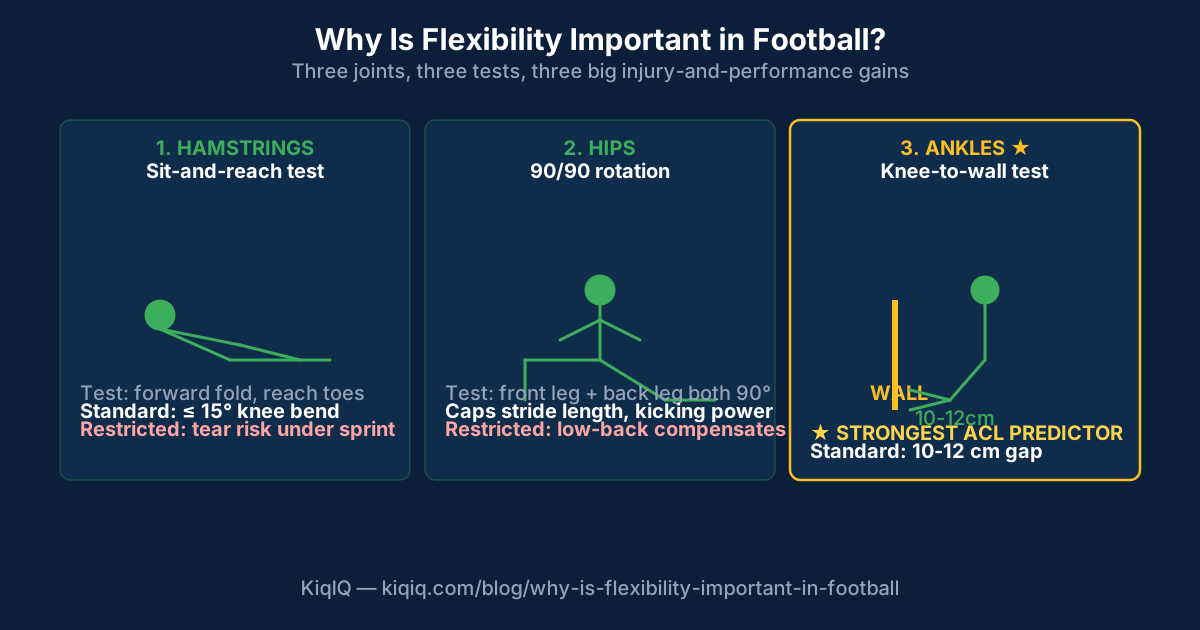
- Hips. Hip mobility caps sprint stride, kicking power, and turning radius. Tight hip flexors are common in players who sit a lot in daily life. Test: 90/90 hip rotation. Standard: passable; restricted: needs work.
- Hamstrings. Hamstrings are the most-injured muscle group in football. Tight hamstrings tear under sprint loads. Test: sit-and-reach (or supine 90/90 with knee straightening). Standard: 0-15° knee bend at full extension; restricted: > 15° gap.
- Ankles. Ankle dorsiflexion (knee moving forward over the toes) is the strongest single predictor of ACL injury. Test: knee-to-wall — stand foot a few cm from a wall, bend the knee toward the wall. The further your toe can be from the wall while still touching with the knee, the better. Standard: 10-12 cm; restricted: < 8 cm.
How to improve flexibility
Three approaches, each with merits:
- Static stretching (post-match / recovery only). Held stretches, 30-60 seconds, after exertion. Improves flexibility over weeks of consistency. Avoid pre-match.
- Dynamic mobility (daily, including pre-match). Movement-based mobility through full ranges. Leg swings, controlled rotations, hip openers. Best done daily for cumulative effect.
- Eccentric loaded stretching. Loaded eccentric work (Nordic curls, slider lunges) builds flexibility under load — the type that prevents injury during sprints, not just static reaches. Most evidence-based intervention.
The flexibility paradox
A common misconception: more flexibility is always better. False. Hyper-flexible players (gymnastic-style) often have weak joint stability and are at higher injury risk than moderately flexible players with strong joint control.
The football-relevant goal is "functional flexibility" — full functional range during sport-specific actions, with joint stability under load. A player who can touch their toes is irrelevant; a player who can sprint at full stride length without their hamstring tightening is the goal.
When restricted flexibility shows up in match play
Three on-pitch signs that flexibility is limiting performance:
- Shortening sprint stride late in matches. Tired hip flexors restrict knee drive; stride shortens. Often visible on broadcast tracking.
- Dropping shooting power. Restricted hip rotation caps the kinetic-chain energy delivered to the ball.
- Slow change of direction. Limited ankle dorsiflexion forces a wider base of support to turn — slower and more vulnerable to being beaten.
Building flexibility into a weekly schedule
A typical professional flexibility schedule:
- Daily 10-min mobility (hips, ankles, T-spine) — performed at home or pre-training.
- 2-3 sessions per week of eccentric strength (Nordic hamstrings, Bulgarian split squats, Copenhagen adductor planks).
- Post-match static stretching (30-60s holds) on the recovery day.
- 1 yoga or pilates session per week for active recovery and flexibility maintenance.
Frequently asked questions
- Why is flexibility important in football?
- Flexibility enables full range of motion for sprinting, kicking, change of direction, and aerial duels. Restricted flexibility caps power output (a tight hip flexor reduces kicking power) and dramatically increases soft-tissue injury risk — tight hamstrings tear under sprint load, limited ankle dorsiflexion is the strongest single predictor of ACL injury.
- Is more flexibility always better?
- No. Hyper-flexibility (gymnastic-style ranges) often coincides with weak joint stability and a higher injury risk. The football-relevant goal is "functional flexibility" — full sport-specific range with joint stability under load. A player who can sprint at full stride without hamstring tightness is the goal, not a player who can touch their toes.
- Which joints matter most for football flexibility?
- Three regions: hips (sprint stride length, kicking power, turning radius — test with 90/90 hip rotation), hamstrings (most-injured muscle group in football — test with sit-and-reach or supine 90/90), and ankles (dorsiflexion is the strongest single ACL-injury predictor — test with knee-to-wall).
- What's the best way to improve flexibility?
- Three combined: daily dynamic mobility (10 min, hip/ankle/T-spine), 2-3 weekly sessions of eccentric strength work (Nordic hamstrings, Bulgarian split squats), and post-match static stretching (30-60s holds). Eccentric strength work has the strongest injury-prevention evidence; daily mobility maintains the gains.
References
- Ankle Dorsiflexion and ACL Injury Risk — Journal of Orthopaedic and Sports Physical Therapy
- Eccentric Hamstring Training and Injury Prevention — British Journal of Sports Medicine
- FIFA 11+ Injury Prevention Programme — FIFA Medical
- Functional Flexibility in Elite Football — UEFA Sports Science
Key terms in this article
Ask KiqIQ a follow-up
Get a live, data-driven answer powered by api-football + KiqIQ's Poisson model. Try one of these prompts or write your own.
Part of pillar
Performance Science
See every article in this knowledge pillar →
Related
Reviewed by a KiqIQ editor before publication. Spotted an error? Email editor@kiqiq.com — we follow our Corrections Policy.