
Why Is Agility Important in Football? Performance Science Explained
Agility — the ability to change direction quickly under control — separates elite footballers from talented ones. We cover why agility matters, how it differs from speed, and the training methods.
 Tap to enlarge
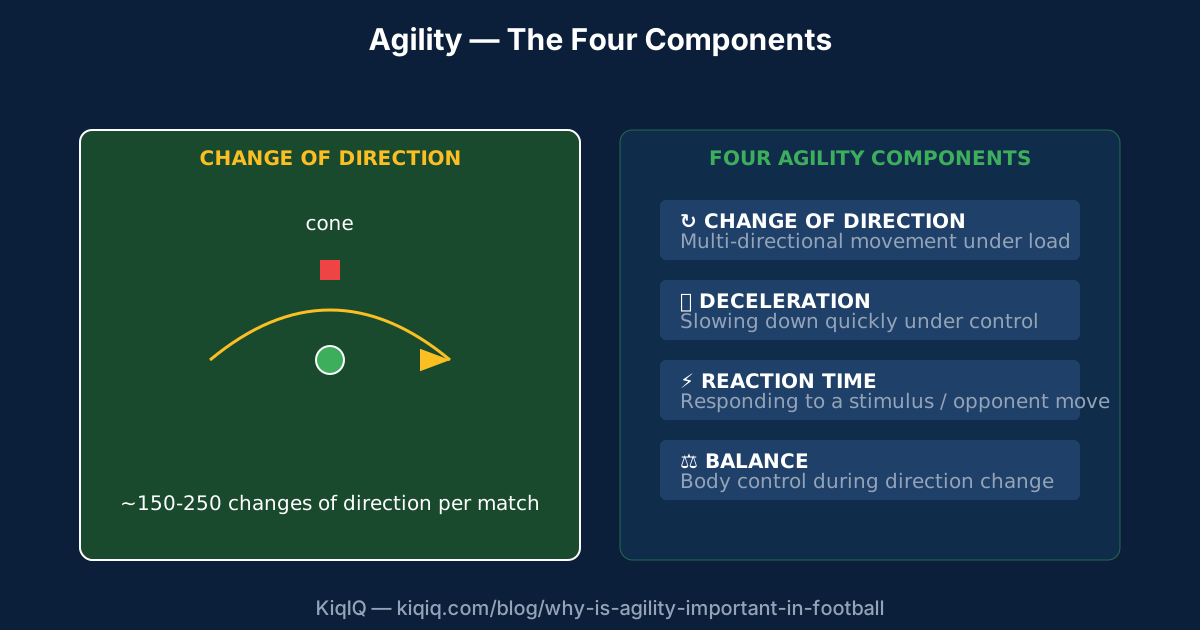
Agility is one of the defining physical qualities in football — the ability to change direction quickly while maintaining control of the body and the ball. It combines change of direction, deceleration, reaction time, and balance. Modern football demands repeated bursts of agility (~150-250 changes of direction per match per player) more than sustained speed. Agility differentiates elite players from merely fast ones — Messi, Iniesta, and Modrić are technical examples of agility-as-genius.
What agility is (and isn't)
Agility is often confused with speed, but they are distinct physical qualities.
- Speed. Maximum velocity in a straight line. Top sprinters reach 11+ m/s; elite footballers reach ~9-10 m/s.
- Agility. Multi-directional movement under cognitive load — change of direction + deceleration + reaction + balance.
- Quickness. Short-burst acceleration; a sub-component of agility.
- Coordination. The neuromuscular control underlying both speed and agility.
Modern sport science divides agility into "pre-planned" change of direction (COD) and "reactive" agility (responding to a stimulus). Football demands both, with reactive agility being the more match-relevant skill.
Why agility matters in football
- Match demands. Players make ~150-250 changes of direction per match. Most are <90° turns; elite playmakers do more.
- 1v1 outcomes. Beating a defender often requires a sharp directional change — Messi's feints, Iniesta's body swerves, Modrić's ball-shielding rotations.
- Defensive performance. Agile defenders close down attackers and recover from being beaten. Reaction speed is the difference between a tackle and a yellow card.
- Pressing efficiency. Agile pressers cover more pressing-action area in less time — high pressing teams need agility, not just stamina.
- Injury prevention. Strong agility profile (good deceleration mechanics) reduces non-contact knee and ankle injuries.
How agility is measured
- 5-10-5 (Pro Agility) test. Sprint 5m right, sprint 10m left, sprint 5m back to start. Time = agility score.
- T-test. Sprint forward, side-shuffle, backpedal. Tests multi-directional capacity.
- Illinois agility test. Multiple changes of direction across a marked course.
- Reactive agility test. Players react to a stimulus (light, hand signal, video) and execute the appropriate movement.
- Position-specific norms. Wingers and attacking midfielders typically score best; centre-backs are typically slowest in pure agility tests.
How to train agility in football
- Cone drills. Pre-planned change-of-direction patterns. Useful for technique but limited transfer to match.
- Reactive drills. Coach signals direction; player must react. Better match transfer than pre-planned drills.
- Small-sided games. 4v4 or 5v5 in compact spaces force constant direction changes — high-transfer training.
- Plyometric work. Bounds, hops, and jumps build explosive deceleration capacity (the under-trained side of agility).
- Eccentric strength training. Slow, controlled lowering builds deceleration capacity. Critical for agility AND injury prevention.
- Cognitive training. Decision-making drills that pair perception with movement (e.g., react to a coach's call mid-sprint).
Famous agility specialists
- Lionel Messi. The textbook example — close control + tight directional changes that nobody can stay with.
- Andrés Iniesta. Body-swerve agility through tight midfield spaces.
- Luka Modrić. Rotational agility shielding the ball under pressure.
- Ronaldinho. Hip-swerve agility in 1v1s.
- Mohamed Salah. Inside-out cutting agility in attack.
- N'Golo Kanté. Defensive agility — repeated quick directional changes to recover possession.
Frequently asked questions
- Why is agility important in football?
- Agility is the ability to change direction quickly while maintaining control of the body and the ball. Football demands ~150-250 changes of direction per match per player. Elite agility differentiates players who can beat defenders 1v1, defend effectively against quick attackers, and press efficiently in modern systems. Agility also reduces non-contact knee and ankle injury risk.
- What is the difference between agility and speed in football?
- Speed is maximum velocity in a straight line — top footballers reach ~9-10 m/s. Agility is multi-directional movement under cognitive load: change of direction + deceleration + reaction time + balance. A fast player isn't necessarily agile, and an agile player isn't necessarily fast (though most elite footballers are both).
- How is agility tested in football?
- Standard tests include the 5-10-5 (Pro Agility) test, T-test (forward sprint + side shuffle + backpedal), Illinois agility test, and reactive agility tests where players respond to a visual / verbal stimulus. Wingers and attacking midfielders typically score best; centre-backs typically slowest. Reactive agility tests have better match-transfer than pre-planned drills.
- How can footballers improve agility?
- Five evidence-based methods: (1) reactive drills where players respond to a stimulus rather than pre-planned patterns; (2) small-sided games (4v4 / 5v5) which force constant direction changes; (3) plyometric work for explosive deceleration; (4) eccentric strength training for deceleration capacity and injury prevention; (5) cognitive training pairing perception with movement.
References
- FIFA Training Centre — Agility — FIFA
- Diamond Football — Agility Drills — Diamond Football
- BJSM — Agility in Sport — British Journal of Sports Medicine
- NSCA — Agility Training — NSCA
Key terms in this article
Ask KiqIQ a follow-up
Get a live, data-driven answer powered by api-football + KiqIQ's Poisson model. Try one of these prompts or write your own.
Part of pillar
Performance Science
See every article in this knowledge pillar →
Related
Reviewed by a KiqIQ editor before publication. Spotted an error? Email editor@kiqiq.com — we follow our Corrections Policy.