
Why Is Cardiovascular Fitness Important in Football?
Cardiovascular fitness powers the repeat-sprint capacity that football demands across 90+ minutes. We cover why aerobic + anaerobic capacity both matter.
 Tap to enlarge
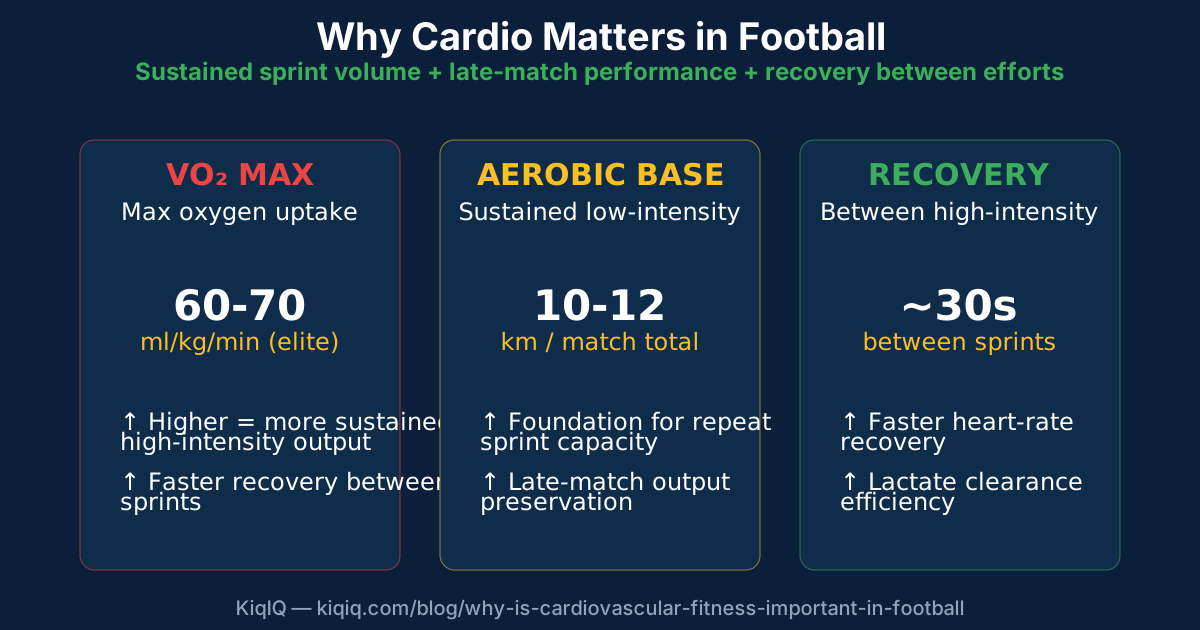
Cardiovascular fitness powers the repeat-sprint capacity football demands across 90+ minutes. Premier League midfielders cover 10-12 km per match with 30-50 high-intensity efforts. Cardio fitness combines aerobic capacity (sustained running) and anaerobic recovery (between sprints). Elite footballers have VO2 max ≥ 60 ml/kg/min.
Why cardio matters in football
Cardiovascular fitness is the platform every other fitness component sits on top of. A player can have elite top-end speed and elite acceleration, but if they cannot recover between sprints they will only access those qualities for the first half of a match. Modern football is built around repeated maximal efforts separated by short, incomplete recoveries — the average gap between high-intensity actions for a Premier League midfielder is under a minute, and that recovery window is almost entirely aerobic.
Cardio fitness also has a cognitive dimension that often gets overlooked. Decision-making degrades sharply under physical fatigue: the same player who picks the right pass in minute 20 will pick the wrong pass in minute 85 simply because their brain is competing with their legs for oxygen. The teams that win late goals are usually the ones whose fitness has held up well enough to keep thinking clearly while their opponents are running on fumes.
- Sustained activity. 90+ minutes of constant movement requires aerobic capacity.
- Repeat-sprint capacity. Football is repeat-sprint, not max-once. Recovery between sprints determines late-match performance.
- Late-match decision-making. Tired players make worse decisions; cardio fitness preserves cognition.
- Pressing intensity. Modern pressing systems require sustained high-intensity work.
- VO2 max norms. Elite outfield ~60-65 ml/kg/min; goalkeepers ~50-55.
How football cardio is trained
Effective football cardio looks very different from generic endurance work. The dominant method at elite level is small-sided games (3v3, 4v4, 5v5 on compressed pitches), which produce heart-rate profiles almost identical to a competitive match while keeping the ball involved. The second pillar is structured interval work — 4×4-minute blocks at 90-95% max HR with 3-minute jog recoveries, or shorter 30-second sprint repeats with controlled rest. Steady-state long runs still appear in pre-season blocks for building aerobic base, but they are a small fraction of the total cardio load during the season.
Position changes the dose. Midfielders and wing-backs need the highest aerobic capacity because they cover the most ground. Centre-backs and target strikers can get away with slightly lower VO2 max but need strong anaerobic recovery for the bursts they do produce. Goalkeepers sit lowest on VO2 norms, with their training tilted heavily towards explosive power and reaction speed rather than endurance.
Frequently asked questions
- Why is cardiovascular fitness important in football?
- Football demands 10-12 km per match across 90+ minutes with 30-50 high-intensity efforts. Cardio fitness combines aerobic capacity (sustained running) and anaerobic recovery (between sprints). Without cardio fitness, players fatigue early, make worse late-match decisions, and can't sustain pressing intensity. Elite footballers have VO2 max ≥ 60 ml/kg/min.
- How is football cardio different from running cardio?
- Football is repeat-sprint cardio — bursts of 6-10 seconds at 90%+ effort, with 20-60 seconds recovery. Running cardio is more sustained at moderate intensity. Football training mixes interval-based (HIIT) with extensive aerobic work; pure long-distance running has limited transfer.
- What is a good VO2 max for an amateur footballer?
- Amateur male outfielders typically test in the 50-58 ml/kg/min range; elite professionals run 60-65. Anything above 55 is a strong amateur base, and most players can add 5-10 ml/kg/min through structured training. Goalkeepers are the exception — VO2 max is less important for the position, so 50-55 is acceptable even at the top level.
References
- BBC Bitesize — Football Fitness — BBC Bitesize
- GSSI — Physiology Demands — GSSI
- PMC — Aerobic Fitness Football — PubMed Central
Key terms in this article
Ask KiqIQ a follow-up
Get a live, data-driven answer powered by api-football + KiqIQ's Poisson model. Try one of these prompts or write your own.
Part of pillar
Performance Science
See every article in this knowledge pillar →
Related
Reviewed by a KiqIQ editor before publication. Spotted an error? Email editor@kiqiq.com — we follow our Corrections Policy.