
Why Is Coordination Important in Football?
Coordination underpins every technical action — passing, dribbling, shooting, tackling. Without it, individual fitness components don't translate to football performance.
 Tap to enlarge
Coordination is the neuromuscular control that underpins every technical action in football — passing, dribbling, shooting, tackling, jumping. Without it, individual fitness components (speed, power, endurance) don't translate to football performance. Coordination is most trainable in childhood and early adolescence; the FA prioritises coordination work in U7-U12 development.
Coordination components
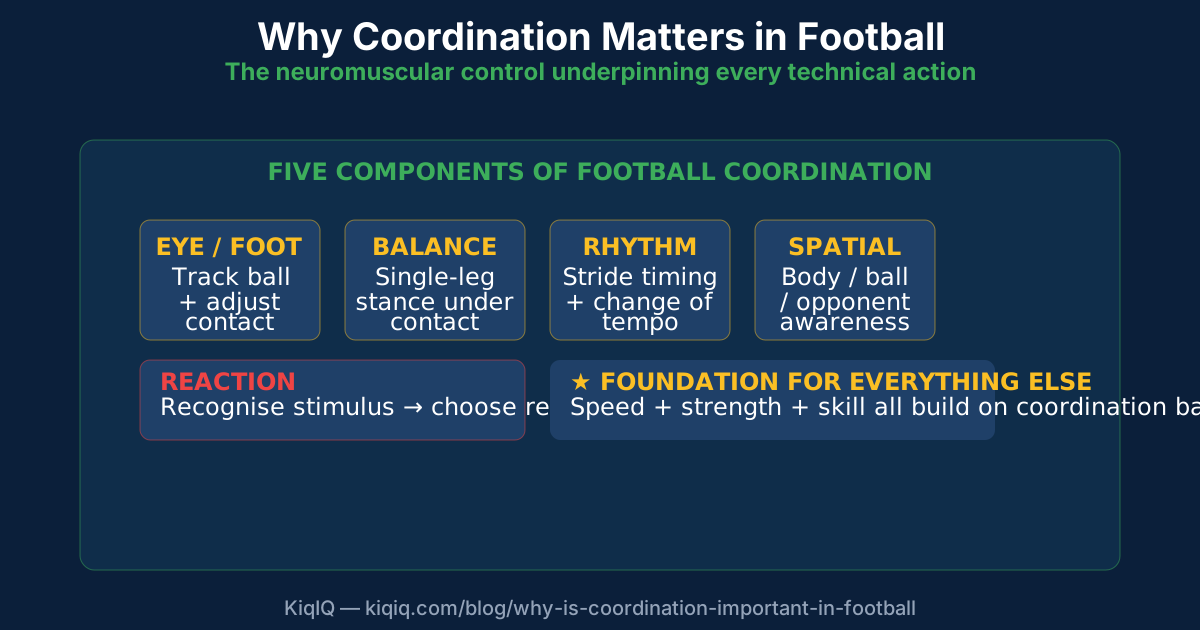
Coordination is usually broken into five sub-skills that combine differently depending on the action. A defensive header needs balance and spatial awareness more than rhythm; a chipped pass on the half-turn needs all five at once. Treating coordination as one thing makes it harder to train — separating it into components lets coaches target the weakest link.
- Hand-eye / foot-eye. Tracking moving objects + executing precise movements.
- Balance. Static + dynamic body control.
- Rhythm. Movement timing — cadence of running, jumping, kicking.
- Spatial awareness. Knowing where you are relative to ball, teammates, opponents, goal.
- Reaction. Responding to stimuli with appropriate movement.
Why coordination matters
Coordination is the multiplier sitting between physical capacity and football output. A player can run fast in a straight line and squat heavy weight, but if they cannot organise their limbs around a moving ball under pressure, none of it reaches the scoreboard. Coordination is what turns athleticism into football, and the gap between gym numbers and match numbers is almost entirely down to this.
- Foundation skill. Speed without coordination = wild sprints; power without coordination = inaccurate strikes.
- Technical execution. Passing, dribbling, shooting all require coordinated movement.
- Injury prevention. Better coordination = better landing mechanics + neural control under fatigue.
- Most trainable young. Critical "skill-acquisition window" 6-12 years old.
How coordination is trained
Coordination is heavily age-dependent. Children between 6 and 12 are inside what motor-learning research calls the "skill-acquisition window" — the nervous system is laying down movement patterns at a rate it never matches again. Coaches at this age prioritise movement variety over specialisation, which is why FA youth curricula keep kids touching the ball with both feet, jumping off both legs, and rotating positions rather than locking them into a role.
Adult coordination is still trainable, but adaptations come from neural rewiring rather than fresh pattern-laying, so progress is slower and more specific. The five most effective methods in adult training are ladder and cone footwork, ball-mastery and juggling work, rhythmic exercises (skipping, plyometric hops to a beat), reactive drills using visual or auditory cues, and bilateral training — deliberately using the weaker foot until it stops feeling weak. None of these need expensive equipment, which is why coordination is one of the highest-leverage areas a self-coached player can target.
Frequently asked questions
- Why is coordination important in football?
- Coordination is the neuromuscular control underpinning every technical action — passing, dribbling, shooting, tackling. Without it, individual fitness components don't translate to performance. Speed without coordination = wild sprints; power without coordination = inaccurate strikes. Coordination is most trainable 6-12 years old.
- How can footballers improve coordination?
- Five methods: (1) ladder drills + cone work for footwork; (2) ball juggling + skills practice; (3) dance / rhythm work; (4) reactive drills with visual / auditory stimuli; (5) bilateral training (weak-foot work). Most progress happens in youth (6-12); adults can improve but adaptations are slower.
- Can adults improve coordination, or is it too late?
- Adults can improve, but more slowly than children. The 6-12 "skill-acquisition window" is when patterns lay down fastest, but neural rewiring continues throughout life. Adult coordination gains tend to be more specific — train a weak left foot and the left foot improves, but the transfer to other skills is smaller than it would be for a young player. Consistency beats intensity here.
References
- BU1Sport — Coordination Football — BU1Sport
- Soccer Interaction — Coordination — Soccer Interaction
- MBP School — Coordination — MBP School
Ask KiqIQ a follow-up
Get a live, data-driven answer powered by api-football + KiqIQ's Poisson model. Try one of these prompts or write your own.
Part of pillar
Performance Science
See every article in this knowledge pillar →
Related
Reviewed by a KiqIQ editor before publication. Spotted an error? Email editor@kiqiq.com — we follow our Corrections Policy.