
Why Is Reaction Time Important in Football?
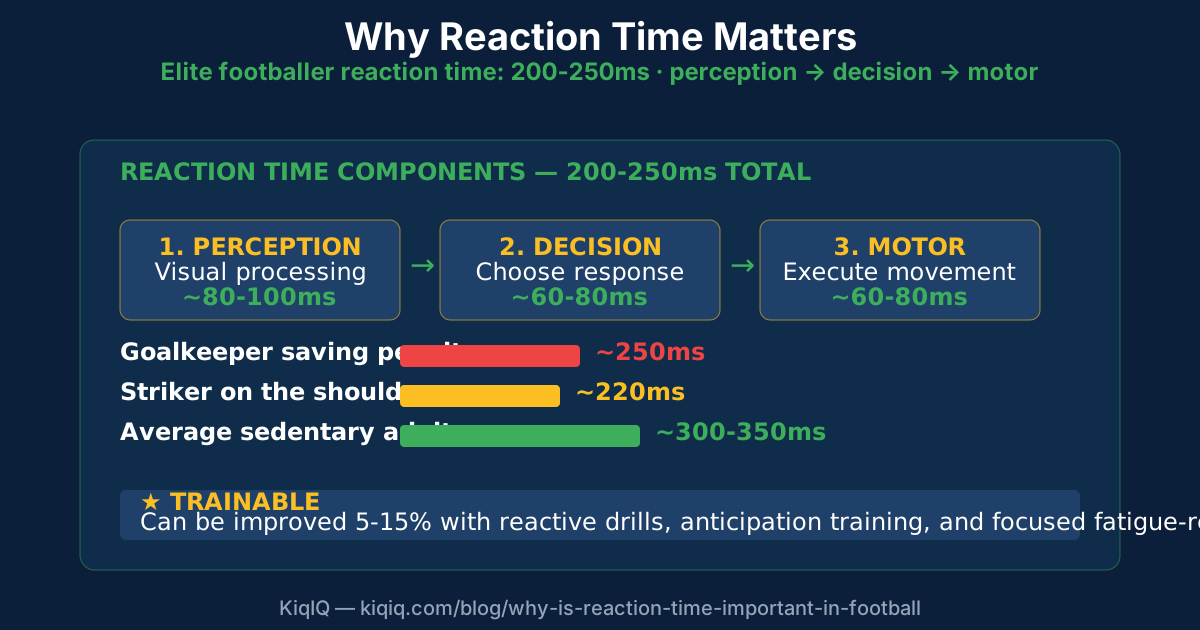
Reaction time determines how quickly players respond to opponent movements, ball deflections, and goalkeeper saves. Elite footballers react in 200-250ms.
 Tap to enlarge
Reaction time is the time between a stimulus and the player's motor response. Elite footballers react in 200-250ms; goalkeepers facing a penalty have ~400ms before the ball arrives. Reaction time matters most for goalkeepers (saves), defenders (intercepting passes), and pressing forwards (closing down on first touch).
How reaction time breaks down
Reaction time is not a single skill — it is the sum of three sub-processes that fire in sequence every time a player responds to something on the pitch. Improving any one of them shaves milliseconds off the total, and milliseconds decide goals.
- Visual processing (~80-120ms). Detecting the stimulus. The retina captures the image and the brain identifies it as relevant (a ball, a body shape, a teammate's pointing arm).
- Decision (~50-100ms). Choosing the response. Trained athletes recognise familiar patterns faster, so the decision phase is where most of the experience gap lives.
- Motor execution (~50-100ms). Initiating the movement. The neural signal travels from the motor cortex to the relevant muscle group and the limb begins to move.
- Total elite reaction. ~200-250ms for trained athletes; ~300-400ms untrained.
Why reaction time matters
Reaction time is most important in moments where the player has no time to think — the ball is already moving, the opponent has already committed, and the only question is whether the body can respond in time. Those moments are spread across every position on the pitch, but they cluster in four specific game situations.
- Goalkeeper saves. Penalty kicks reach the goal in ~400ms; reaction time is the difference between save and goal. Reflex saves from deflections inside the six-yard box can require sub-200ms responses.
- Pressing triggers. Forwards reading defender body shape react to vulnerability cues (a heavy first touch, an open body angle) in <300ms. The fastest pressers turn opposition mistakes into shots before the defender can recover.
- Defensive interceptions. Centre-backs reading through-balls versus through-runners need to commit one way or the other in milliseconds. The wrong choice, made fast, is often better than the right choice made slowly.
- 1v1 outcomes. Faster reaction wins more 1v1s in attack and defence. The attacker who reacts to a defender's weight shift first gets the half-yard that becomes a chance.
How reaction time is trained
Reaction time has a substantial genetic component — peak elite reaction speed is partly determined by neural conduction velocity, which is hard to change. But the trainable portion is still meaningful: most athletes can improve reaction time by 10-20% with structured drills, and the gains stack with improvements in pattern recognition (which has no ceiling and keeps growing into a player's 30s).
Training breaks into two categories. The first is raw reaction-speed work using artificial stimuli — light boards, coach calls, audio cues that the athlete responds to as quickly as possible. The second is football-specific work where the stimulus is built into the drill: small-sided games with mid-flight rule changes, rondos with floating defenders, goalkeeper-specific multi-ball drills where deflections come from unpredictable angles. Specific training improves football reaction more than generic training because the visual and decision phases are tuned to football-shaped stimuli.
Frequently asked questions
- Why is reaction time important in football?
- Reaction time determines how quickly players respond to opponent movements, ball deflections, and visual stimuli. Elite footballers react in 200-250ms. Most important for goalkeepers (penalties arrive in ~400ms), defenders (interceptions), and pressing forwards (closing down on first touch).
- How can football players improve reaction time?
- Reactive drills using visual / auditory stimuli (light boards, coach calls, video clips), small-sided games with rule changes mid-flight, and goalkeeper-specific reaction training (multi-ball drills). Reaction time has a genetic component but most athletes can improve 10-20% with structured drills, and football-specific pattern recognition keeps improving well into a player's 30s.
- Is reaction time the same as agility?
- No. Reaction time is the stimulus-to-response delay; agility is the ability to change direction quickly once moving. The two are correlated — a fast reaction puts a player into motion sooner — but they are trained differently and they fail differently. A player can have elite reaction time and poor agility, or the reverse.
References
- Diamond Football — Reaction Time — Diamond Football
- BBC Bitesize — Components of Fitness — BBC Bitesize
Key terms in this article
Ask KiqIQ a follow-up
Get a live, data-driven answer powered by api-football + KiqIQ's Poisson model. Try one of these prompts or write your own.
Part of pillar
Performance Science
See every article in this knowledge pillar →
Related
Reviewed by a KiqIQ editor before publication. Spotted an error? Email editor@kiqiq.com — we follow our Corrections Policy.