
Why Is Speed Important in Football?
Speed determines who wins races for the ball, beats defenders 1v1, and gets back to defend. We cover why speed matters and how it differs from agility.
 Tap to enlarge
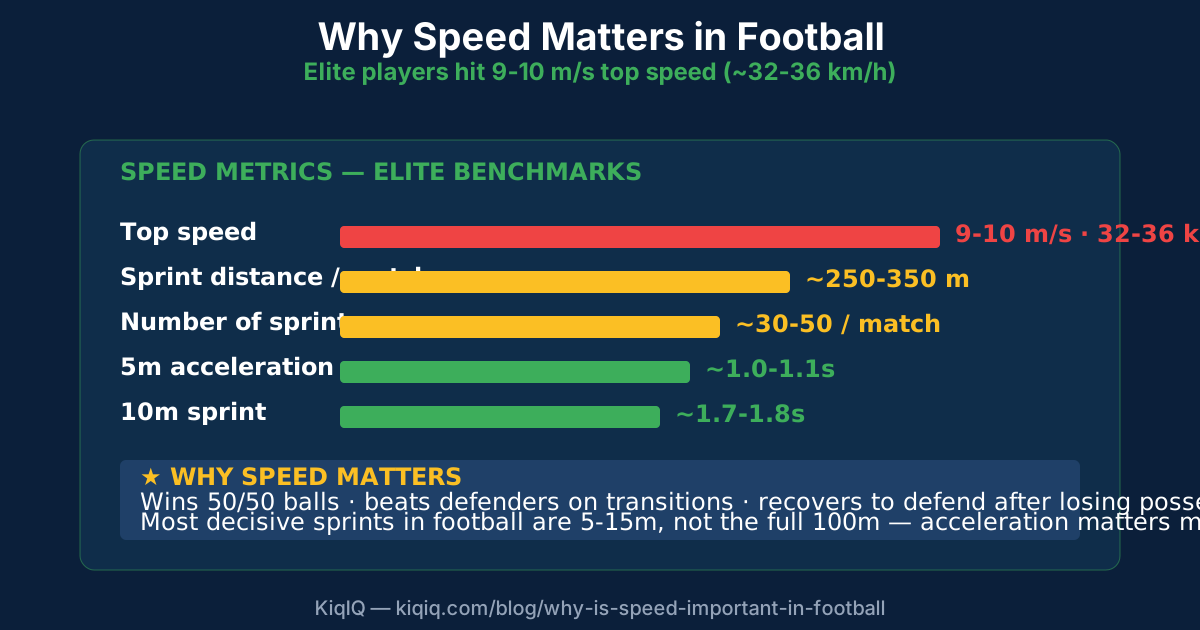
Speed is one of football's defining physical qualities — the ability to move at maximum velocity. Elite footballers reach 9-10 m/s top speed (~32-36 km/h). Speed wins races for the ball, helps beat defenders 1v1, and powers defensive recovery runs. Combined with agility, it differentiates elite-tier from mid-tier players.
Why speed matters
Speed is the single physical attribute that most reliably translates between tiers of football. A technically gifted player in a lower league can play in a top league only if they can keep up with the pace; conversely, a player with elite pace will find a level somewhere even if their first touch is mediocre. That asymmetry is why speed is the trait pro clubs will most consistently pay a premium for — and why a slow player in a fast league rarely survives, no matter how good their other qualities are.
- Wins races for the ball. Through-balls, long passes, second balls — fastest player wins. A single yard of pace decides the outcome of dozens of duels every match.
- Beats defenders 1v1. Pure pace can break the defensive line; combined with technique it produces an elite winger or a centre-forward who plays in behind.
- Defensive recovery. Faster defenders can recover from being beaten more often, which lets them play higher and tighter without the same risk of getting exposed on the turn.
- Pressing efficiency. Fast forwards close down opposition centre-backs faster, forcing turnovers higher up the pitch where they convert into shots.
- Counter-attack speed. Fast counter-attackers exploit space behind a high defensive line; teams without pace cannot run a transitional game-plan no matter what the manager wants.
Speed vs related qualities
Speed is often conflated with agility, acceleration, and sprint endurance, but these are distinct physical qualities with different training requirements and different match relevance. A player can be elite in one and average in another — and in football, the most important of the four is acceleration, not top speed.
- Speed. Maximum velocity in a straight line. Elite ~9-10 m/s. Only relevant during sustained sprints — 30m+ — which happen a handful of times per match.
- Acceleration. Time to reach top speed. The first 5-10m matter more than top speed in football because most duels are won or lost over short distances. This is where the biggest performance gap lives.
- Agility. Multi-directional change-of-direction capacity. Different from speed; trained differently; uses different muscle groups. A fast straight-line runner can be slow at changing direction.
- Endurance. Capacity to repeat sprints with short recovery. Football is a repeat-sprint sport — top speed twenty times across 90 minutes — not a single max-effort sprint. Endurance determines how late in the match a player retains their pace.
How to improve speed
Improving speed is one of the few physical qualities where dedicated, structured training produces consistent gains for most players. Genetics set a ceiling, but very few amateur or even semi-pro players are close to their genetic ceiling — there is almost always 0.3-0.6 m/s of improvement available with the right programme.
The programme has three legs: raw speed work, strength and power, and sprint mechanics. None of them work in isolation. Sprint training without strength work produces a player who can technique their way to a moderate top speed; strength work without sprint work produces a player who is powerful in the gym but slow on the pitch.
- Sprint training. 30-60m max-speed sprints with full recovery (4-6 mins between reps). Volume is deliberately low — six to eight sprints in a session — because quality, not quantity, drives adaptation.
- Strength training. Heavy squats, deadlifts, hip-thrusts — directly transfers to sprint power. The strongest leg-drive produces the fastest acceleration phase.
- Plyometrics. Bounds, hops, jumps — explosive output transfers to the early acceleration phase where the player generates force into the ground.
- Sprint mechanics. Posture, arm action, knee drive — refining technique adds 0.1-0.3 m/s in most players. The cheapest improvement available because it requires no extra fitness.
- Recovery + nutrition. Sprint adaptations require full recovery; high-intensity work without recovery causes regression rather than progress.
Frequently asked questions
- Why is speed important in football?
- Speed wins races for the ball, helps beat defenders 1v1, powers defensive recovery runs, increases pressing efficiency, and enables counter-attack threats. Elite footballers reach 9-10 m/s top speed. Combined with agility and technique, speed differentiates elite-tier from mid-tier players.
- How fast do football players run?
- Elite footballers reach 9-10 m/s top speed (~32-36 km/h). Top sprinters in football (Mbappé, Salah, Adama Traoré) have hit 36+ km/h in matches. Match-average speeds are much lower; top speed is reached only briefly during sprints.
- What is the difference between speed and agility?
- Speed is maximum velocity in a straight line. Agility is multi-directional change-of-direction capacity (deceleration + reaction time + balance). Footballers need both: speed for races and breakaways, agility for 1v1s and pressing. They train differently and don't fully transfer.
References
- Premier League — Speed Stats — Premier League
- Researchgate — Speed in Football — Researchgate
- Football Observatory — Sprint Data — Football Observatory
Key terms in this article
Ask KiqIQ a follow-up
Get a live, data-driven answer powered by api-football + KiqIQ's Poisson model. Try one of these prompts or write your own.
Part of pillar
Performance Science
See every article in this knowledge pillar →
Related
Reviewed by a KiqIQ editor before publication. Spotted an error? Email editor@kiqiq.com — we follow our Corrections Policy.