
High-Speed Running in Football: Thresholds, Metrics, and Match Demands
High-speed running (HSR) is the distance a player covers above a velocity threshold — typically 5.5 m/s. We cover the standard thresholds, position-specific HSR demands, and why HSR matters more than total distance.
 Tap to enlarge
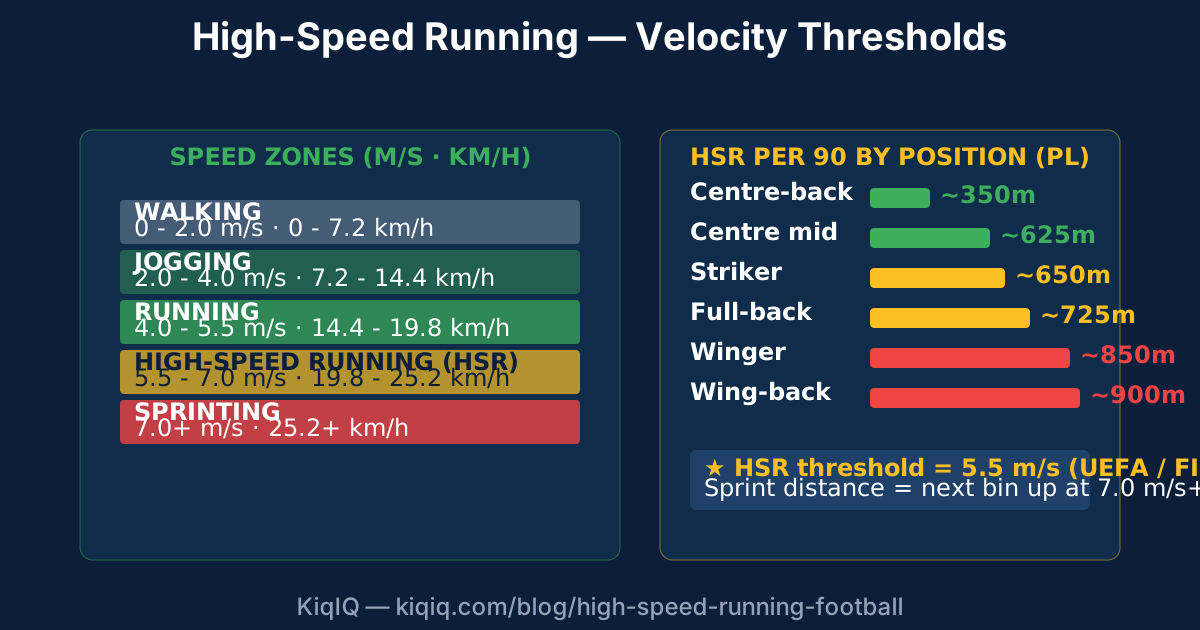
High-Speed Running (HSR) is the distance a player covers above a velocity threshold — typically 5.5 m/s (~19.8 km/h) in elite football. HSR is one of the most important external-load metrics because it captures intensity that total distance misses: the same 11 km covered casually vs at high speed produces very different physiological strain. Sprint distance is the next bin up — typically distance above 7.0 m/s (~25.2 km/h).
Standard velocity thresholds in football
Most modern GPS providers use these velocity bins:
- Walking. 0 - 2.0 m/s (0 - 7.2 km/h).
- Jogging. 2.0 - 4.0 m/s (7.2 - 14.4 km/h).
- Running. 4.0 - 5.5 m/s (14.4 - 19.8 km/h).
- High-speed running. 5.5 - 7.0 m/s (19.8 - 25.2 km/h).
- Sprinting. 7.0+ m/s (25.2+ km/h).
- Position-specific norms exist. Some clubs use individualised thresholds based on each player's peak speed.
Different leagues / providers use slightly different thresholds. UEFA / FIFA research uses 5.5 m/s as the HSR threshold; Premier League providers sometimes use 5.8 m/s. Always cross-check the threshold before comparing across data sources.
Match HSR demands by position (Premier League)
Position-specific HSR distance per 90-minute match in elite football:
- Centre-back (CB). ~250-450m HSR per match. Lowest of any outfield position.
- Full-back (FB). ~600-850m HSR per match. Among the highest due to overlapping runs.
- Centre midfielder (CM). ~500-750m HSR per match. Box-to-box variant on the higher end.
- Wide midfielder / winger. ~700-1,000m HSR per match. Highest of the outfield positions.
- Centre-forward (CF). ~500-800m HSR per match. Varies enormously by tactical role (target-man vs runner).
- Wing-back (WB). ~750-1,050m HSR per match. Hybrid full-back / winger workload.
Why HSR matters more than total distance
Total distance is a weaker performance indicator than HSR. Three reasons:
- Total distance is loosely correlated with match outcome. A team that walks for 90 minutes can still cover 10 km. Distance alone doesn't reflect intensity.
- HSR correlates with attacking output. Match-level HSR per player correlates with chance creation, pressing intensity, and counter-attack speed.
- HSR is a fitness benchmark. Match HSR per 90 is one of the most-used fitness assessment numbers. A pre-season target might be "match HSR ≥ 700m for wingers" before the player is cleared for first-team selection.
- Injury risk peaks at HSR spikes. Sudden jumps in HSR (e.g., a winger covering 1,200m in a match vs his 700m baseline) are a flagged injury-risk indicator.
HSR vs sprint distance
Two related but distinct metrics:
- HSR (5.5 m/s+). Captures all runs at high pace, including ~40m of running into space behind the defence.
- Sprint distance (7.0 m/s+). Captures only the highest-intensity efforts. A typical Premier League winger has 200-400m sprint distance per match — out of 700-1,000m total HSR.
- Why both matter. HSR tells you "how much fast running"; sprint distance tells you "how much maximal-intensity running". A player with high HSR but low sprint distance is a relentless runner; high sprint + low HSR is an explosive runner.
How HSR data is collected
Three main collection methods:
- GPS pods (Catapult, STATSports). A wearable pod between the shoulder blades captures velocity at 10 Hz. Standard in Premier League.
- Optical / camera tracking (TRACAB, Second Spectrum). In-stadium camera systems capture player positions at 25 Hz. Used for broadcast graphics and post-match analysis.
- LPS / RFID. Smaller-scale tracking with floor-mounted antennas; less common in football, more in indoor sports.
Practical HSR monitoring for clubs
Three recommendations:
- Track HSR per player per match as a baseline. Build position-specific norms over a full season.
- Combine HSR with player-load and session RPE for a complete external + internal load picture.
- Watch for HSR spikes. A player covering 50%+ above his baseline HSR in a single match warrants reduced training load the following week.
- Use HSR for return-to-play. Rehab progression should target 60% → 80% → 100% of pre-injury HSR baseline before clearing the player for full match minutes.
Frequently asked questions
- What is high-speed running in football?
- High-speed running (HSR) is the distance a player covers above a velocity threshold — typically 5.5 m/s (~19.8 km/h) in elite football. HSR is one of the most important external-load metrics because it captures intensity that total distance misses. Position-specific HSR per 90 ranges from ~250-450m for centre-backs to ~700-1,000m for wingers in elite leagues.
- What is the high-speed running threshold?
- Most GPS providers use **5.5 m/s (~19.8 km/h)** as the HSR threshold. UEFA / FIFA research uses this number as standard. Some Premier League providers use 5.8 m/s. Always cross-check the threshold when comparing data across sources. Sprint distance is the next bin up at 7.0 m/s+ (~25.2 km/h).
- Why does HSR matter more than total distance?
- Total distance is loosely correlated with match outcome — a team that walks for 90 minutes can still cover 10 km. HSR captures intensity that total distance misses. Match-level HSR per player correlates with chance creation, pressing intensity, and counter-attack speed. Sudden HSR spikes (50%+ above baseline) are also flagged injury-risk indicators.
- How much HSR does a Premier League player cover per match?
- Centre-backs cover the least — typically 250-450m HSR per 90 minutes. Wingers cover the most — typically 700-1,000m. Wide midfielders, full-backs, and wing-backs are also high-HSR positions. Position and tactical role both matter — a target-striker covers far less HSR than a counter-attacking forward in the same role.
References
- Sprint and HSR Research (PubMed) — PubMed
- High-Speed Running Training in Elite Soccer (ISSPF) — International Soccer Science & Performance Federation
- PlayerData — High Intensity Metrics — PlayerData
- Sprint and HSR Review (Sasa Semeredi) — Sasa Semeredi
Key terms in this article
Ask KiqIQ a follow-up
Get a live, data-driven answer powered by api-football + KiqIQ's Poisson model. Try one of these prompts or write your own.
Part of pillar
Performance Science
See every article in this knowledge pillar →
Related
Reviewed by a KiqIQ editor before publication. Spotted an error? Email editor@kiqiq.com — we follow our Corrections Policy.