
Internal vs External Load in Football: The Two-Layer Framework
Football load monitoring splits into two layers: external (movement — distance, HSR, Player Load) and internal (perceived / physiological — RPE, HR, HRV). We map both, why you need both, and how they combine.
 Tap to enlarge
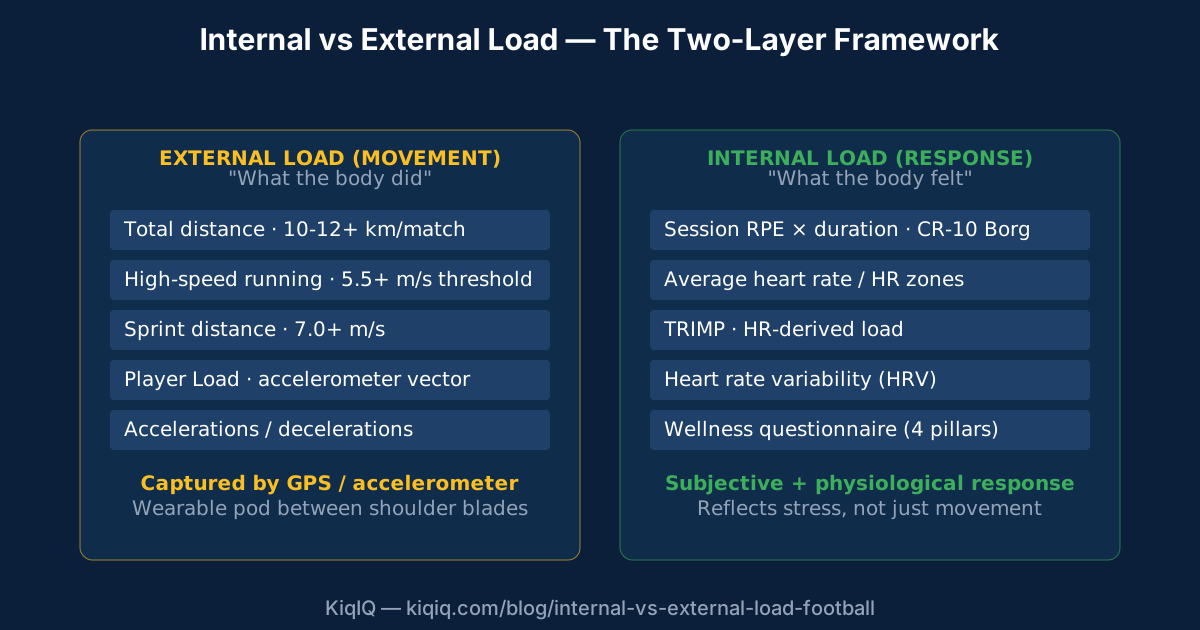
Football load monitoring splits into two layers: external load (movement — what the body did) and internal load (perceived / physiological response — what the body felt). External load is captured by GPS / accelerometer (distance, HSR, Player Load); internal load is captured by perceived effort (RPE), heart rate, and HRV. Both are needed: same external load can produce very different internal stress depending on player state, environment, and tactical context.
External load metrics
- Total distance. Cumulative distance covered across a session/match. Most basic.
- High-speed running (HSR). Distance above 5.5 m/s threshold. Captures intensity.
- Sprint distance. Distance above 7.0 m/s. Highest intensity bin.
- Player Load. Catapult's vector magnitude metric. Captures jumps + COD that distance misses.
- Accelerations / decelerations. Count of high-magnitude accel/decel events.
- All measured by GPS / accelerometer. Wearable pod between shoulder blades.
Internal load metrics
- Session RPE × duration. Subjective effort rating × minutes. Most-used internal metric.
- Average heart rate / HR zones. Time spent in 60-70%, 70-85%, 85%+ of max HR.
- TRIMP (Training Impulse). HR-derived cumulative load with weighting by intensity zone.
- Heart rate variability (HRV). Measured first thing in the morning; reflects autonomic recovery.
- Wellness questionnaire. Sleep, soreness, mood, stress (4-pillar standard).
A player can have low external load (sat in a defensive shape all match) but high internal load (high stress, lots of decisions, late winning goal). External-only monitoring misses this.
Why both layers are required
- External alone misses recovery state. A poorly-rested player's internal load for the same external work will be far higher.
- Internal alone misses what to train. RPE tells you the player worked hard; only external metrics tell you whether the work was running, pressing, sprinting, or aerial duels.
- Combined ratio. Internal-to-external load ratios (e.g. RPE / total distance) are used as efficiency markers.
- Game state context. A losing team often reports higher RPE for the same external work than a winning team — internal captures this; external doesn't.
How clubs combine internal + external in practice
- Daily monitoring dashboard. Player's external + internal scores side-by-side, vs 7-day and 28-day averages.
- Session planning. Coach plans external load target (Player Load + HSR); internal load is post-hoc validation.
- ACWR calculations. Some clubs run ACWR on internal load (RPE-derived) and external load (Player Load) in parallel.
- Selection reviews. A player with high internal load but low external load may need recovery; the inverse may indicate insufficient stimulus.
Common pitfalls
- Treating one as canonical. Some clubs over-rely on Player Load alone or RPE alone. Both layers are required.
- Vendor inconsistency. Catapult, STATSports, Polar — each has slightly different external metrics. Standardise per-club.
- RPE collected too early. Should be 30 minutes after session ends, not immediately after.
- Ignoring environment. Heat, altitude, travel all affect internal load disproportionately. Note them.
Frequently asked questions
- What is internal vs external load in football?
- External load is the movement work the body performed — distance, HSR, sprint distance, Player Load. Internal load is the body's response to that work — perceived exertion (RPE), heart rate, HRV. Both are required to fully understand training and match stress.
- Why do you need both internal and external load?
- Same external work can produce very different internal stress depending on player state, environment (heat, altitude), and tactical context. External alone misses recovery state. Internal alone misses what kind of work was done. Combined, they give a complete monitoring picture.
- What's the most-used internal load metric?
- Session RPE — perceived effort (CR-10 Borg scale, 0-10) multiplied by session duration in minutes. It's cheap, validated across 20+ years of football research, and captures subjective stress that GPS metrics miss.
- What's the most-used external load metric?
- It depends on vendor and use case. Total distance is the simplest; high-speed running (HSR) captures intensity; Player Load (Catapult) captures jumps and changes of direction. Most modern clubs use a combination of all three.
References
- Catapult — Internal vs External Load — Catapult / Firstbeat
- Frontiers in Sports — Internal-External Framework — Frontiers in Sports
- BJSM — Training Load Frameworks — British Journal of Sports Medicine
- Sportsmith — Load Monitoring Practical — Sportsmith
Key terms in this article
Ask KiqIQ a follow-up
Get a live, data-driven answer powered by api-football + KiqIQ's Poisson model. Try one of these prompts or write your own.
Part of pillar
Performance Science
See every article in this knowledge pillar →
Related
Reviewed by a KiqIQ editor before publication. Spotted an error? Email editor@kiqiq.com — we follow our Corrections Policy.