
Readiness Monitoring in Football: Daily Wellness + Objective Tests
Readiness monitoring combines subjective wellness scores (sleep, mood, soreness) with objective tests (CMJ, HRV) to assess whether a player is ready for high-load training. We cover the standard framework and limits.
 Tap to enlarge
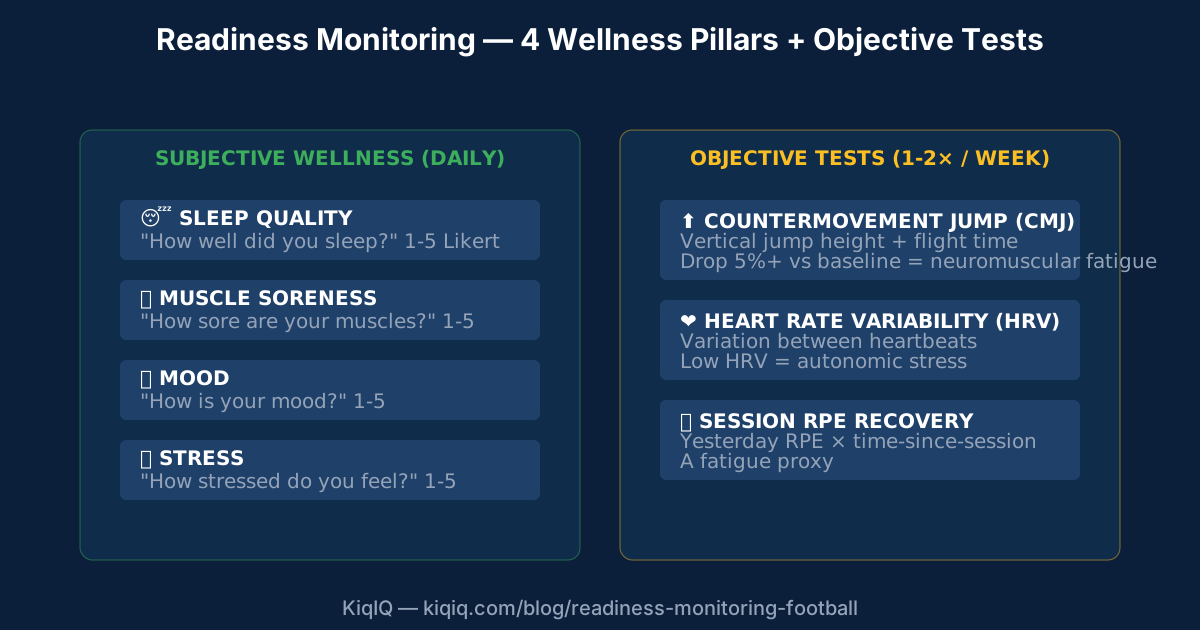
Readiness monitoring combines subjective wellness scores (sleep quality, soreness, mood, stress) with objective tests (countermovement jump, heart-rate variability, sometimes session-RPE recovery) to assess whether a player is prepared for high-intensity training. Used daily across professional football, it's decision-support rather than a standalone injury predictor. The Hooper-Mackinnon and Acute Recovery & Stress Scale frameworks are the most-cited.
The four wellness pillars
Most clubs track four subjective wellness scores daily, on a 5-point or 7-point Likert scale:
- Sleep quality. "How well did you sleep last night?" 1 = very poor, 5 = excellent.
- Soreness. "How sore are your muscles today?" 1 = no soreness, 5 = severe soreness.
- Mood. "How is your mood today?" 1 = very negative, 5 = very positive.
- Stress. "How stressed do you feel today?" 1 = no stress, 5 = severe stress.
- Aggregated readiness score. Sum of the four (or weighted) — typical "ready for high load" threshold is 16+ on a 4×5 scale.
Objective readiness tests
- Countermovement jump (CMJ). Vertical jump height + flight time. Drop of 5%+ vs baseline indicates neuromuscular fatigue.
- Heart-rate variability (HRV). Variation in time between heartbeats. Low HRV = autonomic stress; high HRV = parasympathetic recovery.
- Session-RPE recovery. Yesterday's session-RPE × time-since-last-session = a fatigue proxy.
- Optional: salivary cortisol. Used at elite level; sample collected first thing in the morning. Logistically heavy.
CMJ is the most-used objective marker because it's quick (20 seconds), cheap (no specialist equipment beyond a force plate or smartphone app), and validated across team sports.
How readiness data informs decisions
- High readiness → high training load. Player can be pushed in pressing drills, sprint volume, or match-intensity small-sided games.
- Low readiness → modified load. Reduce sprint volume, focus on technical / tactical work; sometimes pool / bike recovery instead.
- Sustained low readiness → individualised plan. 3-5 consecutive low-readiness days warrants medical review and load decrease.
- Pre-match readiness = team selection input. Players rotating into the matchday squad have their readiness reviewed in the 48 hours before kick-off.
Limitations to be aware of
- Subjective wellness is biased. Players who under-report (to seem tougher) or over-report (to manage workload negotiations) introduce noise.
- Single-day readiness has high variance. Trends over 7-14 days are more informative than any single day.
- Position-specific norms. A "low readiness" score for a CB may be acceptable for that load context; same score for a winger may signal real fatigue.
- Not a single-variable injury predictor. Combine with workload data (Player Load, ACWR), prior injury history, and age.
Implementing readiness monitoring
- Use a wellness app. Most clubs use Smartabase, Catapult Sport Performance, AMS, or simple internal forms.
- Collect the same questionnaire daily. Consistency is more important than complexity. 4 questions × daily = good baseline.
- Add CMJ 1-2x per week. Not daily — over-testing reduces compliance and adds noise.
- Set automated flags. When a player's readiness score drops 20%+ vs his 7-day rolling average, the staff is alerted.
- Combine with external load + ACWR. Readiness alone is one input; the full picture includes load context.
Frequently asked questions
- What is readiness monitoring in football?
- Readiness monitoring combines subjective wellness scores (sleep, soreness, mood, stress) with objective tests (countermovement jump, heart-rate variability) to assess whether a player is ready for high-intensity training. Used daily across professional football as decision-support for training load planning.
- What are the four wellness pillars?
- Sleep quality, soreness, mood, and stress — each rated daily on a 5- or 7-point Likert scale. Aggregated to a readiness score (typically 4-20 on a 4-pillar × 5-point scale). The Hooper-Mackinnon and Acute Recovery & Stress Scale frameworks are the most-cited.
- How is CMJ used in readiness monitoring?
- A countermovement jump test is performed 1-2x per week. A drop of 5%+ in jump height vs the player's 4-week rolling baseline indicates neuromuscular fatigue and triggers a load reduction. CMJ is the most-used objective readiness marker because it's fast, cheap, and validated.
- Is readiness monitoring a reliable injury predictor?
- On its own, no. Readiness monitoring is decision-support, not a standalone predictor. Combined with workload data (Player Load, ACWR), prior injury history, and position-specific norms, it informs training and selection decisions effectively. Single-day readiness has high variance; trends over 7-14 days are more informative.
References
- Readiness in Pro Football (Output Sports) — Output Sports
- Pre-Match Readiness Research (PubMed) — PubMed
- UKSCA — Readiness to Train — UKSCA
- James Malone — Readiness Testing — LinkedIn
Ask KiqIQ a follow-up
Get a live, data-driven answer powered by api-football + KiqIQ's Poisson model. Try one of these prompts or write your own.
Part of pillar
Performance Science
See every article in this knowledge pillar →
Related
Reviewed by a KiqIQ editor before publication. Spotted an error? Email editor@kiqiq.com — we follow our Corrections Policy.