
Acute-Chronic Workload Ratio in Football: ACWR Explained
The Acute-Chronic Workload Ratio (ACWR) compares a player's recent (7-day) load to their longer-term (28-day) load. The ratio's relationship to injury risk is contested — we cover the methodology, the research, and the limits.
 Tap to enlarge
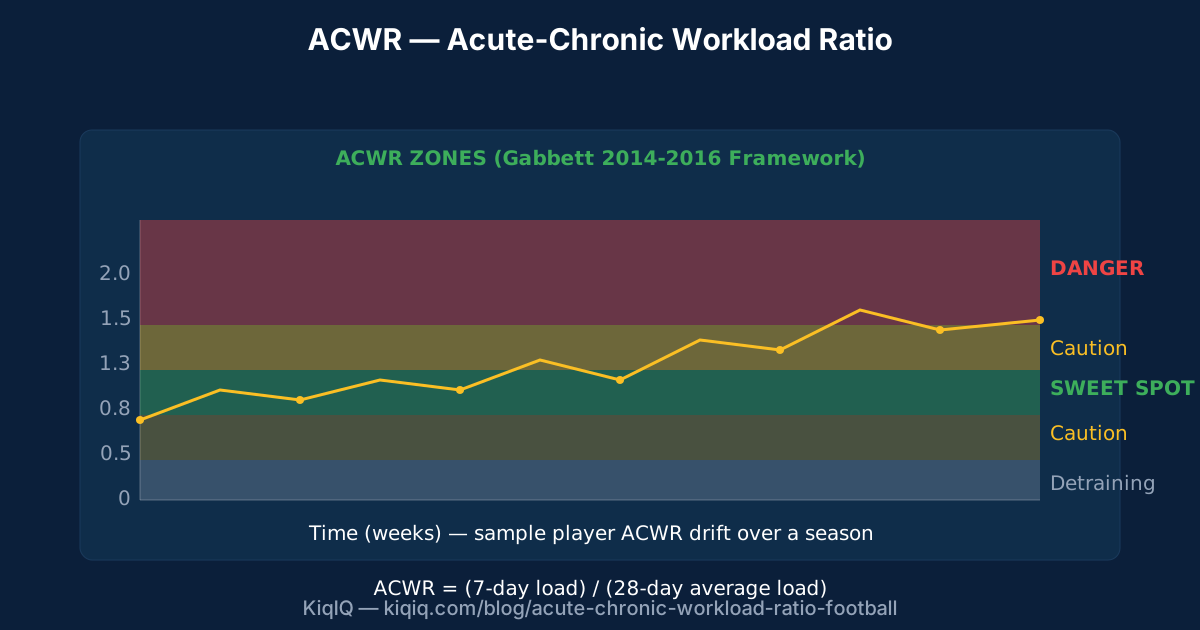
The Acute-Chronic Workload Ratio (ACWR) compares a player's recent (acute, typically 7-day) training load to their longer-term (chronic, typically 28-day) training load. The classic Tim Gabbett research framed an ACWR of 0.8 to 1.3 as a "sweet spot" with low injury risk, and ratios above 1.5 as a "danger zone." Modern research has challenged the framework — the relationship is more nuanced, but ACWR remains widely used as one input to injury-risk monitoring.
How ACWR is calculated
The standard calculation uses Player Load, distance, or RPE-derived load:
- Acute load. Sum of training load (Player Load, total distance, or session-RPE) across the past 7 days.
- Chronic load. Average of weekly training load across the past 28 days (4 weeks).
- ACWR. Acute / Chronic.
- Example. Acute = 4,000 AU. Chronic = 3,500 AU/week. ACWR = 4,000 / 3,500 = 1.14.
Two ACWR variants exist. Rolling-average ACWR uses a simple 28-day average for chronic load. Exponentially-weighted moving average (EWMA) ACWR weights recent days more heavily. EWMA is generally preferred in modern research.
The classic sweet-spot framework
Tim Gabbett's research (2014-2016) proposed three zones based on ACWR values:
- Sweet spot (0.8 - 1.3). Lowest injury risk; player is well-trained for current demand.
- Caution zone (0.5 - 0.8 or 1.3 - 1.5). Modest injury-risk elevation. Either undertraining or moderate spike.
- Danger zone (>1.5). Significantly elevated injury risk in the original Gabbett research. Suggests acute load is far above what the body has prepared for.
- Detraining zone (<0.5). Very low recent load relative to chronic baseline; readiness for return to high load may be reduced.
How ACWR is used in football
Three primary applications:
- Pre-match readiness. Coaches review ACWR for each player 24-48 hours before kick-off; players in the danger zone may be rotated.
- Return-to-play protocols. Post-injury, players must build chronic load gradually before being cleared — ensures ACWR stays in the sweet spot when returning.
- Periodisation planning. Pre-season and in-season micro-cycles are designed so the team's collective ACWR stays in the sweet spot.
- Squad-level monitoring. Heatmap views show all players' ACWR — the team analyst flags those drifting into caution / danger zones.
Modern research has challenged ACWR
The original ACWR framework has come under significant critique since 2019:
- Statistical critique. Some studies report that ACWR's correlation with injury is no stronger than acute or chronic load alone. The ratio adds little.
- Methodological issues. Calculation choice (rolling vs EWMA) materially changes the predicted risk; sensitivity to definition is high.
- Confounders. Other factors (sleep, nutrition, prior injury history, age, position) explain much of the variance attributed to ACWR.
- Replication concerns. Some original Gabbett findings have not been reliably replicated in independent samples.
- Current consensus. ACWR is one useful input but not a single-variable predictor; it should be paired with wellness data, prior injury history, and sleep monitoring.
When ACWR adds value
Three contexts where ACWR is most useful:
- Pre-season / post-injury return. When chronic load is being deliberately built up, ACWR catches premature spike attempts.
- Two-week tournament cycles. International tournaments and concentrated cup runs create rapid load accumulation that ACWR flags.
- Squad-rotation decisions. Comparing ACWR across the squad informs who needs rest and who is well-prepared.
How to implement ACWR in your club
Five practical steps:
- Pick your load metric. Most clubs use Player Load (Catapult), total distance, or session-RPE-derived load. Whichever you choose, stick with it consistently.
- Use EWMA, not rolling average. EWMA weights recent days more heavily and is more responsive to short-term changes.
- Track per player + squad average. Individual ACWR matters most; squad average tracks team-level overload risk.
- Combine with wellness data. Sleep, soreness, mood, and stress questionnaires.
- Don't treat ACWR as a single predictor. Use it alongside RPE, prior injury, age, and position-specific norms.
Frequently asked questions
- What is ACWR in football?
- Acute-Chronic Workload Ratio (ACWR) is a load-monitoring metric comparing a player's recent (7-day) training load to their longer-term (28-day) training load. The classic Tim Gabbett research proposed a "sweet spot" of 0.8-1.3 ACWR for low injury risk, with ratios above 1.5 considered a "danger zone." Modern research has challenged this framework but ACWR remains widely used.
- How is ACWR calculated?
- Acute load = sum of training load (Player Load, total distance, or session-RPE) across the past 7 days. Chronic load = average weekly training load across the past 28 days. ACWR = Acute / Chronic. Example: 4,000 AU acute / 3,500 AU/week chronic = 1.14. Most modern implementations use exponentially-weighted moving averages (EWMA) rather than simple rolling averages.
- Is ACWR reliable for predicting injury?
- Modern research has challenged the original Gabbett framework. ACWR is one useful input to injury-risk monitoring but is not a single-variable predictor. Some studies report that ACWR's correlation with injury is no stronger than acute or chronic load alone. Combine ACWR with wellness data (sleep, soreness, mood), prior injury history, age, and position-specific norms for the most reliable injury-risk picture.
- What is a safe ACWR range in football?
- The classic Gabbett research framed 0.8-1.3 as the "sweet spot" and >1.5 as the "danger zone." However, these thresholds are now contested. The safer practice is to track ACWR within the player's individual baseline — what's normal for one player may be a spike for another. Sustained ACWR above 1.5, combined with high RPE / poor wellness scores, is a clearer warning sign than ACWR alone.
References
- Tim Gabbett — Training Load Research (BJSM) — British Journal of Sports Medicine
- Implementing Training Load Monitoring (PMC) — PubMed Central
- ACWR Critical Review (2021) — Journal of Sports Sciences
- PMC — ACWR Methodology Concerns — PubMed Central
Ask KiqIQ a follow-up
Get a live, data-driven answer powered by api-football + KiqIQ's Poisson model. Try one of these prompts or write your own.
Part of pillar
Performance Science
See every article in this knowledge pillar →
Related
Reviewed by a KiqIQ editor before publication. Spotted an error? Email editor@kiqiq.com — we follow our Corrections Policy.