
Player Load in Football: How the Catapult Metric Works
Player Load is Catapult's proprietary external-load metric — a vector magnitude derived from accelerometer data summing tri-axial accelerations. We explain how it's calculated, what it captures, and its limitations.
 Tap to enlarge
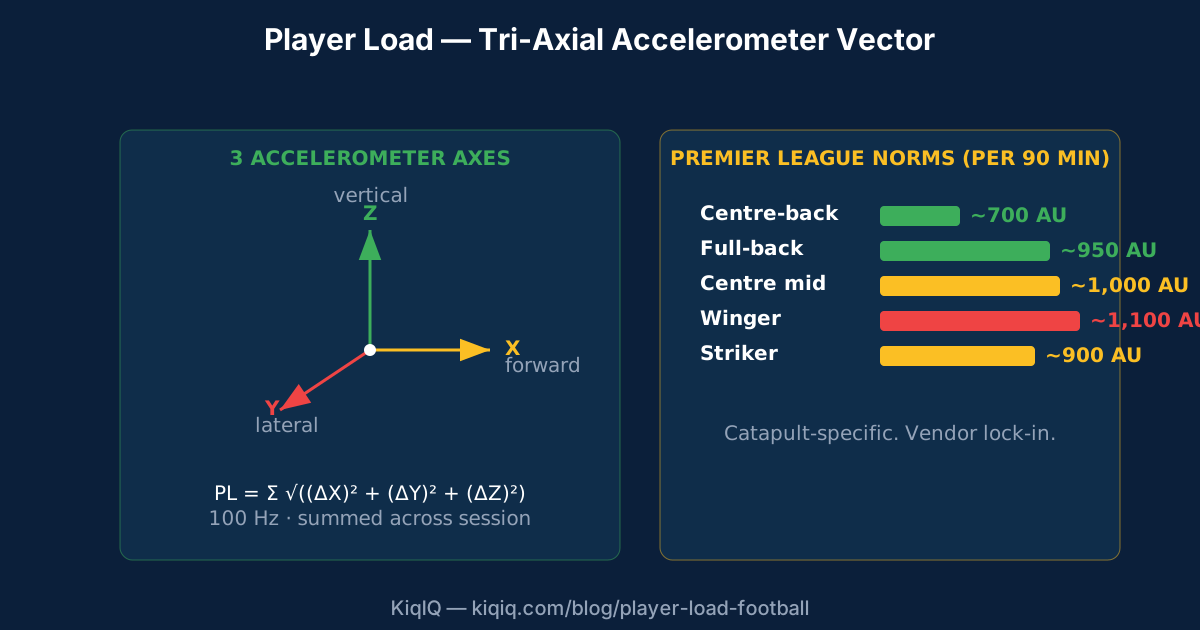
Player Load is Catapult's proprietary external-load metric, derived from a wearable's tri-axial accelerometer. It calculates the vector magnitude of accelerations across three axes (anterior-posterior, medio-lateral, vertical) at 100 Hz and sums them across a session. Player Load captures intensity that distance-only metrics miss — jumps, changes of direction, decelerations, and contact events. It's the dominant external-load metric in elite football across Europe and North America.
How Player Load is calculated
Player Load is a sum of accelerometer-derived vector magnitudes:
- Tri-axial accelerometer. The wearable (a small pod between the shoulder blades) measures acceleration on three axes: forward-backward (X), side-to-side (Y), and up-down (Z).
- Vector magnitude calculation. Each frame (100 Hz typical), Catapult computes √((X_now − X_prev)² + (Y_now − Y_prev)² + (Z_now − Z_prev)²) — the change-in-acceleration vector.
- Summed across the session. All vector magnitudes are summed across the training session or match. The total is reported in arbitrary units (AU).
- Typical match Player Load values. ~700-1,100 AU for a Premier League midfielder over 90 minutes.
- Position-specific norms. CBs ~600-850 AU; CMs ~800-1,100 AU; wingers ~900-1,100 AU; FBs ~850-1,050 AU.
Player Load is NOT calorie expenditure or distance — it is a relative load metric specific to the Catapult ecosystem. Compare values within a player over time, not between vendors.
What Player Load captures that distance misses
Distance-only GPS metrics underestimate intensity in three scenarios where Player Load excels:
- High-intensity short bouts. A 5-meter sprint with deceleration generates more accelerometer load than walking 50m. Distance treats them similarly; Player Load doesn't.
- Changes of direction. A 180° turn generates lateral acceleration with no distance gained — invisible to GPS, but high cost on the body.
- Jumps and aerial duels. Vertical accelerations during jumping for headers; contributes to load but produces zero horizontal distance.
- Tackles and contact events. Impact-driven accelerations that fall outside any speed-based metric.
How clubs use Player Load in practice
Three primary applications:
- Daily load monitoring. Coaches plan training intensity using Player Load targets — e.g., 70% of match load on a moderate day, 100% on a high day.
- Acute-chronic workload ratio (ACWR). Player Load is one of the most-used inputs to ACWR calculations (acute = 7-day rolling Player Load, chronic = 28-day average).
- Return-to-play protocols. Post-injury, players progress through graded Player Load targets (50%, 70%, 90%, 100% of pre-injury baseline) before being cleared.
- Position-specific benchmarks. Each player has individual baseline Player Load by training-day type and match-day type — anomalies trigger review.
Limitations of Player Load
Four honest constraints:
- Vendor lock-in. Player Load is Catapult-specific. STATSports has a similar but not identical metric (Dynamic Stress Load); GPSports has its own. Inter-vendor comparison is unreliable.
- Doesn't directly predict injury. Despite ACWR research, Player Load alone is a weak injury-risk predictor. Combined with sleep, RPE, and prior injury history, it's informative — alone, it's not.
- Position-context dependent. A high Player Load reading is normal for a winger but anomalous for a CB. Coaches must interpret per position.
- Internal load missing. Player Load is purely external (movement). It doesn't capture internal load (cardiovascular, perceived effort) — must be paired with HR data and session RPE for the full picture.
Player Load vs related metrics
Where Player Load fits in the load-monitoring stack:
- Total Distance (TD). Simple but undercounts intensity. Use alongside Player Load for full picture.
- High-Speed Running (HSR). Distance covered above a threshold (typically 5.5 m/s or 19.8 km/h). Captures a specific intensity bin.
- Sprint distance. Distance above 7.0 m/s (25.2 km/h). Highest-intensity bin.
- Player Load. Captures full-body movement load — including elements (jumps, COD, decelerations) that HSR and sprint distance miss.
- Session RPE. Subjective perceived effort × duration. Internal-load proxy. Combine with Player Load for internal + external view.
- Heart rate / TRIMP. Direct internal-load measure. Pair with Player Load.
Implementing Player Load monitoring
Three recommendations for clubs:
- Standardise on one vendor. Catapult, STATSports, or other — pick one. Cross-vendor comparisons are unreliable.
- Build position-specific baselines. Track Player Load per position over a full season; build the team's individual norms before benchmarking.
- Combine with internal load. Pair Player Load with session RPE and (where available) HR data. External-only is half the picture.
Frequently asked questions
- What is Player Load in football?
- Player Load is Catapult's proprietary external-load metric. It's a vector magnitude calculated from accelerometer data across three axes (forward-back, side-side, up-down) at 100 Hz, summed across a session and reported in arbitrary units (AU). Typical Premier League midfielder match Player Load is ~700-1,100 AU.
- How is Player Load calculated?
- For each accelerometer sample (100 Hz typical), Catapult computes the vector magnitude: √((ΔX)² + (ΔY)² + (ΔZ)²) — the change in acceleration on each of three axes. These per-frame vector magnitudes are summed across the entire training session or match. The total is reported in arbitrary units. Position-specific norms range from ~600 AU (CB) to ~1,100 AU (winger).
- What does Player Load capture that GPS distance misses?
- Four things: (1) high-intensity short bouts where distance is small but acceleration is high; (2) changes of direction (lateral acceleration with zero distance gain); (3) jumps and aerial duels (vertical acceleration with zero horizontal distance); (4) tackles and contact events.
- Is Player Load useful for predicting injury?
- Player Load alone is a weak injury-risk predictor. Combined with sleep, RPE, prior injury history, and acute-chronic workload ratio analysis, it becomes more informative. Most clubs use Player Load as one input to a broader monitoring framework — not a single-variable predictor.
References
- Catapult — What is Player Load — Catapult Sports
- Player Load Fundamentals (Catapult Blog) — Catapult Sports
- GPS Player Load Monitoring Protocol — SimpliFaster
- Understanding Player Load: Meanings and Limitations — ResearchGate
Key terms in this article
Ask KiqIQ a follow-up
Get a live, data-driven answer powered by api-football + KiqIQ's Poisson model. Try one of these prompts or write your own.
Part of pillar
Performance Science
See every article in this knowledge pillar →
Related
Reviewed by a KiqIQ editor before publication. Spotted an error? Email editor@kiqiq.com — we follow our Corrections Policy.