
IMU vs GPS in Football: How Each Tracking System Works
GPS measures position via satellites; IMUs (inertial measurement units) measure acceleration / orientation via on-body sensors. Most modern football pods combine both. We explain.
 Tap to enlarge
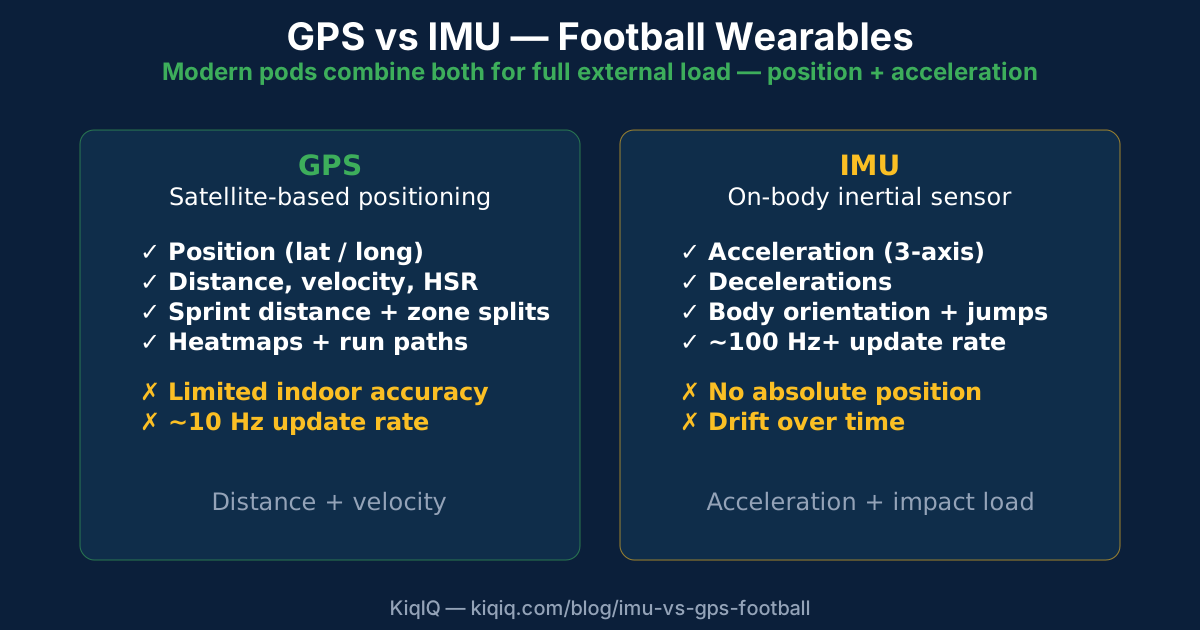
GPS (Global Positioning System) measures a player's position on the pitch via satellite triangulation — typically at 10 Hz. IMU (Inertial Measurement Unit) measures acceleration, orientation, and rotation via on-body sensors (accelerometer + gyroscope + magnetometer) — typically at 100-400 Hz. Modern football pods combine both: GPS for distance and velocity, IMU for jumps, COD, accelerations, and Player Load.
GPS — what it measures well
- Distance covered. Total distance, HSR distance, sprint distance.
- Velocity. Maximum speed, time spent in velocity zones.
- Position on pitch. Heatmaps, average positions.
- Sample rate. 10 Hz typical (10 readings per second).
- Limitations. Indoor venues block GPS; small movements (jumps, COD) under-counted.
IMU — what it measures well
- Accelerations / decelerations. Captures non-linear movement IMU misses.
- Jumps + landings. Vertical accelerations.
- Changes of direction. Lateral accelerations during turns.
- Player Load. Vector magnitude derived from tri-axial accelerometer.
- Sample rate. 100-400 Hz (much higher than GPS).
- Limitations. No position info — can't produce a heatmap or distance metric independently.
Modern combined pods
- Catapult, STATSports, GPSports, PlayerData. All major football wearable vendors combine GPS + IMU.
- GPS provides distance / position. IMU provides intensity / movement-quality detail.
- Single pod, two data streams. Output combined into one dashboard.
- Indoor / futsal use. IMU works without GPS; useful when GPS signal is unavailable.
Frequently asked questions
- What is the difference between IMU and GPS in football?
- GPS measures a player's position on the pitch via satellite triangulation, capturing distance, velocity, and heatmaps. IMU measures acceleration, orientation, and rotation via on-body sensors, capturing jumps, COD, accelerations, and Player Load. Modern football pods combine both for full external-load monitoring.
- What does an IMU measure that GPS cannot?
- Jumps, changes of direction (lateral acceleration with no horizontal distance), accelerations / decelerations, and Player Load (vector magnitude). GPS captures movement across the pitch but undercounts intensity when movement is non-linear or vertical. IMU operates at 100-400 Hz vs GPS at 10 Hz, capturing finer movement detail.
- Do football pods use GPS or IMU?
- Both. Catapult, STATSports, GPSports, PlayerData, and other major football wearable vendors combine GPS and IMU sensors in a single pod. GPS provides distance / position; IMU provides intensity / movement-quality detail. Combined data feeds into one dashboard for full external-load monitoring.
References
- Catapult — IMU vs GPS — Catapult / IMeasureU
- Kinexon — Tracking Systems — Kinexon
- Tandfonline — IMU Comparison — Tandfonline
Ask KiqIQ a follow-up
Get a live, data-driven answer powered by api-football + KiqIQ's Poisson model. Try one of these prompts or write your own.
Part of pillar
Performance Science
See every article in this knowledge pillar →
Related
Reviewed by a KiqIQ editor before publication. Spotted an error? Email editor@kiqiq.com — we follow our Corrections Policy.