
Session RPE in Football: The Internal-Load Workhorse
Session RPE (Rating of Perceived Exertion) multiplied by session duration is the most-used internal-load metric in football. We cover the methodology, the CR-10 scale, validation, and practical implementation.
 Tap to enlarge
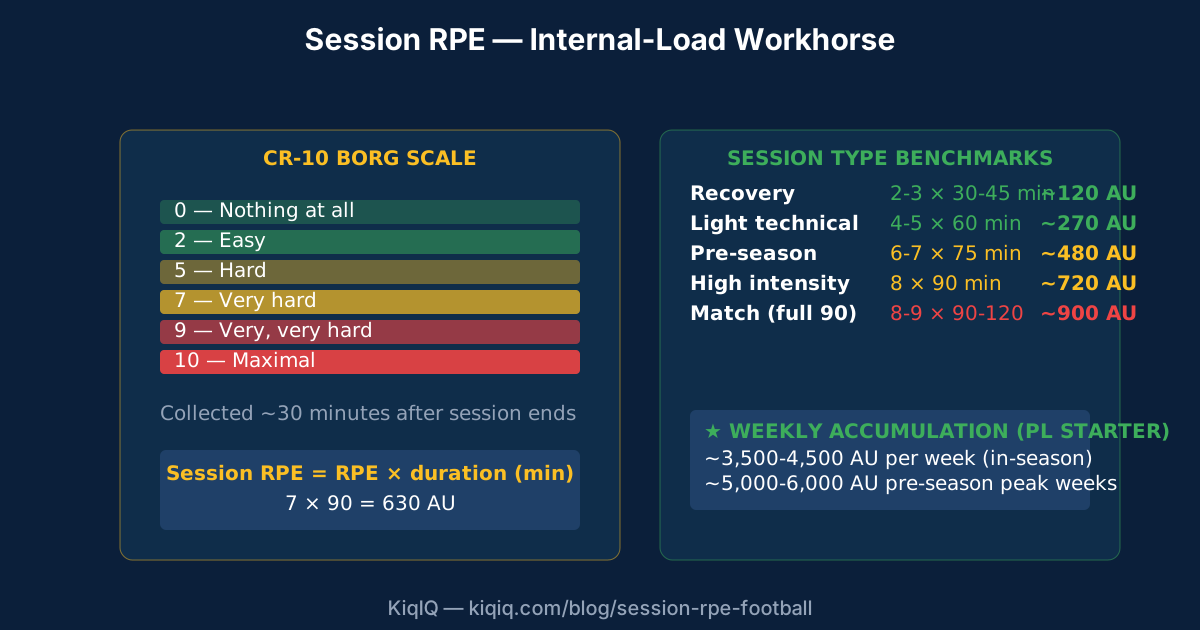
Session RPE is the most-used internal-load metric in football. It multiplies a player's Rating of Perceived Exertion (RPE, on the CR-10 Borg scale, 0-10) by the duration of the session in minutes. The result is reported in arbitrary units (AU) and represents subjective internal load. It's been validated in football repeatedly since the early 2000s and is now standard practice across professional and semi-professional clubs because it's cheap, fast, and meaningfully predictive of fatigue.
How Session RPE works
The methodology is simple by design — that's its strength.
- Step 1. ~30 minutes after the session ends, the player rates their perceived effort on the CR-10 Borg scale (0 = nothing, 5 = hard, 10 = maximal exertion).
- Step 2. Multiply the RPE rating by session duration in minutes. E.g. RPE 7 × 90 minutes = 630 AU.
- Step 3. Log the value against the player and date. Track it over time.
- Why 30 minutes after? Anchored to research showing that ratings collected too soon are biased by the most-recent intense action; later ratings reflect the whole session.
The 0-10 CR-10 Borg scale is critical. The 6-20 RPE scale (also Borg) is for cardiovascular work; CR-10 is for resistance / mixed training and is the version used in football session RPE.
Why Session RPE works in football
Five reasons it has become the default:
- Cheap. Costs nothing — no wearables, no sensors, just a survey form.
- Validated. ~20 years of football-specific research showing strong correlation with TRIMP (heart-rate-derived training impulse) and other internal-load measures.
- Captures internal load. Player Load (external) measures movement; Session RPE measures perceived stress. Both together = full picture.
- Sensitive to context. A high-intensity 60-minute SSG and a low-intensity 90-minute match can have similar Session RPE — accurately reflecting subjective stress.
- Athlete-specific. Two players can do the same training but rate effort differently — Session RPE captures individual differences.
Where Session RPE fits in the load-monitoring stack
Session RPE pairs with external-load metrics for a complete picture:
- External load (movement). Player Load (Catapult), total distance, high-speed running, sprint distance.
- Internal load (perceived / physiological). Session RPE, heart rate (TRIMP), wellness questionnaire (sleep, soreness, mood, stress).
- Combined ACWR. Both internal and external load can feed into Acute-Chronic Workload Ratio (ACWR) calculations for injury-risk monitoring.
Common Session RPE benchmarks
Typical values in elite football:
- Recovery / pool session: RPE 2-3 × 30-45 min = 60-135 AU.
- Light technical session: RPE 4-5 × 60 min = 240-300 AU.
- Standard pre-season training: RPE 6-7 × 75 min = 450-525 AU.
- High-intensity training day: RPE 8 × 90 min = 720 AU.
- Match (intense, full 90): RPE 8-9 × 90-120 min (with stoppage) = 720-1,080 AU.
- Weekly accumulation (in-season). ~3,500-4,500 AU for a Premier League starter.
Practical implementation
Five steps to deploy Session RPE in your club:
- Educate players on the CR-10 scale. Spend 5 minutes explaining what each rating means. "Hard" (7) and "very hard" (8) need consistent definitions.
- Use a wellness app. Most clubs use a wellness app (Smartabase, AMS, Catapult Sport Performance, or Slack-style internal forms) — players rate after each session.
- Collect after a 30-minute window. Set the survey to lock-in 30 minutes after session end.
- Track 7-day rolling sum and 28-day average. These are the inputs to ACWR.
- Combine with external load. Pair every Session RPE rating with Player Load + HSR for the day.
Limitations to be aware of
Three honest constraints:
- Subjective by definition. Players who under-report effort (to seem tougher) or over-report (to manage workload negotiations) introduce bias.
- Game-state effects. A losing team often reports higher RPE than a winning team for the same physical work — the subjective layer captures emotional load too, which is not always desired.
- Recall bias. Earlier-than-30-minute ratings overweight the most-recent intense action; later ratings drift toward a "typical" effort response.
Frequently asked questions
- What is Session RPE in football?
- Session RPE (Rating of Perceived Exertion) is an internal-load metric calculated as the player's effort rating (on the CR-10 Borg scale, 0-10) multiplied by session duration in minutes. The result is reported in arbitrary units (AU). It's the most-used internal-load metric in football because it's cheap, validated, and meaningfully predictive of fatigue.
- How is Session RPE calculated?
- Multiply the player's perceived-effort rating (CR-10 Borg scale, 0-10) by the session duration in minutes. Example: RPE 7 (hard) × 90 minutes = 630 AU. Collect the rating ~30 minutes after the session ends to avoid recall bias toward the most-recent intense action.
- How is Session RPE different from Player Load?
- Session RPE measures **internal** load (perceived effort × duration). Player Load measures **external** load (movement-derived from accelerometer data). Both are valuable; together they give a complete view. Player Load reflects what the body did; Session RPE reflects what the body felt.
- Is Session RPE accurate?
- Yes — within its limits. ~20 years of football-specific research validates Session RPE's correlation with HR-derived training impulse and other internal-load measures. Limitations: subjective bias (under/over-reporting), game-state effects (losing teams often rate higher than winning teams for similar work), and recall bias (rate at 30 minutes post-session, not immediately).
References
- Quantifying Training Load (PubMed, 2023222076) — PubMed
- Monitoring RPE — Topsportslab — Topsportslab
- NSCA — Use of RPE in Team Sports — NSCA Journal of Strength and Conditioning Research
- SimpliFaster — RPE in Team Sports — SimpliFaster
Ask KiqIQ a follow-up
Get a live, data-driven answer powered by api-football + KiqIQ's Poisson model. Try one of these prompts or write your own.
Part of pillar
Performance Science
See every article in this knowledge pillar →
Related
Reviewed by a KiqIQ editor before publication. Spotted an error? Email editor@kiqiq.com — we follow our Corrections Policy.