
Acceleration and Deceleration Load in Football
Acceleration / deceleration counts are external-load metrics capturing high-intensity efforts that distance and HSR miss. We cover the thresholds and why decelerations are the under-trained side.
 Tap to enlarge
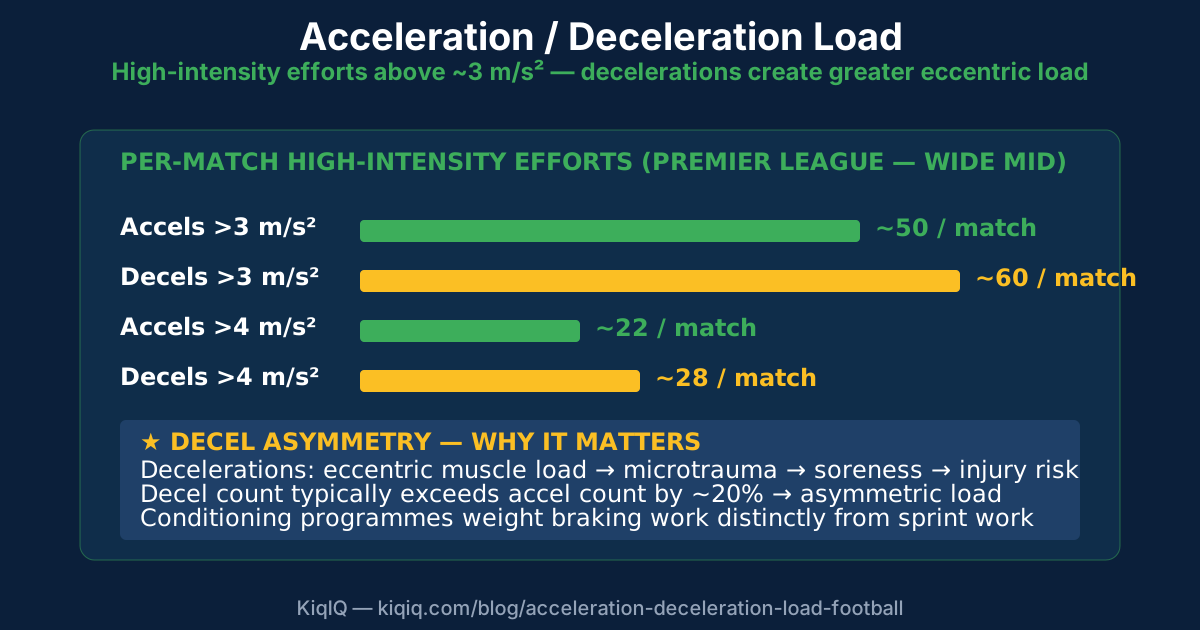
Acceleration and deceleration counts are external-load metrics capturing high-intensity efforts that distance and HSR miss. Standard threshold: any change in velocity ≥ ±3 m/s². Premier League midfielders typically perform 30-60 high-intensity accelerations + decelerations per match. Decelerations create greater eccentric load on the body than equivalent-magnitude accelerations and are the under-trained side of conditioning.
How accel/decel are measured
- GPS / IMU pods. Capture velocity changes at 10-100+ Hz.
- Threshold typical: ±3 m/s². Some providers use ±2 m/s² (lower threshold = more events counted).
- Counted per match. Number of events above threshold; can also report magnitude (e.g., total accel-load).
- Position-specific norms. CMs and FBs typically highest; CBs lowest.
Why decelerations matter more than accelerations
- Eccentric load. Decelerations require eccentric muscle action — the muscle lengthens under load.
- Higher injury risk. Eccentric / deceleration mechanics are linked to ACL, hamstring, and Achilles injuries.
- Under-trained. Most football conditioning focuses on acceleration / sprint training; deceleration capacity is often neglected.
- Programming. Eccentric strength work + drop-jumps + braking drills build deceleration capacity.
Practical use in monitoring
- Daily / match tracking. Combined with HSR and Player Load.
- Asymmetry monitoring. A player whose decel count rises but accel stays flat may be defending more (or attacking less) — context-dependent.
- RTP gating. Post-hamstring injury, accel/decel count must hit pre-injury baseline before RTP.
- Conditioning prescription. Pre-season programming uses accel/decel targets to ensure adequate deceleration capacity.
Frequently asked questions
- What is acceleration / deceleration load in football?
- External-load metrics that count high-intensity velocity changes ≥ ±3 m/s² during a match or training session. Captured by GPS / IMU pods. Premier League midfielders typically perform 30-60 high-intensity accel + decel events per match. Captures intensity that distance and HSR metrics miss.
- Why do decelerations matter more than accelerations?
- Decelerations require eccentric muscle action (muscle lengthens under load), which produces greater mechanical stress and is linked to ACL, hamstring, and Achilles injuries. Accelerations are concentric (muscle shortens). Most football conditioning under-trains deceleration capacity, contributing to non-contact injury risk.
- What is a typical deceleration threshold?
- ±3 m/s² is the standard threshold for "high-intensity" deceleration in elite football monitoring. Some providers use ±2 m/s² (catches more events). Higher-magnitude decelerations (≥5 m/s²) are typically rare but represent the highest-risk events for soft-tissue injury.
References
- PlayerData — Accel/Decel Metrics — PlayerData
- Sportsmith — Deceleration Guidelines — Sportsmith
- PubMed — Accel/Decel Research — PubMed
Ask KiqIQ a follow-up
Get a live, data-driven answer powered by api-football + KiqIQ's Poisson model. Try one of these prompts or write your own.
Part of pillar
Performance Science
See every article in this knowledge pillar →
Related
Reviewed by a KiqIQ editor before publication. Spotted an error? Email editor@kiqiq.com — we follow our Corrections Policy.