
ACWR and Endurance: What Predicts Non-Contact Injuries in Footballers
A 2024 Bundesliga study found the standardised ACWR isn't the strongest non-contact-injury predictor in football. The chronic-load component, calibrated to a player's individual lactate threshold, is.
 Tap to enlarge
The Acute:Chronic Workload Ratio (ACWR) became the default load-management metric in elite football over the last decade. The standard recipe — compare a player's last 7 days of running load to their last 28 days, watch for sudden spikes, modulate training accordingly — is now embedded in every Premier League and Bundesliga performance team's weekly review. A 2024 study on 23 Bundesliga players, published in *Applied Sciences*, sharpens the picture significantly: the ACWR itself isn't the strongest predictor of non-contact injuries. The chronic-workload component — particularly when it's standardised to a player's individual lactate-threshold running speed — does most of the predictive heavy lifting, especially in the last week before injury.
What ACWRHMLD actually is — the variables that drive it
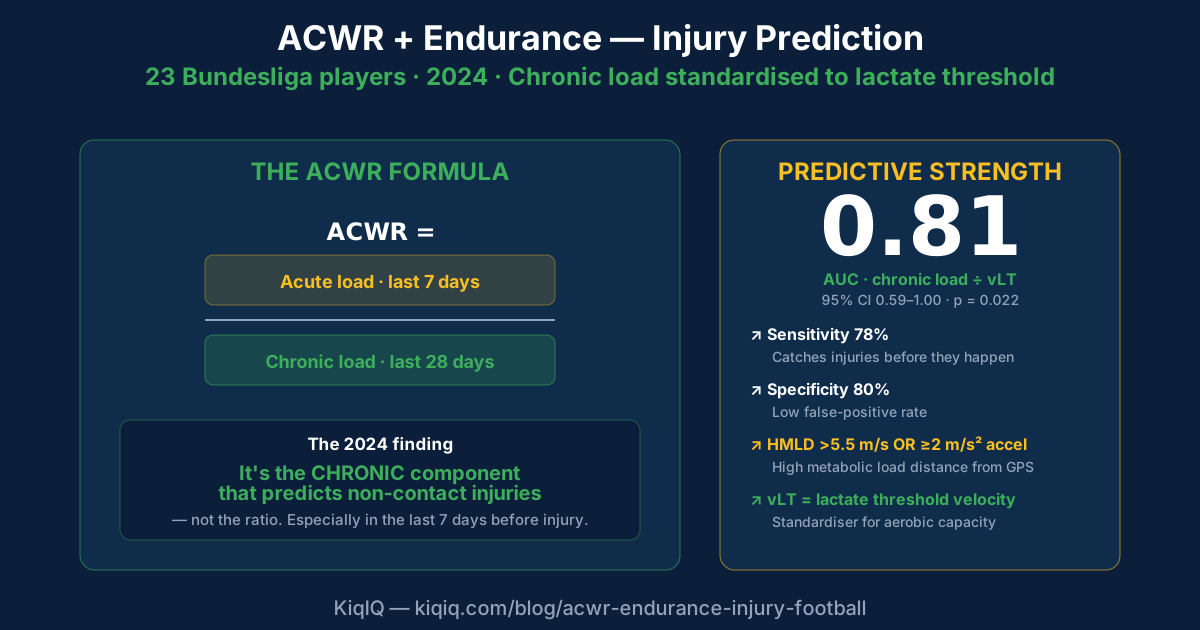
The full term ACWRHMLD describes a specific version of the ratio: acute-to-chronic workload, computed on High Metabolic Load Distance (HMLD). HMLD is the GPS-derived distance covered at a speed above 5.5 m/s OR with an acceleration of at least 2 m/s², which captures both high-speed running and the high-energy accelerations that don't show up in raw distance metrics. The "acute" period is the most recent 7 days; the "chronic" period is the most recent 28 days. Divide the 7-day mean by the 28-day mean and you have ACWRHMLD.
The intuition: if a player's recent week is heavy relative to their recent month, they're running hot — fatigued, undertrained for the spike, more vulnerable. If their recent week is light, they're undercooked relative to their conditioning baseline and may be detraining. Sweet-spot guidance has typically said 0.8-1.3, with spikes above 1.5 flagged as elevated injury risk. The 2024 paper tested that intuition against actual non-contact injury data and found the picture more nuanced.
HMLD covers distance run at >5.5 m/s OR with an acceleration ≥2 m/s². It captures the high-energy efforts plain "total distance" misses.
The headline finding: it's the chronic component, not the ratio
The study tracked 23 first-team Bundesliga players (mean age 24.5, VO2max 53.7 mL/min/kg) across a full competitive season. Eleven players sustained a non-contact injury serious enough to keep them out of team training for at least five days. Each was matched against an uninjured player of the same position; the four-week pre-injury window was compared between the two groups.
The standout result: the chronic workload (CW) — i.e. the 28-day running average — was the best non-contact injury predictor, with the last two weeks before injury carrying the most signal. The ratio itself, and the acute (7-day) component on its own, performed worse than CW. The paper is explicit: "Apparently, only the CW of the ACWR is related to the occurrence of non-contact injuries."
The single strongest predictive metric in the analysis was the chronic workload standardised to each player's individual lactate-threshold velocity (vLT). Standardised CW in the last week before injury produced an AUC of 0.81 (95% CI: 0.59-1.00, p=0.022), with a recommended cut-off of 0.04 km giving 78% sensitivity and 80% specificity. AUC of 0.81 is, in the language of sport-science predictive modelling, a strong signal — not deterministic, but well above the random-chance threshold of 0.5 and competitive with the best individualised load metrics published to date.
Why standardising to lactate threshold matters
Most ACWR work in football treats running load as raw distance — kilometres covered, sprints completed, accelerations registered. But a 7.5 km high-intensity day means something very different for a player whose lactate threshold sits at 16 km/h versus one whose vLT sits at 14 km/h. The first player is running comfortably within their aerobic ceiling; the second is closer to their limit, accumulating more physiological stress for the same external load.
The Marshall et al. study confirms this is more than theoretical. Injured players had a significantly lower VO2max than matched uninjured players (53.2 vs 56.3 mL/min/kg, effect size 0.6) — i.e. the cohort that broke down had less aerobic headroom going into the season. Once you standardise running load to each player's individual lactate-threshold velocity, the same external workload reveals very different internal stress between players. The paper's conclusion is direct: "It is extremely necessary to standardize the ACWR using the aerobic capacity. The isolated use of load parameters is insufficient."
Practical takeaways for coaching and S&C
For performance teams looking at how to apply this in-season, the paper points in five directions. None of them require new equipment — most clubs in Europe's top five leagues already have the GPS layer (STATSports, Catapult, Chiron Hego optical tracking) and the pre-season lactate diagnostics in place. The change is in interpretation.
- Run pre-season lactate diagnostics for every senior squad player. Establish individual vLT and VO2max — these are the standardising denominators for in-season load.
- Watch chronic load (28-day) more than the ratio. Sudden spikes in the ACWR ratio are still worth noting; persistent chronic load above a player's aerobic-capacity-adjusted threshold matters more.
- Pay special attention to the last week. The strongest predictive window in the data was the seven days immediately preceding injury — that's where weekly load management matters most.
- Standardise externally-measured load to internally-measured capacity. HMLD on its own is useful; HMLD divided by each player's vLT-anchored capacity is more useful.
- Don't rely on subjective effort (sRPE) for objective load tracking. The paper recommends GPS-derived HMLD over sRPE as the workload variable.
What the study doesn't answer
The findings come from a 23-player sample at one Bundesliga club over one season. That's typical for elite-football load-management studies — players don't come in batches of thousands — but it limits how confidently the cut-offs (0.04 km, 78%/80% sensitivity-specificity) generalise to other leagues, other player ages, or women's football. The paper is also explicitly about non-contact injuries; contact injuries (tackles, collisions) are a separate problem with different drivers.
The cohort exclusion of goalkeepers is also worth flagging. Goalkeeper running profiles look nothing like outfield profiles, so HMLD and lactate-threshold metrics need their own benchmark for the position before any ACWR cut-off is applied. KiqIQ's broader performance-science pillar covers the goalkeeper-specific physical profile elsewhere; treat this article as outfield-only.
Frequently asked questions
- What does ACWR stand for in football?
- ACWR is the Acute:Chronic Workload Ratio — the most recent 7-day average of a workload variable (e.g. high metabolic load distance) divided by the most recent 28-day average. It is the standard load-management metric used by elite football performance teams to monitor whether a player's recent training spike is meaningfully above their conditioning baseline.
- What is HMLD (high metabolic load distance)?
- HMLD is a GPS-derived running metric capturing distance covered at speeds above 5.5 m/s OR with accelerations of at least 2 m/s². It picks up both high-speed running and the high-energy short bursts that raw total distance misses, making it a better proxy for the metabolically expensive parts of a football match than distance alone.
- Does the ACWR actually predict injuries?
- The ratio itself is weaker than the underlying chronic-workload component. The 2024 Marshall et al. study of Bundesliga players found chronic workload (28-day average) — especially in the last week before injury, and especially when standardised to a player's individual lactate-threshold velocity — produced the strongest non-contact injury signal (AUC 0.81).
- Why should chronic workload be standardised to lactate threshold?
- Two players can run the same external distance with very different internal stress depending on their aerobic capacity. Standardising external running load to each player's individual lactate-threshold velocity converts the same kilometre into different physiological costs, which more accurately captures injury risk. Injured Bundesliga players in the study had significantly lower VO2max than uninjured matched controls.
- How does this apply to S&C practice?
- Run pre-season lactate diagnostics on every senior-squad player, watch chronic workload more than the ratio itself, focus on the seven days immediately before potential injury risk, standardise GPS-measured load to individual aerobic capacity, and prefer GPS-derived HMLD over subjective sRPE as the workload variable. Goalkeepers need separate benchmarks.
References
- Marshall et al. (2024) — Is the Endurance Standardized ACWRHMLD or the Underlying Acute and Chronic Components Related to Injuries? — Applied Sciences (MDPI) (Oct 2024)
Ask KiqIQ a follow-up
Get a live, data-driven answer powered by api-football + KiqIQ's Poisson model. Try one of these prompts or write your own.
Part of pillar
Performance Science
See every article in this knowledge pillar →
Related
Reviewed by a KiqIQ editor before publication. Spotted an error? Email editor@kiqiq.com — we follow our Corrections Policy.