
Jump Monitoring in Football: CMJ, RSI, and Neuromuscular Fatigue
Countermovement jump (CMJ) and reactive strength index (RSI) are the most-used jump tests in football monitoring. We explain the metrics and how clubs use them.
 Tap to enlarge
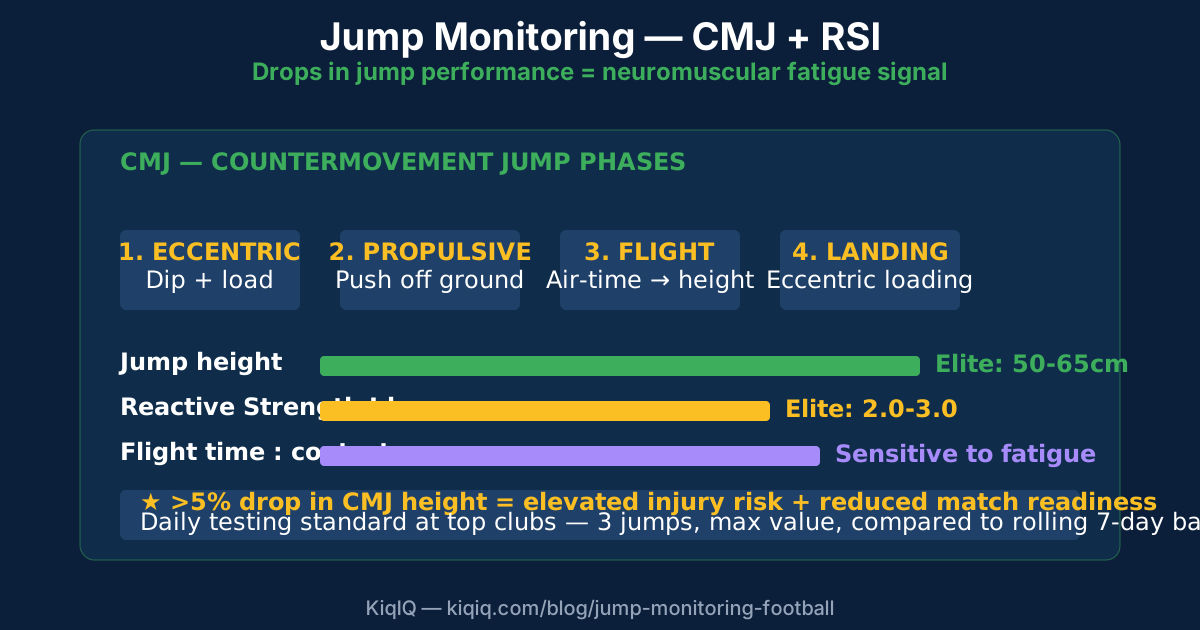
Countermovement jump (CMJ) and reactive strength index (RSI) are the most-used jump tests in football monitoring. CMJ measures vertical jump height + flight time; RSI measures the ratio of jump height to ground contact time. Both are sensitive to neuromuscular fatigue — a 5%+ drop vs baseline is a typical fatigue trigger for load reduction.
Countermovement jump (CMJ)
- Test protocol. Player stands, dips into a counter-movement, then jumps explosively.
- Key metrics. Jump height (cm), flight time (ms), peak power, contact time, eccentric depth.
- Equipment. Force plate (gold standard), contact mat, or smartphone app (Vert / My Jump 2).
- Norms. Premier League outfield averages 35-45cm; elite jumpers reach 55-60cm.
Reactive strength index (RSI)
- Calculation. Jump height ÷ ground contact time. Captures elastic / reactive ability.
- RSI from drop jump. Player drops from a box, lands, jumps as quickly + high as possible.
- Typical values. RSI > 2.0 = excellent; 1.5-2.0 = good; <1.5 = needs work.
- Sensitive to fatigue. RSI drops more than CMJ when fatigued.
Use in football monitoring
- 1-2× per week testing. Not daily — over-testing reduces compliance.
- 5% drop threshold. Players whose CMJ or RSI drops 5%+ vs 4-week rolling baseline are flagged.
- RTP gating. Post-injury return-to-play often requires CMJ within 5% of pre-injury baseline.
- Pre-match readiness. Some clubs use CMJ as a 24-48 hour pre-match readiness check.
Frequently asked questions
- What is jump monitoring in football?
- Jump monitoring uses countermovement jump (CMJ) and reactive strength index (RSI) tests to assess neuromuscular fatigue. A 5%+ drop in CMJ jump height or RSI vs the player's 4-week rolling baseline indicates fatigue and triggers load reduction. Used 1-2× per week in elite football.
- What is the difference between CMJ and RSI?
- CMJ measures vertical jump height + flight time from a static start. RSI is jump height ÷ ground contact time, typically measured from a drop jump (player drops from a box, lands, jumps explosively). RSI captures reactive / elastic ability; CMJ captures concentric power. RSI is more sensitive to fatigue.
- How often should football clubs test CMJ and RSI?
- 1-2× per week is standard. Daily testing reduces compliance and adds noise to the data. Most clubs schedule jump testing on MD-3 or MD-2 days as part of training-load monitoring.
References
- Science for Sport — CMJ — Science for Sport
- PubMed — CMJ Monitoring — PubMed
- Sportsmith — Jump Monitoring — Sportsmith
Ask KiqIQ a follow-up
Get a live, data-driven answer powered by api-football + KiqIQ's Poisson model. Try one of these prompts or write your own.
Part of pillar
Performance Science
See every article in this knowledge pillar →
Related
Reviewed by a KiqIQ editor before publication. Spotted an error? Email editor@kiqiq.com — we follow our Corrections Policy.