
The Quick Throw-In: How Top Teams Use Speed to Score
The quick throw-in is football's underrated transition weapon. We explain when to use it, the tactical principle, and the famous examples from Liverpool's Mané goal to Spurs' Heung-Min Son routine.
 Tap to enlarge
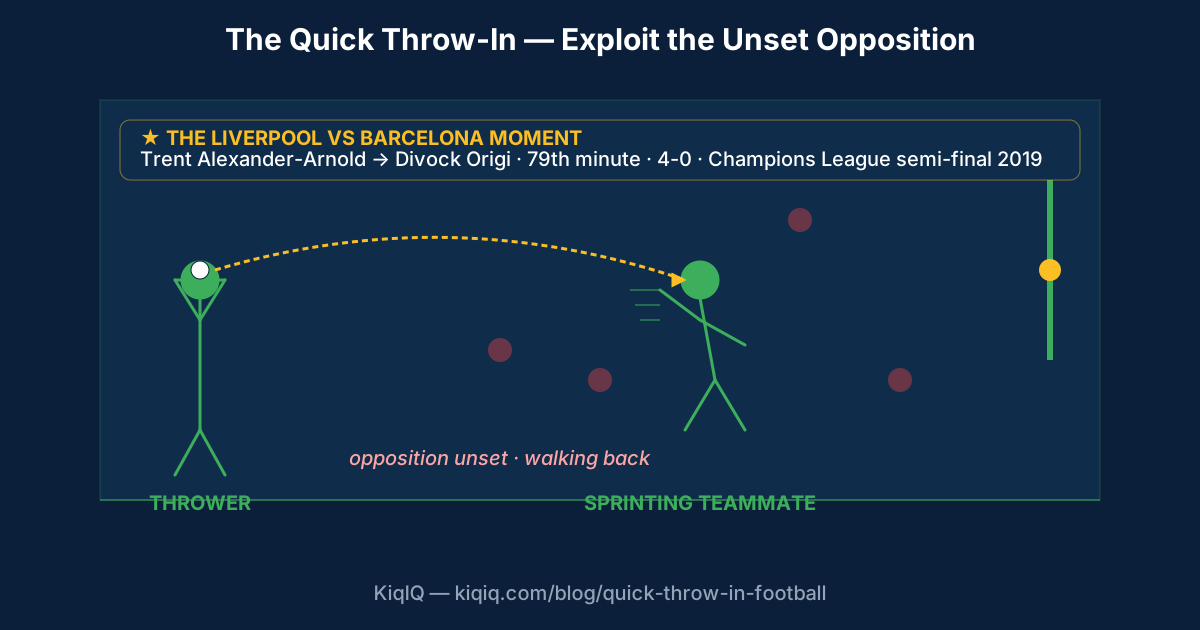
The quick throw-in is football's underrated transition weapon. While the opposition is unset — defenders walking back, midfielders not yet in shape, goalkeeper out of position — a fast throw-in to a sprinting teammate creates a high-quality chance. Liverpool's Trent Alexander-Arnold to Divock Origi vs Barcelona (2019 Champions League semi-final) is the canonical modern example. The key is recognising the moment.
When a quick throw-in is most dangerous
Three situations where the quick throw produces high-xG chances:
- Just after a defensive clearance. The clearing defender is out of position; their teammates are still resetting; the back-line is gappy. A quick throw to a striker behind the line creates a 1v1 with the goalkeeper.
- After a defender has gone to retrieve the ball. While one defender is fetching the ball off the pitch, the rest of the team relaxes. A quick throw to an unmarked midfielder breaks the moment of relaxation.
- Following a counter-attack that fizzled out at the touchline. Opposition midfielders are still drifting back from the failed attack; the quick throw catches them mid-recovery.
The quick throw exploits the few seconds when the opposition is mentally checking out. Reading that moment is the skill.
Liverpool vs Barcelona, 2019 — the canonical example
On 7 May 2019 in the Champions League semi-final second leg, Liverpool led 3-0 on the night, level on aggregate. In the 79th minute, Liverpool won a corner. As Trent Alexander-Arnold prepared to take it, he noticed Divock Origi unmarked at the near post. The Barcelona defenders had not yet set their corner-defending shape.
Alexander-Arnold played the corner short and quick — straight to Origi, who finished from 6 yards. 4-0 on the night. 4-3 on aggregate. Liverpool reached the Champions League final and went on to win it. The moment became one of the most iconic in modern football and the canonical reference for the quick attacking restart.
The principle generalises: any moment when the opposition is unset is a quick-restart opportunity, whether throw-in, corner, free kick, or goal-kick.
How teams coach the quick throw
Three coaching principles:
- The thrower scans before they pick the ball up. The decision is made before the ball is in their hands. Hesitation kills the quick throw.
- Designated quick-throw teammates. Specific players are coached to break for space at the moment a throw-in is awarded — typically a striker or wide forward.
- Communication signals. Teams use signals (a pre-defined hand gesture or call) to indicate "we're going quick" — letting teammates know to make the run.
When NOT to take a quick throw
Three scenarios where slowing down is correct:
- When leading late in the match. A quick throw can lose possession; a slow throw runs down the clock. Keep the ball.
- When the opposition is set. A quick throw against a settled defensive shape often gives the ball back immediately.
- When teammates are not ready. If the closest forward is busy looking at the bench, a quick throw will go to no one.
The throw-in itself
Even a quick throw-in must follow IFAB Law 15:
- Both feet on or behind the touchline at the moment of release.
- Both hands on the ball, ball delivered from behind and over the head.
- Ball must be thrown, not rolled.
- Thrown from the spot the ball crossed the touchline (or close — referees usually allow a 1-2m margin).
Other quick-restart situations
The same principle (exploit the unset opposition) applies elsewhere:
- Quick goal-kick. A goalkeeper who plays out fast catches midfielders unset. Manuel Neuer is the master.
- Quick free kick. A free kick taken before the opposition wall is in place creates 1-on-1 opportunities.
- Quick corner (the Origi goal). A corner taken before defenders have set their marks.
Frequently asked questions
- What is a quick throw-in in football?
- A quick throw-in is a throw-in taken before the opposition has reset their defensive shape. It exploits the few-second window when defenders are walking back, midfielders are not yet in position, and the goalkeeper is out of position. A fast throw to a sprinting teammate in space creates a high-quality counter-attacking chance. The skill is recognising the moment.
- Why is the Liverpool vs Barcelona corner famous?
- On 7 May 2019, Trent Alexander-Arnold took a corner kick quickly while Barcelona defenders were not yet set, finding Divock Origi unmarked at the near post for Liverpool's fourth goal. Liverpool won the second leg 4-0 to overturn a 3-0 first-leg deficit, advanced to the Champions League final, and won the trophy. The moment is the canonical reference for quick attacking restarts in modern football.
- How do teams coach quick throw-ins?
- Three principles: the thrower scans before picking the ball up (decision made before ball in hands); designated forwards are coached to break for space at every throw-in; pre-defined signals indicate when to go fast. Hesitation kills the quick throw — once the moment passes, the opposition resets.
- When should you NOT take a quick throw-in?
- When leading late in the match (slow throws run down the clock), when the opposition is already set (the speed advantage is gone), or when teammates are not ready (a quick throw to no one is a turnover). Quick throws are a transition weapon, not a default.
References
- IFAB Laws of the Game — Law 15: The Throw-In — IFAB
- Liverpool vs Barcelona 2019 — Tactical Retrospective — The Athletic
- Quick Restart Tactics — The Analyst — The Analyst
- Set-Piece Coaching at Brentford — StatsBomb
Key terms in this article
Ask KiqIQ a follow-up
Get a live, data-driven answer powered by api-football + KiqIQ's Poisson model. Try one of these prompts or write your own.
Part of pillar
Tactical Intelligence
See every article in this knowledge pillar →
Related
Reviewed by a KiqIQ editor before publication. Spotted an error? Email editor@kiqiq.com — we follow our Corrections Policy.